
President Donald Trump descends from several Celtic and Germanic tribes from Germany, Britain and Scandinavia. In this video I describe the sources of his ancestry; the Gaels, Vikings Suebi and other warrior peoples who made him a fighter.
Showing posts with label german. Show all posts
Showing posts with label german. Show all posts
Friday, 6 December 2024
Donald Trump's Celtic and Germanic Ancestry
President Donald Trump descends from several Celtic and Germanic tribes from Germany, Britain and Scandinavia. In this video I describe the sources of his ancestry; the Gaels, Vikings Suebi and other warrior peoples who made him a fighter.


Friday, 15 March 2024
The Origin of Palaeo-Germanic in Sweden? A new pre-print.
‘Steppe Ancestry in western Eurasia and the spread of the Germanic Languages’ by McColl et al 2024 uses a novel method looking at IBD sharing to identify a previously unknown sub-population within Scandinavia’s Corded Ware culture which it calls “East Scandinavian”.
This population is alleged to have formed around 2000 BC which is 800 years after Corded Ware folk first entered Scandinavia. It is distinct from earlier Corded Ware populations in the region, and contemporary Corded Ware people in Denmark and Norway, because instead of just WHG admixture it has additional EHG admixture from a source their model predicts to come from Latvia/Lithuania.
The authors suggest a possible migration across the Baltic sea to explain this East Scandi group despite there being no evidence for this in the archaeological record. They point out that the “timing coincides with the introduction of a new, Late Neolithic sheep breed to Scandinavia. It also coincides with the spread of a new burial rite of gallery graves in south Sweden, the Danish islands and Norway, a new house type, the first durative bronze networks, as well as with the end of an east-west divide in Scandinavia between 4050 and 3650 BP. (2050 BC- 1650 BC)” Yet none of these new arrivals they list necessarily came from across the Baltic sea.
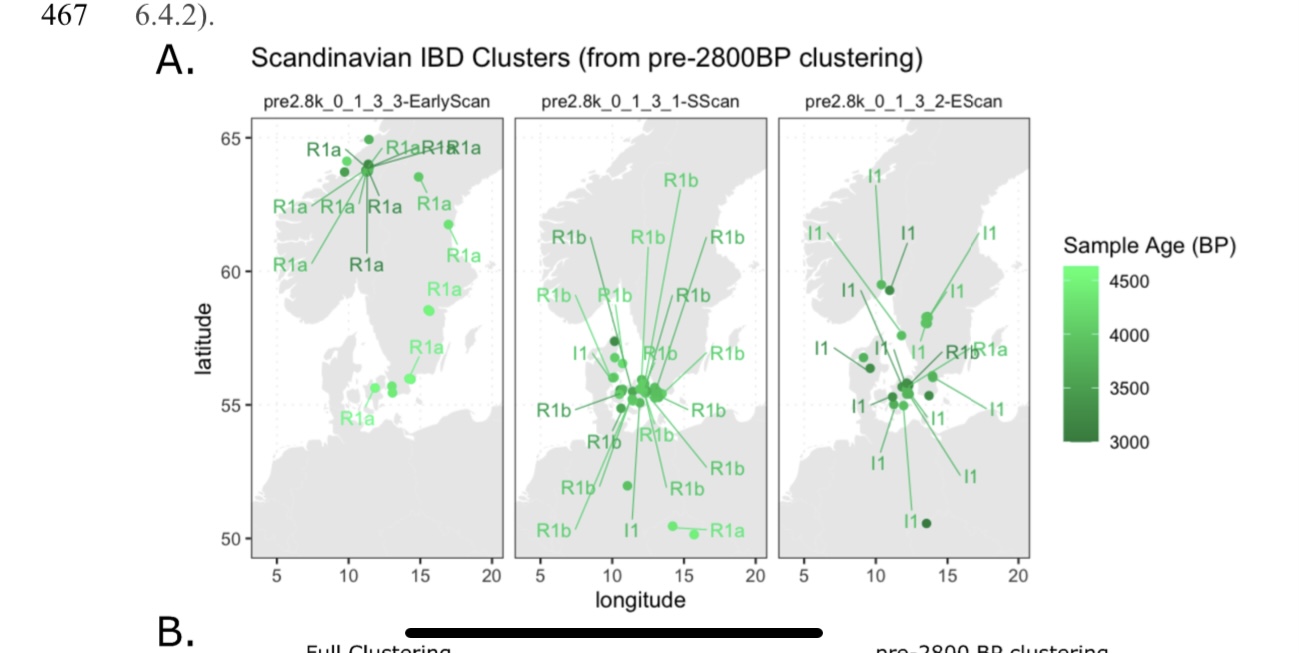
The feasibility of a mass migration of a people across the Baltic at this period in history is questionable. Sea crossings from the South are far more plausible or even land routes via the Arctic North. Figure 4.A shows the geographical distribution of individual samples belonging to the 3 Scandinavian Clusters they identified existing prior to 800 BC, after which they merged. They say there is a strong correspondence between the clusters and specific haplogroups as follows:
- Early Scandinavian including the oldest Swedish (Battle Axe Culture) and Danish samples and almost all Norwegians all have R1a.
- A later ‘Southern Scandinavian’ cluster restricted to Denmark and the southern tip of Sweden mostly with R1b but some I1.
- A second later ‘Eastern Scandinavian’ cluster, spread across Sweden and overlapping with that of the Southern Scandinavia cluster which is dominated by I1.
The third map of this so-called “Eastern Scandi” group shows mainly samples from the South though, and the I1 haplogroup distribution is not demonstrated to have come from the “East”, in fact it appears from this data to have come from the south. We already have an I1 sample from North Germany dating to 3300 BC, older than these samples, so by tying this newly identified group to the I1 haplogroup, they have brought into question their own claim that it has a Baltic origin. This will only be settled with the discovery of an I1 sample in a Corded ware context dating to around 2700 BC.
They admit that it is now necessary to confirm “the proposed Bronze Age source of the East Scandinavians along the Baltic coast.” My own view is that the elevated EHG ancestry in this East Scandi group may incorrectly have been identified as Latvian in origin due merely to a sampling bias, and lack of SHG samples. The elevated EHG in Sweden seems more plausible to be local and the I1 is most likely to have entered Scandinavia from the South, not across the Baltic. The reliability of their IBD method depends on the reference samples used.
While I question their conclusions about the origin of this East Scandi group, I am more convinced by their suggestion that it was responsible for the spread of the ancestor of what became Palaeo-Germanic language in the period between 1050 BC - 500 BC when it borrowed from Celtic and into Finno-Saamic. They show that after 2000 BC the East Scandi group expanded into Denmark and Norway. The mixing of East Scandi with South Scandi is dated between 1700 BC-1400 BC which spans both Nordic Bronze age 1 and 2 and directly precedes the construction of the famous Kivik tomb in Scania around 1400 BC.

This mixing event formed the Iron Age Scandinavian genetic profile such that by the Iron Age Jutland can be entirely modelled with the admixed Danish Bronze age source, while Iron Age Norway and the Danish Isles also have additional East Scandi admixture on top of the initial Bronze Age mixing, showing further migrations of these intrepid East Scandis. They say this admixed Iron Age Southern Scandinavian group is “central to understanding the Germanic dispersal” and I agree. We can trace the spread of IA South Scandi ancestry into Germany, Britain and the Netherlands. The findings about Germanic expansion in the historical period are very interesting too.
Sunday, 30 October 2011
What is Cultural Marxism?

The term cultural Marxism has gained momentum recently. It refers to an ideological movement, that began with the Frankfurt school of Marxist thought, which views culture as a central battleground for the advance of global Marxism. The mass media and all Western academic institutions are completely infiltrated by Cultural Marxist perspectives such as Critical Theory. Being a cultural Marxist is not the same as being a traditional Marxist, as the former no longer depend on the revolutionary potential of the proletariat, focusing instead on indoctrination of the Middle Class. Cultural Marxism is cultural destruction; attacking religion, government, the family, gender roles, European ethnic identities and any other traditions or institutions that are deemed obstacles to the foundation of an international Marxist state.
This way of looking at the world and the media is sometimes described as 'political correctness', though the two are not the same thing, the latter may be regarded as a product of the former. Cultural Marxism plays an important role in many university degrees, particularly in the field of media. All media graduates in the UK now have some experience of the theories of Antonio Gramsci, Herbert Marcuse, Max Horkheimer and Theodor Adorno. These theories are highly regarded within the field of media and have influenced the way it has developed over the 20th and 21st centuries. Almost all cultural institutions in the UK are now influenced by the dogma of the cult of cultural Marxism.
Here Horkheimer explains some of their goals.
Marcuse on the elitism of the Frankfurt school - the hypocrisy of this so called working class movement.
The discipline of critical theory = compulsary cultural suicide.
A documentary from an American perspective on the effect of cultural marxism
Subscribe to:
Posts (Atom)
