
Anglo-German relations were good in the 19th century up until the Boer war, and have been tense ever since. In this talk, historian, Tom Rowsell , explains the deep roots the two nations share in common; the Anglo-Saxons, the Celts, the Bell Beaker folk, The Single Grave Culture and the network of Bronze Age cultures in Northern Europe who traded with each other and shared mutual descent from the Corded Ware culture. The talk was delivered to students in Hamburg in February 2026.
Showing posts with label archaeology. Show all posts
Showing posts with label archaeology. Show all posts
Monday, 9 March 2026


Wednesday, 2 July 2025
The Greatest Living Bronze Sword Smith
Neil Burridge is an accomplished sword smith and widely considered the greatest living smith of historical replica cast bronze swords and daggers. He has cast and forged hundreds of replica blades from Ancient Greek Mycenaean, to Nordic Bronze Age and Celtic style weapons. I visited him in his workshop to collect a special replica of the Huntshaw dagger he made for me and we chatted about his work and the history of bronze working.
Thursday, 27 March 2025
Monday, 20 January 2025
Ancient Germanic Swastika: Documentary

I have collected tons of archaeological to support my theory of what the fylfot really means. I hope you will agree with my conclusion and that you will find these artefacts and charming and intriguing as I do.
The swastika was used by ancient Germanic peoples such as the Goths, Anglo-Saxons and Vikings. But what did it mean? Some say it was a symbol of the sun, some think it was borrowed from the Romans. In this video I explain how the swastika aka fylfot was actually connected to the cult of the god Wotan aka Odin.
Sources
- Behrens, F. 2023. Der Tierstil II im Merowingerreich. Berlin, Boston: De Gruyter. https://doi.org/10.1515/9783110981247
- Behr, C., ‘Die Beizeichen auf den völkerwanderungszeitlichen Goldbrakteaten.’ Frankfurt a. M. [u.a.] (1991)
- Burillo-Cuadrado, Ma & Burillo, Francisco. (2014). The swastika as representation of the sun of helios and mithras. Mediterranean Archaeology and Archaeometry. 14. 29-36.
- Carus. P., “FYLFOT AND SWASTIKA” in The Open court (1887)
- Cheesman. C., THE HERALDS’ SWASTIKA (2019)
- Godfrey-Faussett, T.G., ‘The Saxon cemetery at Bifrons’ (Kent Archaeology 1876)
- Haseloff, Eine ‘jütländische Fibelgruppe und ihre Verwandten’ in “Die germanische Tierornamentik der Völkerwanderungszeit” 1981
- Hauck. K., Die Goldbrakteaten der Völkerwanderungszeit (1985) -Helm. R., ‘Germanischer Schmuck’ (1957) -MacLeod and Mees 'Runic Amulets and Magic Objects' (2006)
- Pennick. N., ‘Woden’s Swastika’ in Journal of Geomancy vol. 3 no. 4, July 1979
- Sansoni, U., ‘Alpine and Scandinavian rock art in the Bronze Age, a common cultural matrix in a web of continental influences’ In Picturing Bronze Age ( Swedish Rock Art Series: volume 3 2015)
- Renner-Volbach, D., ‘Die durchbrochenen Zierscheiben der Merowingerzeit’ Dorothee Renner. Rom.-German. Zentralmuseum zu Mainz, (1970)
- Toreld. A., Andersson. T., hallristning Field report (2012)
- Theune-Grosskopf, B., & Nedoma, R. (2008). Chairs in graves of the Migration and Merovingian period mirrored by a new find with rune inscription from Trossingen, Lkr. Tuttlingen. Archaologisches Korrespondenzblatt. 38. 423-436.
Friday, 26 April 2024
NEW DNA Genetic Origin of the Indo-Europeans: Yamnaya/Sredny Stog
A new paper called The Genetic Origin of the Indo-Europeans (2024) reveals that the Proto-Indo-European languages originated in the Yamnaya and Sredny Stog cultures of Ukraine and South Russia. The split of PIE languages from Anatolian languages is revealed to have taken place on the steppe (lower Volga). Sredny Stog DNA is found in Central Anatolian Bronze Age Hittite samples proving the real IE people were indeed Steppe herders from Eastern Europe and not an unknown Armenian population as previously claimed in 2022. I discuss the findings in this stream.
Friday, 19 January 2024
Saturday, 23 December 2023
Pagan Iconography on Bracteates with Dr Scott Shell
Scott Shell received his Ph.D. in Germanic Linguistics from the University of California at Berkeley. The emphasis of his study has been on historical linguistics, runology and mythology. He runs a YouTube channel called @Scott T. Shell (Continental Germanic Heathenry) which focuses on the pagan religion of the Old Saxons. Tonight he will discuss the iconography and runic inscriptions found on Germanic bracteates of the Migration era.
Thursday, 23 November 2023
Saturday, 19 August 2023
The First Civilisation? Vinča culture with Ben Elliott
The Vinča culture of Serbia is one of the first human civilisations. Possibly the first to smelt copper, one of the earliest uses of a symbolic proto-script and a hyper industrious producer of advanced ceramics including the earliest anthropomorphic life size clay busts. Yet few know of the wonders of this ancient culture. In this episode, I spoke to the historian Ben Elliott who travelled to Serbia to make a film called Quest for Vinca which aims to increase awareness of these fascinating Neolithic people.
Tuesday, 30 May 2023
CARN EUNY: Cornwall’s 2000 year old CELTIC VILLAGE
Cornwall, or Kernow in the Cornish language, was once part of an independent Celtic kingdom called Dumnonia. In this documentary we travel 2000 years back in time to the Celtic iron-age village and roundhouses of Carn Euny. The Iron Age village preserves some of the oldest Celtic architecture, as well as a mysterious passage and chamber called a fogou and a sacred well which has been in constant use since pagan times. We shall also see reconstructed Celtic roundhouses from Butser ancient farm to get an insight into the daily life, culture, religion and economy of the Ancient Britons.
Sources:
- Berresford Ellis, Peter., ‘The Ancient World of The Celts’ (Constable, 1998)
- Borlase “The Natural History and Antiquities of Cornwall, and Observations of the Scilly Islands"
- Christie, P., et al (1978). The Excavation of an Iron Age Souterrain and Settlement at Carn Euny, Sancreed, Cornwall. Proceedings of the Prehistoric Society, 44, 309-433.
-Walker, Charles ‘Strange Britain’ 1989
Friday, 30 September 2022
The Rise and Fall of Archaeology with Stone Age Herbalist
Stone Age Herbalist is a dissident archaeologist, twitter personality and substack blogger. In this Jive Talk he describes the ancient origins of archaeology as a discipline, how it rose to a more rigorous practice in the modern era and then degenerated into modern woke archaeology. We discuss gay cavemen, transgender vikings, the migrations and invasions of Anglo-Saxons, Beaker folk, Yamnaya and others and finally end with a chat about anthropology in general.
Follow Stone age Herbalist on Twitter
Follow Stone age Herbalist on Twitter
Sunday, 25 September 2022
Thursday, 22 September 2022
Anglo-Saxon DNA proves the INVASION IS REAL!
'The Anglo-Saxon migration and the
formation of the early English gene pool' by Joscha Gretzinger and colleagues (2022) has answered some of the much debated and controversial questions concerning the Anglo-Saxon invasion of England which began in the 5th century AD. The study finds that as much as 75% of the ancestry of skeletons from England in the cemeteries from that time comes from Germanic migrants from Germany and Denmark. In this video I break down and summarise the findings.
Monday, 12 September 2022
Ship of the Sun or Ship of the Dead? Stone Ships

Art
Original works created for this video
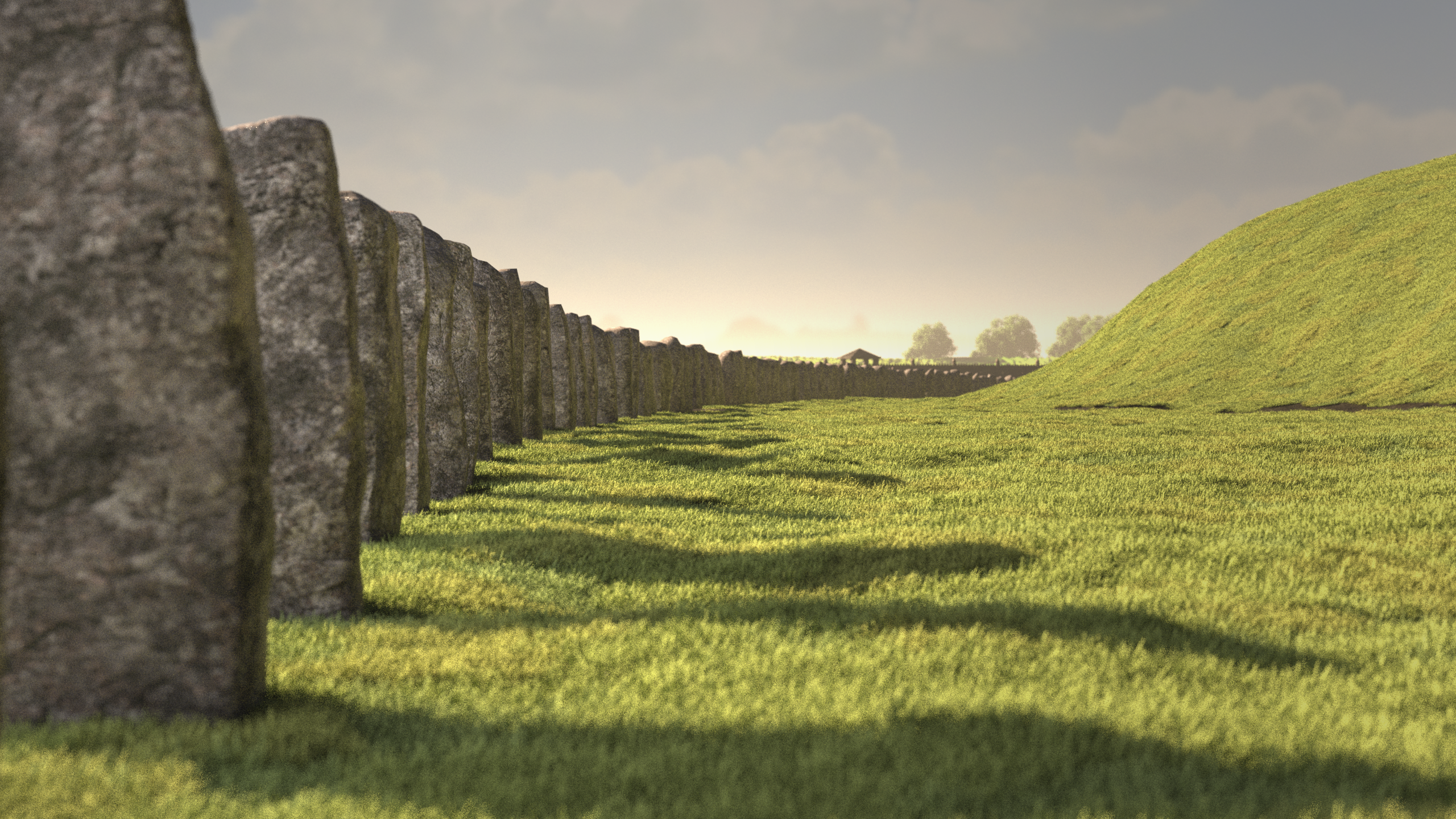
Robert Molyneaux - CGI reconstruction of the Jelling stone ship in Denmark

Other art work used in the video
Christian Sloan Hall - Odin / First blood / Eastre dawn goddess
Roy Douglas - Vendel helmet cgi
Christopher Steininger - Ship to the otherworld animation
Stella Spente - Freyja in her chariot
Christopher Steininger - Ship to the otherworld animation
Stella Spente - Freyja in her chariot
Ryan Murray - Treudd ritual
Gemini Science - CGI ship burial
Graman - Sutton hoo burial
Eva Gjerde - Storhaug ship burial
Eva Gjerde - Storhaug ship burial
Sources
- Bonde, N & Stylegar, F. A., ‘Between Sutton Hoo and Oseberg – dendrochronology and the origins of the ship burial tradition’, Danish Journal of Archaeology (2016), 5:1-2, 19-33
- Davidson, H.E., The Road to Hel: A Study of the Conception of the Dead in Old Norse Literature, Cambridge University, (1943).
- Elliott, R. N. ‘Håga in context – An analysis of the Håga complex in the Bronze Age landscape of the Mälar Valley region’ (Uppsala: 2020)
- Jackson, E. “Not Simply Lists”: An Eddic Perspective on Short-Item Lists in Old English Poems. Speculum, 73(2), 338–371. (1998)
- Shenk, Peter, To Valhalla by Horseback? Horse Burial in Scandinavia during the Viking Age, (Oslo: The Centre for Viking and Medieval Studies, University of Oslo, 2002).
- Skoglund, P., ‘Stone ships: continuity and change in Scandinavian prehistory, World Archaeology, 40:3, 390-406, (2008)
- Rowsell, T., “Riding to the Afterlife:The Role of Horses in Early Medieval North-Western Europe,” MA Thesis, University College of London, (2012).
- Rowsell, T., "Religious Continuity in Northern European Boat Burial Practices of the Vendel Period" Research proposal, (2015)
- Vikinge skibs museet website
MUSIC:
The whole other - Ether oar
Wolcensmen - Sunne (remix by Eternal Rik)
Saichaika - Musica aeterna
Halindir - Hedelandet II
Bark sound productions - My
Aaron Kenny - yonder hill and dale
Patrick Patrikios - away
Kevin MacLeod - Rites
Stark von Oben - Praetorian Germanicus
Stark von Oben - Winter Soulstice
Ormgård - Séta
Borg - Death of Winter
Myling - Töcken
Halindir - Hummocks in fog
Rishi Shah - From Runes to Ruins
Xurious - Steppe expansion
Thursday, 28 October 2021
New Genetic Study on Tarim Mummies of China
New genetic data on Tarim mummies disproves my claim that early Tarim mummies were Iranic. It also shows the likely origin of Tocharian languages is in the Dzungarian Basin just north of Tarim rather than Tarim itself. Tarim mummies date from 2000 BC to AD 200 yet this sample only looks at the very oldest of those. Even older samples (3000–2800 BC) in the new study are from the Dzungarian Basin and these samples appear to be Afanasievo derived and therefore are likely the source of Tocharian languages, and if so then the language moved South into Tarim from them, but the early mummies from Tarim itself, at least the 13 in this study which date from 2100–1700 BC, do NOT appear to be Tocharians or even, as I speculated in my video las year, Iranic speaking Aryans, rather an isolated refugia of ice-age like people predominantly descended from Ancient North Eurasians and West Siberian Hunter-Gatherers (WSHG themselves were 72.5% ANE, 7.5% West European Hunter-Gatherer, and 20% Ancient East Asian).


We can't say what language these Siberian mammoth hunters turned lizard-eaters of Tarim spoke (not an Indo-European one though), although we know the genes associated with Tocharian and Iranic speakers both entered the Tarim basin region later on. Interesting that the mummies appear to be European in phenotype despite not descending from Indo-European bronze age steppe peoples who are autosomally like modern Europeans. As the paper says:
“The Tarim mummies’ so-called Western physical features are probably due to their connection to the Pleistocene ANE gene pool,”
So they look physically European because they have ANE DNA. This also answers the question of why some Ainu people from Japan, and some ancient native American skeletons like Kennewick man, look like Europeans; They all have ANE DNA and ANE were obviously Europoid.
/https://tf-cmsv2-smithsonianmag-media.s3.amazonaws.com/filer/51/9f/519fea8a-a215-48fe-ba09-fae09a0bb3e3/kennewick-hero.jpg "kennewick man")

This also explains why the material culture of early Tarim people resembles that of Siberian peoples. Take the idols for example:

You find faces similar to this everywhere you find WSHG/ANE ancestry in Siberia and Central Asia. The Mansi, Kalash and Ket all make figurines in similar trends to this day.

It is important to remember that these new samples from Tarim represent only the first 400 years of that burial tradition which lasted a further 1900 years! Without samples from those following long 19 centuries we cannot say for sure when the WSHG people disappeared but I highly suspect that later Tarim mummies like Cherchen man (see below), who died c. 1000 BC, in all probability do have steppe admixture and could well be Iranic or Tocharian speakers.
 |
| Chercen man depicted by Andrew Whyte |
Tocharian and Iranic speakers of steppe descent entered the Tarim basin from different routes at different times, but the original inhabitants were these ANE descended Siberian people and they mixed with the incoming Indo-Europeans. So I still think that Cherchen man and the Yanghai cannabis shaman were both Indo-European people.

So what do we know about the people of this Siberian ANE-rich refugia?
Their race underwent a bottleneck and formed over 9000 years ago
They were homogenous population scattered in the Tarim desert, rarely mixing with neighbours
They adopted pastoralist lifestyle from neighbouring steppe peoples
They consumed dairy products like kefir but were lactose intolerant
They farmed animals - likely due to Afanasievo influence
They were not European but they looked European due to ANE ancestry
They had genes associated with dark skin in SLC24A5 and SLC45A5 like East asians do
We don’t know what language they originally spoke
They likely adopted Tocharian and Iranic languages after mixing with their Afanasievo neighbours of the Dzungarian basin to the North who were related to Yamnaya, and Andronovo neighbours to the West who were Aryans. This occurred sometime after 1700 BC
They buried their dead with ephedra twigs like later BMAC and Iranic cultures did
They made idols similar to those made by other Siberian peoples
Friday, 8 January 2021
Saturday, 2 January 2021
The Royal Indo-European Horse Sacrifice
The most important sacrificial animal in the original Indo-European religion was the horse - The very power of their kings depended on an elaborate ritual horse sacrifice. In this video we will look at the rite of horse sacrifice in various Indo-European traditions in order to get an idea of why the Proto-Indo-Europeans considered it such an important royal ritual and what it looked like. Beginning with the enormous Ashvamedha in India, and moving on to Rome's October Horse rite and ending on old Norse written sources combined with archaeological evidence from the Nordic Bronze age through to the Viking age - we get a pretty clear picture of the gruesome and often sexual rituals associated with the inauguration of kings and the necessary solar horse sacrifice. This video is mainly based on the recent book on the same subject by Kaliff & Oestigaard.
Sources:
Dumézil, G. 1970. ‘Archaic Roman Religion. Volume One.’ The John Hopkins University Press. Baltimore and London. Eliade, M. 1993. ‘Patterns in Comparative Religion.’ Sheed and Ward. New York. Eliade, M., ed., ‘Encyclopedia of Religion’ (NY: Collier Macmillan, 1987), VI:463; Kaliff, A., & Oestigaard, T., ‘The Great Indo-European Horse Sacrifice: 4000 Years of Cosmological Continuity from Sintashta and the Steppe to Scandinavian Skeid’ (2020) Outram, A., et al. ‘Horses for the dead: funerary foodways in Bronze Age Kazakhstan’ - (March 2011) Puhvel, J., ‘Comparative Mythology’ 1987 Rowsell, T., Riding To The Afterlife: The Role Of Horses In Early Medieval North-Western Europe. (2012) Sikora, M., ‘Diversity in Viking Age horse burial’ in The Journal of Irish Archaeology(Belfast: 2003-4). P.87. Solheim, S. 1956. Horse-fight and horse-race in Norse tradition. Studia Norvegica No. 8. H. Aschehoug & Co. (W. Nyaard). Oslo. Veil, Stephan & Breest, Klaus & Grootes, P. & Nadeau, Marie-Josée & Huels, Matthias. (2012). A 14 000-year-old amber elk and the origins of northern European art. Antiquity. 86. 660-673.Sunday, 13 September 2020
Pagan Viking Travel Guide to Sweden / History documentary
In this film, i take you on a trip around Sweden's places of power; sacred spaces remaining from the bronze age, iron age and viking times. I travel through central Sweden to show you some of the most fascinating and mysterious archaeological religious sites and, through them, help you to understand a bit more about the ancient religion of the Norse peoples and where you can go in Sweden to see these things for yourself.
Art:
Viking warriors by Christian Sloan Hall
Treudd by Ryan Murray
Animated god pole and ship by Christopher Steininger
Map:
Sources:
https://www.academia.edu/1366943/The_Grave_as_a_Doorway_to_the_Other_World_Architectural_Religious_Symbolism_in_Iron_Age_Graves_in_Scandinaviahttp://www.arkeologiskasamfundet.se/csa/Dokument/Volumes/csa_vol_18_2010/csa_vol_18_2010_s223-250_magnell_iregren.pdf
http://www.isvroma.it/public/pecus/graslund.pdf
http://cogito.ucdc.ro/2012/vol4n2/en/13_the-four-eyed-dog.pdf
https://core.ac.uk/download/pdf/147825787.pdf
http://www.arkeologiskasamfundet.se/csa/Dokument/Volumes/csa_vol_18_2010/csa_vol_18_2010_s79-103_bradley_et-al.pdf
https://www.researchgate.net/figure/Ulan-IV-kurgan-4-grave-15-3D-wagon-reconstruction-created-using-Autodesk-3-ds-Max_fig7_271587800
Thursday, 30 April 2020
Odin and the Horned Spear-Dancer
Viking and Anglo-Saxon artwork often includes a man with bird shaped horns. This mysterious figure is known as the horned man or the weapon dancer. The motif shows up in various different contexts and over a huge geographic range and timeframe - from early Anglo-Saxon England to Viking age Russia. It is commonly associated with the cult of the Nordic god Odin or the Anglo-Saxon god Woden and with extraordinary shamanic rituals as I shall explain in this video.
Sources:
- Mortimer, Paul, 'What Colour a God's Eyes' (2018)
- Oehrl, Sigmund, 'Horned ship-guide – an unnoticed picture stone fragment from Stora Valle, Gotland' (2016)
- Oehrl, Sigmund, 'DOCUMENTING AND INTERPRETING THE PICTURE STONES OF GOTLAND' (2017)
Artwork
The following paintings of the horned spear dancer are by Hungerstein.


Friday, 10 April 2020
The Huntshaw dagger and barrows of Darracott moor
This blog post explains the significance of the barrows of Darracott moor in North Devon and the discovery in 1875 of a dagger in barrow number 2, dubbed the Huntshaw dagger, which was recreated by Neil Burridge in 2025.
In this video I explore the Bronze Age burial ground of Darracott moor in Huntshaw, Devon. The largest barrow has a road going straight over it. Another barrow contained a dagger which is in the museum in Exeter. Below I have included the original lecture notes regarding the two excavations of the 19th century.
In this video I look at the significance of Cornwall and Devon to the European Bronze Age and I show the recreation of the Huntshaw dagger by the smith Neil Burridge.
 |
| Date of Huntshaw barrow excavations mapped |
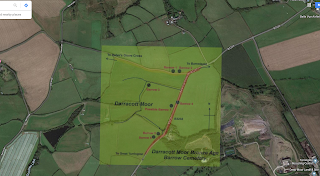 |
| Location of barrows superimposed on Google map |
 |
| Arial view of barrow 1 and 2 |
 |
| Dissection of barrow and cist |
 |
| Display cabinet at Museum of Barnstaple & North Devon |
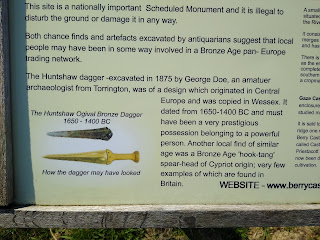 |
| Information sign with details of Huntshaw barrows at Berry Castle |
 |
| the Huntshaw dagger |
 |
| Replica of the Huntshaw dagger by Neil Burridge |
EIGHTEENTH REPORT of the Committee, consisting of Mr. P. F. S. Amery, Rev. S. Baring-Gould, Dr. Brushl Mr. R. Burnard, Mr, Cecil M. Firth, Mr. J. Brosling Rowe, and Mr. R. Hansford Worth (Secretary), appointed to collect and record facts relating to Barrows in Devonshire, and to take steps, where possible, for their investigation.
Edited by R. H. WORTH, Hon. Secretary.
(Read at Great Torrington, August, 1899)
Your Committee's Report this year deals with the exploration of certain barrows on Broad Down, near Honiton; the exploration of barrows on Raddick Hill by Mr. Barnard; and of a barrow at Torrington by Mr. G. M. Doe.
EXAMINATION OF A BARROW IN THE PARISH OF GREAT TORRINGTON.
This barrow is one of a series of five, two of which were opened in 1875, and were made the subject of a paper by my late father, read by him at the meeting of this Association here in that year.
The one in question is much larger than any of the others, being from 70 to 80 feet in diameter, and from 4 to 5 feet high. As, however, the highway passes over it, it has probably been considerably lowered. The accompanying plan will show the relative position
of this barrow to its companions. The exploration was commenced on the 26th June last by digging a trench on the north-west side at right angles to the road. In a very short time the workmen came on a mass of whitish grey clay with irregular layers of charcoal, in some places more than an inch in thickness, with here and there a stone which appeared to have been subjected to the action of fire. This lay on the natural clay of the surrounding land. On getting near the centre of the barrow a layer of very different character was discovered. This extended for about 24 feet, and was of varying thickness, from 3 to 14 inches. A thin layer of the greyish white clay with the streaks of charcoal was spread under it, and it was capped over with the same, the streaks and masses of charcoal in this capping of clay being very distinct, and appearing to follow the curve of the barrow. The layer in question consisted of fine reddish earth mixed with burnt matter of a totally different composition from that of the charcoal in the clay. A few small stones which seemed to have been burnt, together with small pieces of quartz, were interspersed in this mass, one being a good-sized rock crystal, and in places pieces of blackened burnt bones were embedded. Parallel. with the road, and at the foot of its boundary hedge, was a perfectly straight line of loose "acre stones," a foot in width and height, which ran through about the centre of the barrow for a length of 60 feet, and on the level of the ground. These stones may have been placed for drainage purposes when the road was made, as they passed through the clay, etc., of the barrow, the layers of which were continued on each side of the stones. On reaching the hedge the trench was discontinued, and the centre of the barrow was cleared away to the ground level, which was carefully examined, but without finding any traces of its having been previously disturbed. After working for a week lack of funds prevented further exploration, but it appears not improbable that the actual interment consisted of the mass of burnt matter and bones. It may be, too, that at the making of the road the barrow was disturbed; nevertheless it has only been very partially explored.
There was no indication of a capping of stones around this barrow, as in those previously opened in 1875. A piece of rusted iron 3 inches long, 1 inch wide, and about inch thick was found imbedded in the clay, etc., in the centre of the barrow, but as it was very near the line of stones before mentioned, it may have got there when the road was: made. (GEORGE M. DOE.)
This second excavation report concerns Barrows 1 and 2, the latter of which contained the Huntshaw dagger.
DOE, G.M. The Examination of two Barrows near Torrington. Trans. Dev. Assoc., 7,102-105 (1875).
THE EXAMINATION OF TWO BARROWS NEAR TORRINGTON.
BY GEORGE DOE.
(Read at Torrington, July, 1875)
In the year 1867 a partial examination of two barrows, situated in the parish of Huntshaw, about two and a half miles from the town of Great Torrington, was made by my friends, the late Mr. Henry Fowler and Mr. Samuel Pearce; and an interesting paper, relating chiefly to the eastern barrow, was read by Mr. Fowler at the meeting of the Devonshire Association held at Barnstaple in that year, which concluded thus:
"Our want of success in finding any such remains as urns or cists may be attributed to the possible fact, that they were placed in some part of the bed of the barrow out of the centre; for in such a case it is evident that numerous cuttings might be made without coming across them. We have hopes, therefore, that some remains will still be found, and the more so as the perfectly undisturbed state of the portions already examined precludes the idea of the barrow having ever before been opened."
Subsequently to the Barnstaple meeting, Mr. Fowler and I had frequent conversations on the subject; and when it became known that the Association would meet at Torrington, we decided on making a thorough examination of the barrows. with a view to the production of a sequel to his paper. Had his life been spared, I should have remained in the background, and an account of the further exploration of the barrows would probably have come from the able pen of Mr. Fowler; but as that could not be, I have felt it an almost religions duty to offer this imperfect effort as my humble tribute to his memory.
The necessary permission of the Hon'ble. Mark Rolle, the landowner, and of Mr. Webb, the tenant, having been obtained, workmen were engaged, and operations commenced few weeks since, under the intelligent superintendence of Mr. Alexander McKelvie, the district highway surveyor, at the western extremity of the western mound (into which a short cutting had been made in 1867, as shown by dotted lines on the accompanying plan), and continued for two days, during which rather more than a half of the mass was removed without any further result than a confirmation of Mr. Fowler's statement, that it was composed almost entirely of one homogeneous mass of clay, with occasional streaks of charcoal, covered by a capping of stone. The clay, which could not have been found on or very near the spot, had evidently been worked or puddled. It could be cut as easily as cheese, being quite free from stones or grit, and varied from a whitish-grey to a bright orange colour; but the streaks of charcoal contained occasional small pieces of brittle red stone, which appeared to have been burnt with the charcoal.
On the third day the workmen had not cut far into the eastern half, when they came upon a rounded heap of stones, measuring ten feet from north to south, and twelve feet from east to west at the base, and four feet in height, the top being three feet below the surface of the harrow. A careful removal of these stones-which appeared to have been "acre stones, and were as clean as when first collected-revealed, in the centre of the heap, a small empty chamber, so rudely constructed that it fell in on the displacement of the covering stones. At the west of this, but on a lower level, another chamber was discovered about eighteen inches square, and nearly a foot in depth, covered by a stone of the same kind as, but much larger than those forming the pile. This chamber was nearly filled with fragments of burnt human bones, and decomposed matter, which may perhaps be the remains of a cloth or skin in which they had been wrapped. Nothing else was found in this chamber, which was floored with flat stones placed on the original surface of the land; nor was any further discovery made among the stones, nor in the mound, the outer and less elevated parts of which were carefully probed with an iron bar. The case with which the clay had been pierced suggested that in the exploration of the eastern mound (through which a cutting had been made in 1867, as shown by dotted lines on the plan) considerable labour might be saved; and the iron bar was accordingly sunk again and again into the portion of the mound corresponding with that under which the interment had been made in its western neighbour. After numerous trials, a spot was at length reached where the gentle insinuations of the iron were arrested at a depth of about two feet, A circular excavation was then made through the capping of clay and the underlying beds of earth and charcoal, which soon brought to light a heap of stones similar to that already described, except that it was circular, with a diameter of eleven feet at the base, and that there was a slight depression or sinkage in its northern half. After the removal of about one half of the heap, pieces of burnt human bones, mixed with ashes and earth, were found between the stones, gradually increasing in number towards the south, where, in a small imperfectly-constructed chamber, was discovered a flat mass of damp leaves, so perfect that they were immediately recognized as oak and beech. Whether they originally formed a chaplet, or in what other form, or for what purpose they were placed there, I will not hazard a speculation. A little further towards the south one of the workmen observed something pointed protruding two or three inches, which he tried to pull out, but fortunately he was unable to do so. The stones above it having been carefully removed, a bronze dagger, which at first sight I mistook for a spear head, was disclosed lying on a flat stone with its point towards the east. Adhering to each side of it were found some very thin pieces of decayed wood, which undoubtedly had formed part of the sheath. They have been preserved; and a more minute inspection of them will, I believe, confirm this view. At the broad end of the blade. are three rivets, by which it had been attached to a wooden handle, the shape and grain of which may be distinctly traced on each side. A small quantity of decomposed wood, in which were found two rivet-heads, extended a few inches over the face of the stone on which the weapon lay; but no trace of a staff could be seen. The dagger is nine and a half inches in length, and two and a quarter inches in width at its broadest part, becoming narrower by a double curve of each edge towards the point. Its present weight is barely eight ounces; but it must have become lighter by the corrosion of its surface, which, however, is still in a wondrously good state of preservation. About a quarter of an inch from the edge two sunk lines, forming a thread, surround the blade, the space between the outer line and the edge being fluted like a modern sword.
Similar daggers are figured in Mr. Llewellyn Jewitt's Grave Mounds and their Contents, p. 132, and in Mr. W. Copeland Borlase's Nenia Cornubia, p. 236; both of which appear to be far more imperfect than the one I have attempted to describe.
As no interment was discovered in 1867, our late operations drew down some contempt and pity from outsiders. The workmen were almost ashamed to undertake the job, because their predecessors had been ridiculed for their pains. One gentleman made the flattering remark, that those who talked of opening the barrows must be either knaves or fools; another attributed the mounds to some enterprising brick maker, who had come to grief, and stopped his works; a third referred them to the old charcoal-burners; another knew that they had been made for a pleasure-ground; whilst one fully charged with English history offered a solution of the mystery by suggesting that they were thrown up during or after a battle in the time of the Great Rebellion.
It may be easily imagined, then, how gratifying was the discovery which has thrown some light on what was previously veiled in obscurity. To my mind there is now not a shadow of a doubt that these barrows were erected by our Celtic ancestors before the Roman occupation of Britain, and during the period designated by archaeologists as the Bronze Age. Should any doubts, however, be entertained on this point, they will, I believe, be dispelled by a perusal of Sir John Lubbock's learned exposition of the reasons why our bronze weapons cannot be referred to the Romans, in the first chapter of his Pre-historic Times. But the dagger, which as a specimen of art-manufacture would not be discreditable to the present century, was probably the handiwork of a race of higher civilization than the builders of the barrows could lay claim to, and imported by one of the merchant adventurers who in that early age visited the tin-producing counties of Cornwall and Devon.
I may add that the investigation of these barrows has afforded another proof of the necessity for examining every part of a sepulchral mound before passing judgment on its character and contents. It is a curious fact that each of the cuttings made in 1867 went within a foot of the interment.
Subscribe to:
Posts (Atom)
