Showing posts with label barrows. Show all posts

Tuesday, 5 May 2026

The Barrow as the Symbol of Western Man


A free preview episode of Radio North Sea International is now available on Survive the Jive podcast. There is no more potent, holy and enduring symbol of Western man, than the barrow! It links the Iliad, Beowulf, the sagas, the Celts, Germans, Scythians and slavs! 6000 years of excellence!

Friday, 11 July 2025

British Tin Started Europe’s Bronze Age 🇬🇧


Discover the pivotal role Britain played in sparking Europe’s Bronze Age in this free history documentary! 🌟 Unearth the secrets of the Beaker folk, who mainstreamed tin-bronze in the British Isles around 2200 BC, revolutionising metallurgy with Cornwall and Devon’s rich tin deposits. Focusing on the iconic Huntshaw dagger, explore how such early bronze weapons, buried in sacred barrows, symbolised power and spirituality. 🗡️ Dive into the history of tin trade, ancient craftsmanship, and the cultural significance of Bronze Age daggers, including exclusive insights from master swordsmith Neil Burridge. 🛠️ Why were these state-of-the-art weapons buried with the dead? Watch to uncover the mysteries of Britain’s Bronze Age legacy!

Full interview with Neil Burridge sword smith 

More on the Huntshaw barrows 


Sources: 

-Doe, G.M. The Examination of two Barrows near Torrington.(1875) 
-Jones, Quinnell. ‘Daggers in the West: Early Bronze Age Daggers and Knives in the South-west Peninsula’. Proceedings of the Prehistoric Society (2013) 
-Wang, Strekopytov, Roberts,’Copper ingots from a probable Bronze Age shipwreck off the coast of Salcombe, Devon: Composition and microstructure’ Journal of Archaeological Science, Volume 97, 2018. -Williams et al. From Land's End to the Levant: did Britain's tin sources transform the Bronze Age in Europe and the Mediterranean?. Antiquity (2025)
-Hameldown dagger, Legendary Dartmoor website (2016) 

Wednesday, 7 August 2024

HYPERBOREAN ODYSSEY 1: Norway


I spent half a month working on a cruise ship, travelling around Norway and the Scottish islands. Part 1 of my Hyperborean Odyssey is in Western Norway, beginning with the ancient burial grounds of Gunnarshaug and Rehaugane near Norway's Viking capital Avaldsnes, then admiring the fjords around Ulvik and Olden and finishing off in the rainy city of Alesund. This is a historical travel series.

Thursday, 10 August 2023

The OLDEST TOMBS on Earth? Megalithic Origins (4900 - 2700 BC) | Ancient...


The entire history of the megalith builders of Neolithic France's western Brittany region from the migration and rise of the first farmers to the demise of the culture. This feature length documentary shows how the famous megalithic monuments of Britain and Ireland, such as Stonehenge, derive from much earlier ones in Brittany. Who were the first farmers in France? Why did they start building the impressive megalithic chambered tombs or the enormous standing stones known as menhirs? This documentary looks at the world’s first tombs, some close to 7000 years old, and traces the development of the dolmens and other tombs from 5000 BC to 2700 BC. We also learn how the first farmers interacted with the Mesolithic Western Hunter Gatherers who were already there, and how they may have influenced this megalithic monument tradition. Learn how the exquisite jadeite axe heads of the Neolithic were symbols of power imported from the far away Alps. We visited the tombs of Gavrinis, Petit Mont, Table des Marchands, the Barrow tomb of Kercado and the truly ancient Saint-Michel tumulus among others. You will also learn about the 4 mile long alignments of Carnac and what they were made for. The adventure starts at the 9 maidens stones in Cornwall and ends on the stunning coasts of Morbihan in Brittany.
 Sources:
  • Cassidy el al (2016)  
  • Cassidy, L.M., Maoldúin, R.Ó., Kador, T. et al. A dynastic elite in monumental Neolithic society. (2020).  
  • Fowler, C., Olalde, I., Cummings, V. et al. A high-resolution picture of kinship practices in an Early Neolithic tomb. Nature 601, 584–587 (2022).  
  • Paulsson, B. S., (2018)  
  • Petrequin, P. et al,.- The production and circulation of alpine jade axe-heads (2016) 
  • Rivollat et al., 2015 
  • Scarre, Chris, 'The Study of Neolithic Brittany', Landscapes of Neolithic Brittany (Oxford, 2011; online edn, Oxford Academic, 16 Mar. 2015) 
  • Shennan, S. “The First Farmers of Europe” (2018) 
  • Le Roux, C-T., 1999a. L’outillage de pierre polie en métadolérite ue type A. Les ateliers de Plussulien (Côtes-d”Armor): production et diffusion au Néolithique dans la France de l’ouest et au-delà. Rennes: Travaux du Laboratoire Anthropologie. Préhistoire et Quaternaire Armoricains 
  • Le Roy et al.,Funerary behaviour of Neolithic necropolises and collective graves in France. Evidence from Gurgy «Les Noisats» (Middle Neolithic) and Passy/Veron «La Truie Pendue» (Late Neolithic) (2014) 
  • Whittle, A., ‘Very Like a Whale’: Menhirs, Motifs and Myths in the Mesolithic–Neolithic Transition of Northwest Europe. 2000.

Thursday, 8 December 2022

The Northman - An analysis of pagan scenes

Further to my written review of The Northman (2022), published on this blog in April, I have now created a much longer and more detailed video review of the film. This video includes close watching scene analysis of all the parts of the film which pertain to Nordic paganism. I explain the sources and reasoning behind the stylistic and thematic decisions of the film makers and provide examples of written and archaeological precedents to justify them wherever possible.


Robert Eggers' The Northman is the best Viking film ever made but some of the pagan themes within are too esoteric for everyone to understand. In this review, I explain the origin of the pagan rituals and symbols throughout the film and what they mean. Everything from valkyries, to the raven fylgja, the horned spear dancer, and the Odinic initiation ritual in a Neolithic barrow. I also explain the tension depicted in the film between the cults of the gods Freyr and Odin.


ARTWORK

Most art was by Christian Sloan Hall including Odin, Freya, Starkad and Valkyries
Horned spear dancers by Hungerstein
Wading through Hell by Jack Jones
Hel goddess by Leo Albiero
World tree by Pete Amachree
Spirit of Yule by Christopher Steininger
Mimir’s head by Graman
Vendel helmet cgi by Roy Douglas
Bear spirit and corpse animations by Castor and Bollux animation

MUSIC


Torulf
Hildigaldra
Borg

SOURCES

Primary

  • Gesta Danorum by Saxo Grammaticus
  • Germania by Tacitus
  • Risala by Ibn Fadlan
  • Egil’s saga
  • Njal’s saga
  • Vatnsdæla saga
  • Eyrbyggja saga
  • Landnámabók 
  • Sturlaugs saga starfsama
  • Gautreks saga
  • Grettir's saga
  • Saga of Bósa and Herraud
  • Víga-Glúms saga
  • Heimskringla
  • Beowulf
  • Hervarar saga


Secondary


  • Chadwick, N., ‘Dreams in Early European Literature’, in: Carney, James, and David Greene (eds), Celtic studies: essays in memory of Angus Matheson 1912–1962, London: Routledge, 1968. 33–50.
  • Davidson, H.E.,  Gods and Myths of Northern Europe (1964)
  • Davidson, H.E., The Road to Hel: A Study of the Conception of the Dead in Old Norse Literature, Cambridge University, (1943). 
  • Peter-Schjødt, J., ‘Óðinn - The Pervert?’ in Res Artes et Religio: Essays in Honour of Rudolf Simek   p. 534 (2021: Kısmet Press) https://archive.org/details/res-artes-et-religio-essays-in-honour-of-rudolf-simek-kismet-press
  • Ramos, Eduardo, ‘The Dreams of a Bear: Animal Traditions in the Old Norse-Icelandic Context’ (2014)
  • Rowsell, T., “Riding to the Afterlife:The Role of Horses in Early Medieval North-Western Europe,” MA Thesis, University College of London, 2012.
  • Rowsell, T., “Woden and his Roles in Anglo-Saxon Royal Genealogy”, University College London, (2012).
  • Rowsell, T., "Religious Continuity in Northern European Boat Burial Practices of the Vendel Period" Research proposal, (2015)
  • Rowsell, T., “Gender Roles and Symbolic Meaning in Njáls Saga” Medievalists.net 2012
  • Kershaw, K., ‘The one-eyed god: Odin and the (Indo-)Germanic Männerbünde’ (Journal of Indo-European studies monograph) 2000.

Friday, 1 October 2021

Yamnaya: Indo-European documentary


The Yamnaya culture, also called the Kurgan or Late Ochre Grave culture, of the late Neolithic and Bronze age Pontic steppe is believed to be one of several Proto-Indo-European speaking Western Steppe herder peoples who were ancestral to many modern peoples and who spread Indo-European languages across Eurasia. But what did Yamnaya look like? In this documentary film you can see 3D forensic facial reconstructions of Yamnaya men by the artist Robert Molyneaux and you can learn all about what Yamnaya people ate, why they loved milk, how they lived, their burial customs, how they spread and more.


Art


Music

Xurious - Steppe expansion

Altyn Tuu - Altai throat singing

Gargoyle - dance with me

The Whole Other - Ether Oar

Patrick Patrik - Away

Doug maxwell - tribal war council

Bark sound productions - in return 

kevin macleod - Master of the feast

Aethelruna - Output

Chris Zabriskie - The Theatrical Poster for Poltergeist III

Borg - The Dancing Forest

Khan Kurra - Little dragon

Chris Zabriskie - I Am Running Down the Long Hallway of Viewmont Elementary


Sources

  • Ali J. Berens, et al. “The Genomic Health of Ancient Hominins.” Human Biology, vol. 89, no. 1, Wayne State University Press, 2017, pp. 7–19, https://doi.org/10.13110/humanbiology.89.1.01.
  • Anthony, D., ‘The Horse, the Wheel, and Language’ 2007. 
  • Clemente, et al. (2021). \The genomic history of the Aegean palatial civilizations’. Cell. 184. 10.1016/j.cell.2021.03.039.
  • Damgaard, et al (2018). ‘The first horse herders and the impact of early Bronze Age steppe expansions into Asia’. Science. 360. eaar7711. 10.1126/science.aar7711.
  • Frînculeasa, Alin. (2020). The Children of the Steppe: descendance as a key to Yamnaya success.
  • Gordon, Raymond G., Jr. (ed.), 2005. Ethnologue: Languages of the World,
  • Haak, W., Lazaridis, I., Patterson, N. et al. Massive migration from the steppe was a source for Indo-European languages in Europe. Nature 522, 207–211 (2015).
  • Hanel, Andrea. (2020). Skin colour and vitamin D: An update. Experimental Dermatology. 29. 10.1111/exd.14142.
  • Hegyi, Alexandru & Diaconescu, Dragos & Urdea, Petru & Sarris, Apostolos & Pisz, Michał & Onaca, Alexandru. (2021). Using Geophysics to Characterize a Prehistoric Burial Mound in Romania. Remote Sensing. 13. 842. 10.3390/rs13050842.
  • Heyd, Volker (2017). "Kossina's smile". Antiquity. 91 (356): 348–359. doi:10.15184/aqy.2017.21. hdl:10138/255652. S2CID 164376362.
  • Khokhlov, A. A., ‘Morphogenetic processes in the Volga-Urals in the early Holocene (based on craniological materials of the Mesolithic-Bronze Age)’ Federal State Budgetary Educational Institution of Higher Education Samara State Social and Pedagogical University (2017).
  • Klejn et al. (2017). Discussion: Are the Origins of Indo-European Languages Explained by the Migration of the Yamnaya Culture to the West?. European Journal of Archaeology. 21. 1-15. 10.1017/eaa.2017.35.
  • Kotova, Nadezhda. (2010). Burial clothing in Neolithic cemeteries of the Ukrainian steppe. Documenta Praehistorica. 524486477634. 10.4312/dp.37.14.
  • Kruc, S. I., ‘Paleoantropologicheskie issledovaniia Stepnogo Podneprovia: (epoha bronzy)’ ‘Paleoanthropology of the steppe Dnieper region: (Bronze Age)’ ACADEMY OF SCIENCES OF THE UKRAINIAN SSR INSTITUTE OF ARCHEOLOGY, Naukova Dumka: Kiev (1984).
  • Lazaridis, I., Nadel, D., Rollefson, G. et al. Genomic insights into the origin of farming in the ancient Near East. Nature 536, 419–424 (2016).
  • Marnetto, D., et al. (2021). ‘Ancestral contributions to contemporary European complex traits’ bioRxiv 2021.08.03.454888
  • Mathieson, I., Alpaslan-Roodenberg, S., Posth, C. et al. The genomic history of southeastern Europe. Nature 555, 197–203 (2018).
  • Meyer, Christian et al (2009). The Eulau Eulogy: Bioarchaeological Interpretation of Lethal Violence in Corded Ware Multiple Burials from Saxony-Anhalt, Germany. Journal of Anthropological Archaeology. 28. 412-423. 10.1016/j.jaa.2009.07.002.
  • Narasimhan VM, Patterson NJ, Moorjani P, et al. The Genomic Formation of South and Central Asia. bioRxiv. (2018).
  • Olalde, I., Brace, S., Allentoft, M. et al. The Beaker phenomenon and the genomic transformation of northwest Europe. Nature 555, 190–196 (2018).
  • Preda-Bălănică, Bianca, and Alin Frinculeasa. “(2020)
  • B. Preda-Bălănică, A. Frînculeasa, V. Heyd, The Yamnaya Impact North of the Lower Danube. A Tale of Newcomers and Locals, Bulletin De La Société Préhistorique Française, 117, 1, p. 85-101.” Bulletin de la Société préhistorique française (2019): n. pag. Print.
  • K., & Linden, M. V. (2020). The spatiotemporal spread of human migrations during the European Holocene. Proceedings of the National Academy of Sciences of USA
  • Rascovan, Nicolas, et al. (2018). Emergence and Spread of Basal Lineages of Yersinia pestis during the Neolithic Decline. Cell. 176. 10.1016/j.cell.2018.11.005.
  • Rasmussen S, et al. Early divergent strains of Yersinia pestis in Eurasia 5,000 years ago. Cell. 2015 Oct 22;163(3):571-82. doi: 10.1016/j.cell.2015.10.009. Epub 2015 Oct 22. PMID: 26496604; PMCID: PMC4644222.
  • Romain Garnier, Laurent Sagart, Benoît Sagot. ‘Milk and the Indo-Europeans’. Martine Robeets; Alexander Savalyev Language Dispersal Beyond Farming, John Benjamins Publishing Company, pp.291-311, 2017, 978 90 272 1255 9. ff10.1075/z.215.13garff. Ffhal-01667476f
  • Saag et al, ‘Genetic ancestry changes in Stone to Bronze Age transition in the East European plain’ (2021)
  • Saag L. Human Genetics: Lactase Persistence in a Battlefield. Current Biology : CB. 2020 Nov;30(21):R1311-R1313. DOI: 10.1016/j.cub.2020.08.087. PMID: 33142099.
  • Susat, Julian. et al. (2021). A 5,000-year-old hunter-gatherer already plagued by Yersinia pestis. Cell Reports. 35. 10.1016/j.celrep.2021.109278.
  • Taylor, W.T.T., Barrón-Ortiz, C.I. Rethinking the evidence for early horse domestication at Botai. Sci Rep 11, 7440 (2021).
  • Ullrich, Herbert & Stephan, Carl. (2016). Mikhail Mikhaylovich Gerasimov’s Authentic Approach to Plastic Facial Reconstruction. Anthropologie (Czech Republic). 54. 97-107.
  • Wang, CC., Reinhold, S., Kalmykov, A. et al. Ancient human genome-wide data from a 3000-year interval in the Caucasus corresponds with eco-geographic regions. Nat Commun 10, 590 (2019).
  • Wilkin, S., Ventresca Miller, A., Fernandes, R. et al. Dairying enabled Early Bronze Age Yamnaya steppe expansions. Nature (2021).

Friday, 10 April 2020

The Huntshaw dagger and barrows of Darracott moor

This blog post explains the significance of the barrows of Darracott moor in North Devon and the discovery in 1875 of a dagger in barrow number 2, dubbed the Huntshaw dagger, which was recreated by Neil Burridge in 2025. 

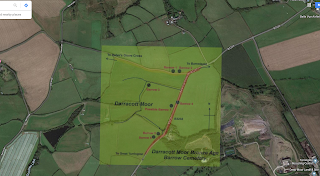
In this video I explore the Bronze Age burial ground of Darracott moor in Huntshaw, Devon. The largest barrow has a road going straight over it. Another barrow contained a dagger which is in the museum in Exeter. Below I have included the original lecture notes regarding the two excavations of the 19th century.


In this video I look at the significance of Cornwall and Devon to the European Bronze Age and I show the recreation of the Huntshaw dagger by the smith Neil Burridge. 


Date of Huntshaw barrow excavations mapped

Location of barrows superimposed on Google map

Arial view of barrow 1 and 2 

Dissection of barrow and cist

Display cabinet at Museum of Barnstaple & North Devon

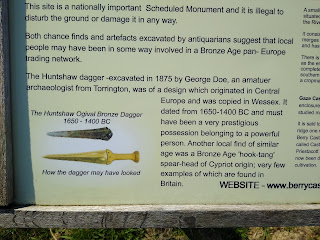
Information sign with details of Huntshaw barrows at Berry Castle

the Huntshaw dagger

Replica of the Huntshaw dagger by Neil Burridge


This first excavation report concerns Barrow 4, the largest on the moor, which the road goes over.

DOE, G.M. Examination of a Barrow in the Parish of Great Torrington. Trans. Dev. Assoc., 31,99-100 (1899).

EIGHTEENTH REPORT of the Committee, consisting of Mr. P. F. S. Amery, Rev. S. Baring-Gould, Dr. Brushl Mr. R. Burnard, Mr, Cecil M. Firth, Mr. J. Brosling Rowe, and Mr. R. Hansford Worth (Secretary), appointed to collect and record facts relating to Barrows in Devonshire, and to take steps, where possible, for their investigation. 

Edited by R. H. WORTH, Hon. Secretary. (Read at Great Torrington, August, 1899) 

Your Committee's Report this year deals with the exploration of certain barrows on Broad Down, near Honiton; the exploration of barrows on Raddick Hill by Mr. Barnard; and of a barrow at Torrington by Mr. G. M. Doe. 

EXAMINATION OF A BARROW IN THE PARISH OF GREAT TORRINGTON. This barrow is one of a series of five, two of which were opened in 1875, and were made the subject of a paper by my late father, read by him at the meeting of this Association here in that year. The one in question is much larger than any of the others, being from 70 to 80 feet in diameter, and from 4 to 5 feet high. As, however, the highway passes over it, it has probably been considerably lowered. The accompanying plan will show the relative position of this barrow to its companions. The exploration was commenced on the 26th June last by digging a trench on the north-west side at right angles to the road. In a very short time the workmen came on a mass of whitish grey clay with irregular layers of charcoal, in some places more than an inch in thickness, with here and there a stone which appeared to have been subjected to the action of fire. This lay on the natural clay of the surrounding land. On getting near the centre of the barrow a layer of very different character was discovered. This extended for about 24 feet, and was of varying thickness, from 3 to 14 inches. A thin layer of the greyish white clay with the streaks of charcoal was spread under it, and it was capped over with the same, the streaks and masses of charcoal in this capping of clay being very distinct, and appearing to follow the curve of the barrow. The layer in question consisted of fine reddish earth mixed with burnt matter of a totally different composition from that of the charcoal in the clay. A few small stones which seemed to have been burnt, together with small pieces of quartz, were interspersed in this mass, one being a good-sized rock crystal, and in places pieces of blackened burnt bones were embedded. Parallel. with the road, and at the foot of its boundary hedge, was a perfectly straight line of loose "acre stones," a foot in width and height, which ran through about the centre of the barrow for a length of 60 feet, and on the level of the ground. These stones may have been placed for drainage purposes when the road was made, as they passed through the clay, etc., of the barrow, the layers of which were continued on each side of the stones. On reaching the hedge the trench was discontinued, and the centre of the barrow was cleared away to the ground level, which was carefully examined, but without finding any traces of its having been previously disturbed. After working for a week lack of funds prevented further exploration, but it appears not improbable that the actual interment consisted of the mass of burnt matter and bones. It may be, too, that at the making of the road the barrow was disturbed; nevertheless it has only been very partially explored. There was no indication of a capping of stones around this barrow, as in those previously opened in 1875. A piece of rusted iron 3 inches long, 1 inch wide, and about inch thick was found imbedded in the clay, etc., in the centre of the barrow, but as it was very near the line of stones before mentioned, it may have got there when the road was: made. (GEORGE M. DOE.) 
 
This second excavation report concerns Barrows 1 and 2, the latter of which contained the Huntshaw dagger.

DOE, G.M. The Examination of two Barrows near Torrington. Trans. Dev. Assoc., 7,102-105 (1875). THE EXAMINATION OF TWO BARROWS NEAR TORRINGTON. BY GEORGE DOE. (Read at Torrington, July, 1875) 

In the year 1867 a partial examination of two barrows, situated in the parish of Huntshaw, about two and a half miles from the town of Great Torrington, was made by my friends, the late Mr. Henry Fowler and Mr. Samuel Pearce; and an interesting paper, relating chiefly to the eastern barrow, was read by Mr. Fowler at the meeting of the Devonshire Association held at Barnstaple in that year, which concluded thus: "Our want of success in finding any such remains as urns or cists may be attributed to the possible fact, that they were placed in some part of the bed of the barrow out of the centre; for in such a case it is evident that numerous cuttings might be made without coming across them. We have hopes, therefore, that some remains will still be found, and the more so as the perfectly undisturbed state of the portions already examined precludes the idea of the barrow having ever before been opened." Subsequently to the Barnstaple meeting, Mr. Fowler and I had frequent conversations on the subject; and when it became known that the Association would meet at Torrington, we decided on making a thorough examination of the barrows. with a view to the production of a sequel to his paper. Had his life been spared, I should have remained in the background, and an account of the further exploration of the barrows would probably have come from the able pen of Mr. Fowler; but as that could not be, I have felt it an almost religions duty to offer this imperfect effort as my humble tribute to his memory. 
 
The necessary permission of the Hon'ble. Mark Rolle, the landowner, and of Mr. Webb, the tenant, having been obtained, workmen were engaged, and operations commenced few weeks since, under the intelligent superintendence of Mr. Alexander McKelvie, the district highway surveyor, at the western extremity of the western mound (into which a short cutting had been made in 1867, as shown by dotted lines on the accompanying plan), and continued for two days, during which rather more than a half of the mass was removed without any further result than a confirmation of Mr. Fowler's statement, that it was composed almost entirely of one homogeneous mass of clay, with occasional streaks of charcoal, covered by a capping of stone. The clay, which could not have been found on or very near the spot, had evidently been worked or puddled. It could be cut as easily as cheese, being quite free from stones or grit, and varied from a whitish-grey to a bright orange colour; but the streaks of charcoal contained occasional small pieces of brittle red stone, which appeared to have been burnt with the charcoal. On the third day the workmen had not cut far into the eastern half, when they came upon a rounded heap of stones, measuring ten feet from north to south, and twelve feet from east to west at the base, and four feet in height, the top being three feet below the surface of the harrow. A careful removal of these stones-which appeared to have been "acre stones, and were as clean as when first collected-revealed, in the centre of the heap, a small empty chamber, so rudely constructed that it fell in on the displacement of the covering stones. At the west of this, but on a lower level, another chamber was discovered about eighteen inches square, and nearly a foot in depth, covered by a stone of the same kind as, but much larger than those forming the pile. This chamber was nearly filled with fragments of burnt human bones, and decomposed matter, which may perhaps be the remains of a cloth or skin in which they had been wrapped. Nothing else was found in this chamber, which was floored with flat stones placed on the original surface of the land; nor was any further discovery made among the stones, nor in the mound, the outer and less elevated parts of which were carefully probed with an iron bar. The case with which the clay had been pierced suggested that in the exploration of the eastern mound (through which a cutting had been made in 1867, as shown by dotted lines on the plan) considerable labour might be saved; and the iron bar was accordingly sunk again and again into the portion of the mound corresponding with that under which the interment had been made in its western neighbour. After numerous trials, a spot was at length reached where the gentle insinuations of the iron were arrested at a depth of about two feet, A circular excavation was then made through the capping of clay and the underlying beds of earth and charcoal, which soon brought to light a heap of stones similar to that already described, except that it was circular, with a diameter of eleven feet at the base, and that there was a slight depression or sinkage in its northern half. After the removal of about one half of the heap, pieces of burnt human bones, mixed with ashes and earth, were found between the stones, gradually increasing in number towards the south, where, in a small imperfectly-constructed chamber, was discovered a flat mass of damp leaves, so perfect that they were immediately recognized as oak and beech. Whether they originally formed a chaplet, or in what other form, or for what purpose they were placed there, I will not hazard a speculation. A little further towards the south one of the workmen observed something pointed protruding two or three inches, which he tried to pull out, but fortunately he was unable to do so. The stones above it having been carefully removed, a bronze dagger, which at first sight I mistook for a spear head, was disclosed lying on a flat stone with its point towards the east. Adhering to each side of it were found some very thin pieces of decayed wood, which undoubtedly had formed part of the sheath. They have been preserved; and a more minute inspection of them will, I believe, confirm this view. At the broad end of the blade. are three rivets, by which it had been attached to a wooden handle, the shape and grain of which may be distinctly traced on each side. A small quantity of decomposed wood, in which were found two rivet-heads, extended a few inches over the face of the stone on which the weapon lay; but no trace of a staff could be seen. The dagger is nine and a half inches in length, and two and a quarter inches in width at its broadest part, becoming narrower by a double curve of each edge towards the point. Its present weight is barely eight ounces; but it must have become lighter by the corrosion of its surface, which, however, is still in a wondrously good state of preservation. About a quarter of an inch from the edge two sunk lines, forming a thread, surround the blade, the space between the outer line and the edge being fluted like a modern sword. Similar daggers are figured in Mr. Llewellyn Jewitt's Grave Mounds and their Contents, p. 132, and in Mr. W. Copeland Borlase's Nenia Cornubia, p. 236; both of which appear to be far more imperfect than the one I have attempted to describe. 
 
As no interment was discovered in 1867, our late operations drew down some contempt and pity from outsiders. The workmen were almost ashamed to undertake the job, because their predecessors had been ridiculed for their pains. One gentleman made the flattering remark, that those who talked of opening the barrows must be either knaves or fools; another attributed the mounds to some enterprising brick maker, who had come to grief, and stopped his works; a third referred them to the old charcoal-burners; another knew that they had been made for a pleasure-ground; whilst one fully charged with English history offered a solution of the mystery by suggesting that they were thrown up during or after a battle in the time of the Great Rebellion. It may be easily imagined, then, how gratifying was the discovery which has thrown some light on what was previously veiled in obscurity. To my mind there is now not a shadow of a doubt that these barrows were erected by our Celtic ancestors before the Roman occupation of Britain, and during the period designated by archaeologists as the Bronze Age. Should any doubts, however, be entertained on this point, they will, I believe, be dispelled by a perusal of Sir John Lubbock's learned exposition of the reasons why our bronze weapons cannot be referred to the Romans, in the first chapter of his Pre-historic Times. But the dagger, which as a specimen of art-manufacture would not be discreditable to the present century, was probably the handiwork of a race of higher civilization than the builders of the barrows could lay claim to, and imported by one of the merchant adventurers who in that early age visited the tin-producing counties of Cornwall and Devon. I may add that the investigation of these barrows has afforded another proof of the necessity for examining every part of a sepulchral mound before passing judgment on its character and contents. It is a curious fact that each of the cuttings made in 1867 went within a foot of the interment.

Friday, 13 March 2020

How to receive a visionary dream according to pagan sources


 The video specifically looks at an irish rite known as Imbas forosnai performed by elite seer poets known as Filíd, also the tairbfheis, a rite to determine the High king at the Hill of Tara. In Wales there were the awenyddion and in Scotland they had a pagan rite of prophecy called Taghairm. I also look at several Anglo-Saxon and Norse Icelandic saga sources discussing Ulfhednar, Hammramr, Elves, haunted barrows and seers and compare them with the dreams described by Homer and Pausanias in Ancient Greece.


Sources:


Chadwick, N., ‘Dreams in Early European Literature’, in: Carney, James, and David Greene (eds), Celtic studies: essays in memory of Angus Matheson 1912–1962, London: Routledge, 1968. 33–50.

Martin Martin A Description of the Western Islands of Scotland (1703)

O Rahilly, T. F., ‘Early irish history and mythology’ (Dublin 1946)

Ramos, Eduardo, ‘The Dreams of a Bear: Animal Traditions in the Old Norse-Icelandic Context’ (2014) 

Tendulkar, S. and Dwivedi, R., “Swapna’ in the Indian classics: Mythology or science?” (2010)  

Vaschide and H. Piéron, ‘PROPHETIC DREAMS IN GREEK AND ROMAN ANTIQUITY’ (Oxford : 1901)

The Wooing of Emer by Cú Chulainn (Author: [unknown]), p.303 (paragraph 78.) 

Thursday, 28 February 2019