
Showing posts with label hindu. Show all posts
Showing posts with label hindu. Show all posts
Friday, 18 March 2022


Thursday, 30 December 2021
Belief in the Unknown and Unknowable
Once more, before I move on
and set my sights ahead,
in loneliness I lift my hands up to you,
you to whom I flee,
to whom I, in the deepmost depth of my heart,
solemnly consecrated altars
so that ever
your voice may summon me again.
Deeply graved into those altars
glows the phrase: To The Unknown God.
I am his, although I have, until now,
also lingered amid the unholy mob;
I am his—and I feel the snares
that pull me down in the struggle and,
if I would flee,
compel me yet into his service.
I want to know you, Unknown One,
Who reaches deep into my soul,
Who roams through my life like a storm—
You Unfathomable One, akin to me!
I want to know you, even serve you.
—Friedrich Nietzsche, 1864. Translated by Michael Moynihan
Nietzsche here frankly expresses a strikingly honest form of spirituality which I believe typified the highest sentiments of the Indo-European spiritual worldview. It combines faith, which most religions require, with an honest appraisal of what is truly known of the divine by mortals. In this case the existence of the god is unquestioned, but the exact nature or even the name of the god are not known.
In this post I will provide some examples of this heroic spiritual view of the divine and of death. Consider the Nāsadīya Sūkta also known as the Hymn of Creation, the 129th hymn of the 10th mandala of the Rigveda (10:129). In it, the speaker or singer asks philosophical questions about Creation, and answers himself - we do not know and maybe even the creator himself does not know.
1. Then even non-existence was not there, nor existence,
There was no air then, nor the space beyond it.
What covered it? Where was it? In whose keeping?
Was there then cosmic fluid, in depths unfathomed?
2. Then there was neither death nor immortality
nor was there then the torch of night and day.
The One breathed windlessly and self-sustaining.
There was that One then, and there was no other.
3. At first there was only darkness wrapped in darkness.
All this was only unillumined cosmic water.
That One which came to be, enclosed in nothing,
arose at last, born of the power of knowledge.
4. In the beginning desire descended on it -
that was the primal seed, born of the mind.
The sages who have searched their hearts with wisdom
know that which is, is kin to that which is not.
5. And they have stretched their cord across the void,
and know what was above, and what below.
Seminal powers made fertile mighty forces.
Below was strength, and over it was impulse.
6. But, after all, who knows, and who can say
Whence it all came, and how creation happened?
the gods themselves are later than creation,
so who knows truly whence it has arisen?
7. Whence all creation had its origin,
the creator, whether he fashioned it or whether he did not,
the creator, who surveys it all from highest heaven,
he knows — or maybe even he does not know.
This reflects the religious attitude of the Bronze Age Aryan, in which no insincere claims are made about what can actually be known with any certainty by mere mortals. Obviously this is less consoling than a religion which claims to have all the answers, but in this spiritual worldview, truth comes first.
This same attitude is evident in Greece where there was a shrine to the unknown God at the Areopagus. St Paul exploits this in his sermon, twisting the pagan honesty about that which is unknown of the divine, and calling this a failing of the pagan faith.
"As I walked around and looked carefully at your objects of worship, I even found an altar with this inscription: TO AN UNKNOWN GOD. So you are ignorant of the very thing you worship — and this is what I am going to proclaim to you."
Either in ignorance, or as a technique of deception, Paul missed the pious and honest religious meaning of celebrating that which is unknown and unknowable of the divine by mortals. Christianity can not accommodate this kind of expression of faith, if it did we should see Christian prayers where they ask frank questions about what it is possible for them to know with certainty:
"Did the angel really appear to Mary or was it a daemon? We cannot say.
Was Jesus really a god or was he possessed by a daemon? It cannot be known.
Is YHWH the only god or is he lying? Maybe even He himself doesn’t know for sure.”
Instead, even uttering such things is called heresy. The Bible and the Abrahamic faiths in general provide only a tautological argument that their claims are true because of the scripture and that the scripture is true because it says it is true.
We have seen how Christianity exploited the frank admission by Greek pagans of what can be known of the divine by manipulating the less secure and less knowledgeable pagans who longed for consoling answers to the great unanswerable questions. I believe the same thing occurred 700 years later in England.
In Historia Ecclesiastica Gentis Anglorum, Bede describes how the pagan King Edwin of the Northumbrians calls a council of his wisest retainers to debate whether they should convert to Christianity and it is at this point that one of the "king's chief men" gave the following speech:
“The present life of man upon earth, O King, seems to me in comparison with that time which is unknown to us like the swift flight of a sparrow through the mead-hall where you sit at supper in winter, with your Ealdormen and thanes, while the fire blazes in the midst and the hall is warmed, but the wintry storms of rain or snow are raging abroad. The sparrow, flying in at one door and immediately out at another, whilst he is within, is safe from the wintry tempest, but after a short space of fair weather, he immediately vanishes out of your sight, passing from winter to winter again. So this life of man appears for a little while, but of what is to follow or what went before we know nothing at all.”Evidently the anecdote is provided by Bede as an example of a pagan feeling hopeless with the uncertainty of pagan beliefs, and thus wanting something more solid in the form of Christian doctrine. However, this story is intended to impress pagans and encourage them to convert and is part of a conversion narrative, therefore we should expect to see in it tropes that would be recognised by pagans. For that reason I believe that Bede has used a well known pagan poetic metaphor about the uncertainty of life, not only after death, but before birth! I have covered in my videos how Germanic and Celtic pagans believed in a form of reincarnation so the fate of the “soul” prior to birth was also a concerning question for them.
The idea that this passage was just an expression of Christian belief is unsatisfactory because Christians do claim to know the fate of the soul after death and they certainly do not consider that souls have a similar existence prior to birth as they do after death. The possibility that this passage is a modified pagan metaphor, misrepresented by Bede in a similar way to how Paul had misrepresented the unknown god, seems very likely and it is therefore mysterious to me that no other historian has suggested it (as far as I am aware). The passage was, after all, put in the mouth of a pagan Anglo-Saxon, so why should we not presume it is intended to reflect a pagan world view to some extent?
I am also convinced it has pagan provenance because it matches the heroic and frank attitude toward death and the divine which is seen elsewhere in Indo-European religions and which I have outlined above.
The same heroic, Indo-European fatalistic resolve in the face of death survives in Buddhism and is beautifully portrayed in the film Kagemusha by Kurosawa. In the scene below, Oda Nobunaga the demon king, quotes the following lines:
"Human life lasts only 50 years, compare it with the life of Geten (a form of Buddhist paradise, where one day lasts years of our world), it is truly a dream and an illusion. Life, once given, cannot last forever”
The text recited by Oda Nobunaga is from a Japanese Noh play called "Atsumori" which was named after Taira no Atsumori, a Taira soldier who died during the Gempei war 1180-1185 (Taira vs Minamoto clan). The Oda clan claimed descent from the Taira and this dance and song is famous for having been recited by Oda Nobunaga which is why Kurosawa included it in Kagemusha. Watching this performance, I can imagine the story of the sparrow in the hall was sung in a similar way, in a meadhall by a scop to all the Thegns and the Lord. I imagine them moodily pondering the unknowable destiny of the soul as the scop strummed his lyre and recited the holy verses.
Monday, 4 May 2020
Friday, 13 March 2020
How to receive a visionary dream according to pagan sources
The video specifically looks at an irish rite known as Imbas forosnai performed by elite seer poets known as Filíd, also the tairbfheis, a rite to determine the High king at the Hill of Tara. In Wales there were the awenyddion and in Scotland they had a pagan rite of prophecy called Taghairm. I also look at several Anglo-Saxon and Norse Icelandic saga sources discussing Ulfhednar, Hammramr, Elves, haunted barrows and seers and compare them with the dreams described by Homer and Pausanias in Ancient Greece.
Sources:
Chadwick, N., ‘Dreams in Early European Literature’, in: Carney, James, and David Greene (eds), Celtic studies: essays in memory of Angus Matheson 1912–1962, London: Routledge, 1968. 33–50.
Martin Martin A Description of the Western Islands of Scotland (1703)
O Rahilly, T. F., ‘Early irish history and mythology’ (Dublin 1946)
Ramos, Eduardo, ‘The Dreams of a Bear: Animal Traditions in the Old Norse-Icelandic Context’ (2014)
Tendulkar, S. and Dwivedi, R., “Swapna’ in the Indian classics: Mythology or science?” (2010)
Vaschide and H. Piéron, ‘PROPHETIC DREAMS IN GREEK AND ROMAN ANTIQUITY’ (Oxford : 1901)
The Wooing of Emer by Cú Chulainn (Author: [unknown]), p.303 (paragraph 78.)
Monday, 12 August 2019
Horse-healing magic from the steppes

I have long known of the second Merseberg charm, one of two which constitute the only surviving pagan verses in Old High German. As with most Germanic pagan things, we only have it by chance; a cleric at an abbey happened to put it in a liturgical book in the 10th century. We can be sure the charm, a cure for an injured horse, dates to many centuries earlier because it actually invokes seven pagan gods.
Phol ende uuodan uuorun zi holza.
du uuart demo balderes uolon sin uuoz birenkit.
thu biguol en sinthgunt, sunna era suister;
thu biguol en friia, uolla era suister;
thu biguol en uuodan, so he uuola conda:
sose benrenki, sose bluotrenki, sose lidirenki:
ben zi bena, bluot si bluoda,
lid zi geliden, sose gelimida sin!Later I discovered that this charm, written in Christian times, did not merely date to the days of Germanic paganism, but far further back. The evidence is in in Book IV/12 of the Atharva-Veda, compiled in India between 1200 BC - 1000 BC.
Phol and Wodan were riding to the woods,
and the foot of Balder's foal was sprained
So Sinthgunt, Sunna's sister, conjured it;
and Frija, Volla's sister, conjured it;
and Wodan conjured it, as well he could:
Like bone-sprain, so blood-sprain, so joint-sprain:
Bone to bone, blood to blood, joints to joints, so may they be glued
I do not think for a moment that the Germanic charm is derived from the Vedic source. I find it far more likely both derive from a charm belonging to the Yamnaya culture on the Neolithic Eastern European steppes which was originally for horses, as in the case of the Merseberg charm, and that it was adapted in India for human use. It has been established that Yamnaya were late Proto-Indo-European speakers and are responsible for the modern domestic horse, so they were of course the first to develop magic for the aid of horses, and this would have spread with the horses, religion and Indo-European languages.Rohan! art thou, causing to heal (rohanî), the broken bone thou causest to heal (rohanî): cause this here to heal(rohaya), O arundhatî!That bone of thine which, injured and burst, exists in thy person, Dhâtar shall kindly knit together again, joint with joint!Thy marrow shall unite with marrow, and thy joint (unite) with joint; the part of thy flesh that has fallen off, and thy bone shall grow together again!Thy marrow shall be joined together with marrow, thy skin grow together with skin! Thy blood, thy bone shall grow, thy flesh grow together with flesh!Fit together hair with hair, and fit together skin with skin! Thy blood, thy bone shall grow: what is cut join thou together, O plant!Do thou here rise up, go forth, run forth, (as) a chariot with sound wheels, firm feloe, and strong nave; stand upright firmly!If he has been injured by falling into a pit, or if a stone was cast and hurt him, may he (Dhâtar, the fashioner) fit him together, joint to joint, as the wagoner (Ribhu) the parts of a chariot!
Today I was made aware of another cognate for the charm; this time from Ireland, an account contributed by a school child in county Cork in 1938.
There was an old woman named Layng that lived near this school and she had cure of the sprain. These are the words of the charm. "Our Lord God went a hunting through moors and through mountains. His foals foot wrested, he sat down and blessed it, saying from bone to bone, from flesh to flesh every sinew in its own place." She used rub the sprain very much while saying these words and she would say the Lords Prayer." She was a protestand. She left the charm to some men around this place. Some of the old people had charms for stopping blood, toothache, rash, St. Anthony's fire, choking and one very old man heard a charm for making rats come out of their holes and cut their necks with a razor.Now, the fact she was a Protestant, and that as far as I am aware Layng is a name of Scottish origin, brought to Ireland by Scottish immigrants, makes me hesitant to ascribe this to an ancient Irish tradition. I consider three possible explanations.
- That this is of West-Germanic origin, like the Merseberg charm, and was brought to Scotland by Anglo-Saxons.
- That this is a North Germanic cognate brought to Scotland by Vikings.
- This is a Scots-Celtic cognate charm from the same Indo-European root as the Germanic and Vedic ones.
The woman invoked "Our Lord God" which is not only a common epithet of the Christian God, but also a name for Odin. I am not aware of a Celtic god who is invoked by this name. There are at least 10 more examples of charms in recorded Irish folklore which follow the same formula.
There is also an example from Sweden written down in 1860 which may be a Northern cognate if it is not derived from the West Germanic one.
Dåve red över vattubro,
Så kom han in i Tive skog;
Hästen snava mot en rot
och vrickade sin ena fot.
Gångande kom Oden:
- Jag skall bota dig för vred,
kött i kött, ben i ben,
jag skall sätta led mot led,
och din fot skall aldrig sveda eller värka mer
Dåve rode over Vattubro, then he came into Tive woods; the horse tripped on a root and sprained one of his feet. Odin came walking: I will cure you for sprain, meat to meat, bone to bone, I will put joint to joint, and your foot shall never sting or hurt again.
And another from 19th century Sweden which invokes the goddesses:
Fylla red utför berget, hästen vred sin vänstra fot, så mötte hon Freja. – Jag skall bota din häst. Ur vred, ur skred, i led! Jag skall bota dig för stockvred, stenvred, gångvred, ont ur kött, gott i kött, ont ur ben, gott i ben, gott för ont, led för led, aldri mer skall du få vred! Fylla rode down the hill, the horse sprained its left foot, then she met Freja. I will cure your horse. Out sprain, out fall, in joint! I will heal you from log sprain, stone sprain, walk sprain bad out of flesh, good into flesh bad out of bone, good into bone good for bad, joint for joint, never again shall you have sprain!In 2013 I read one of my poems in a cafe in London. As you can hear, it was very much influenced by this magic charm...
Thursday, 25 April 2019
Thursday, 11 April 2019
Aryan Invasion of India: Myth or Reality?
DNA evidence has shed new light on the origins of the Indian people, the Hindu religion and the Sanskrit language. Pastoralists of the Andronovo culture from the Bronze age steppe invaded India from the North West and brought Indo-European languages to the Indian subcontinent. These pastoralists were ethnically white people, and they mixed with Indians to create the modern genetic diversity of India. This theory has been developed over 200 years, and has often been attacked as a colonial fable or even as Nazi propaganda, but now genetic science has vindicated the Victorian scholars who said the roots of the Aryans lay in the Corded Ware culture of Europe.
Sunday, 14 October 2018
Hinduism in Bali - Temples and Dances
Balinese Hindu temples, puras, are different from those in India. They are enclosures with open air areas for worship. The compounds are connected with beautifully decorated gates, and each contains thatched shrines. Learn more in my latest video..
Tuesday, 8 May 2018
The Milk Drinking Serpent

Out on a Spring jog last weekend I was delighted to encounter a grass snake which I chased into a corner where I could admire it. They are very lucky in the folklore of Indo-European countries and this must be due to its former mythological status. The grass snake (natrix natrix) is a non-venomous serpent found across Europe and the Eurasian steppes where the Proto-Indo-Europeans originated.
A paper by Lender and Janssen (2014) argued that the grass snake has been sacred since the Neolithic, and owes its wide distribution due to the fact that dung heaps made by farmers create the perfect nesting environment for them to thrive. The paper shows that the grass snake spread during the Neolithic with agriculture. We can presume it spread even more in the late Neolithic, after the Indo-Europeans brought lactase persistence to the region and made cows an even more valuable resource.
Snakes got a bad name with Christianity, and the grass snake lost its special status in many places. However, in Lithuania, the last European country to be Christianised, the grass snake, known as žaltys, is still a sacred animal. In mythology, it is a household spirit, and Baltic people, particularly young couples, would keep them as pets beneath the bed, and feed them by hand. If a grass snake was found in the wild then people would try to befriend it with an offering of milk.
I am assured by a Swedish friend that the same practice of offering bowls of milk to grass snakes, snok, also occurred in Sweden until quite recently. This got me wondering how widespread the practice was.
Then I read in the Hindu myth of Mansā Devi, the goddess of snakes, the story of a girl called Behula who placated malicious serpents with bowls of milk to drink. The snakes were vicious in the legend but the snake goddess is revered and she can heal or prevent snake bites. In fact, there is even a Hindu snake festival held in July/August called Naga Panchami, during which snake spirits (Naga) are worshiped. Just as the realm of the underworld in Norse mythology is populated by serpents such as Nidhogg, Hindu cosmology relegates Naga to the lowest of the seven realms of the universe. During this festival, snakes are sometimes bathed in milk or they are fed milk, but as you can see from the image below, the snakes are reluctant to participate. Some Indians don't realise that snakes prefer bugs and rats to bowls of milk.

The notion of malevolent spirits such as elves or fairies or even animals such as hares stealing butter or milk is common in the folklore of the British Isles, but in rural parts of England, such as Gloucestershire, there are specific examples where milk is said to be sucked directly from the cow's udder by a snake. This charming tale from 1700 is a nice example:
The story begins with the unaccountable failure of an Alderney cow to yield her customary supply of milk. Hitherto the reputation of Daisy, the animal in question, had been above reproach. She had borne twelve promising calves in thirteen years, and had supplied milk with the regularity of penny-in-the-slot machine. But without warning her generous fountains ran suddenly dry, and to quote ‘our Jarge’ my principal informant ‘Her didn’t yield not spot of milk for more’n two days.’ The farm bailiff, suspecting that gipsies or tramps must have got at Daisy’s supply, instructed the cowman to keep an eye on that excellent beast, which Jorge accordingly did, with surprising results. After a brief period of vigilance the honest fellow sought out the bailiff and made his report boldly as follows; ‘l’ve been a-waitin’, and I do know what be wrong with our Daisy. I’ve seed snakes.’ Now the farm hand who sees snakes is rarely encouraged. ‘Jarge,’ however, stuck manfully to his story, which was that had come upon Daisy lying on the grass with expression of bovine bliss upon her countenance ‘same if her bein’ tickled pleasantlike.’ He made the cow get up, and then to his astonishment saw two great snakes wriggle in the grass where she had lain. ‘I struck out stick’ quoth Jarge ‘and killed ’em dead. They’ve been a-suckin’ our Daisy’s milk this three days.’In Spain, rural peasants not only still believe that snakes will steal the milk of their cows, but also that a sickly child may be suffering because a snake has been stealing the mother's milk straight from the tit while she sleeps. The Spaniards are wont to kill snakes wherever they see them. No doubt due to Christian superstition and ignorant prejudice. The snake in these folkloric beliefs is reduced to a despised thief (maybe due to Christianity), unlike the revered serpents in the other examples, but in each case, the enduring belief that snakes drink milk must derive from some pre-Christian, Indo-European source.
Snakes, being reptiles, do not have the necessary digestive equipment to break down the lactose in milk and therefore have no interest in drinking it. In fact, even human adults couldn't digest milk until the Indo-Europeans spread their lactase persistent genes across Eurasia in the Bronze age. The Indo-Europeans had a prominent serpent in their mythology which was slain by the storm god. They also had a myth about enchanted apples being stolen from a deity by a sub-race of god-like beings. It seems likely that there was a folk belief among these early drinkers of cow and goat milk, that their treasured nutritious beverage would be stolen from them by serpents and that serpent-like nature-spirits ought also to be placated with offerings of milk.
EDIT: There is a whole paper on this phenomenon here - ERMACORA (2017)
EDIT 2019: There is also an Austrian folk story about a milk drinking grass snake. See video below.
Saturday, 3 March 2018
Indo-European Archery Contest Myth
While reading the Hindu epic Mahābhārata for the first time, I was struck by several quite obvious parallels in European literature regarding archery, which immediately aroused my suspicion of a common Proto-Indo-European origin. Not just because both Indian and Homeric sources use similar language, such as describing arrows as "winged" and bows as "shining" (West, 2007) but because of similar kinds of contests of archery.

The first simply involves the stringing of an incredibly strong bow. In Mahābhārata it is a bow so strong that it can be strung by none but Arjuna the son of Indra the thunder god. This feat Arjuna performs at a contest where he shoots five arrows into a horn. The story has the same origin as one in the Odyssey, in which Penelope, wife of Odysseus, says to her suitors in her husband's absence that she will marry any who can string his bow. All fail but Odysseus himself, who strings the bow while in disguise and thus woos his own wife. This follows an Indo-European tradition of heroic wooing.

In the Iliad at the funeral of Patroclus there is an archery contest in which a bird must be shot from the top of a mast, and this is very like Drona's archery test in Mahābhārata in which a fake bird is used as the target instead.
Another Greek source tells the story of how Heracles seeks a throne through marriage and hears that Eurytus, king of the city of Oechalia, is holding an archery contest with his daughter Iole as a bride for a winner. Of course Heracles beats everybody.
Another example in Mahābhārata was the archery contest in which the hand of Princess Draupadi is the prize at her Swayamvara. The five Pandavas all attend in disguise as Brahmins. Here we see both the theme of the archery contest with a Princess bride as the prize, and also the the theme of the heroic suitor in disguise.
You may recognise this story from Robin Hood? I did! Michael Nagler wrote that the origin of this story, widespread in mythology and fairy tales, is an Indo-European contest "with a disguised hero whose invincible identity is hidden behind a mask of social inferiority, the former arousing the suitors' fear and the latter their indignant rejection."
Michael N. (1993) "Penelope's Male Hand: Gender and Violence in the Odyssey,"
Indo-European Poetry and Myth By M. L. West (2007)

The first simply involves the stringing of an incredibly strong bow. In Mahābhārata it is a bow so strong that it can be strung by none but Arjuna the son of Indra the thunder god. This feat Arjuna performs at a contest where he shoots five arrows into a horn. The story has the same origin as one in the Odyssey, in which Penelope, wife of Odysseus, says to her suitors in her husband's absence that she will marry any who can string his bow. All fail but Odysseus himself, who strings the bow while in disguise and thus woos his own wife. This follows an Indo-European tradition of heroic wooing.
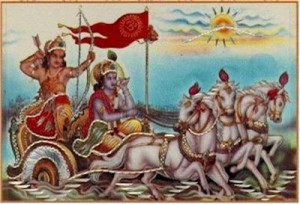
In the Iliad at the funeral of Patroclus there is an archery contest in which a bird must be shot from the top of a mast, and this is very like Drona's archery test in Mahābhārata in which a fake bird is used as the target instead.
Another Greek source tells the story of how Heracles seeks a throne through marriage and hears that Eurytus, king of the city of Oechalia, is holding an archery contest with his daughter Iole as a bride for a winner. Of course Heracles beats everybody.
Another example in Mahābhārata was the archery contest in which the hand of Princess Draupadi is the prize at her Swayamvara. The five Pandavas all attend in disguise as Brahmins. Here we see both the theme of the archery contest with a Princess bride as the prize, and also the the theme of the heroic suitor in disguise.
You may recognise this story from Robin Hood? I did! Michael Nagler wrote that the origin of this story, widespread in mythology and fairy tales, is an Indo-European contest "with a disguised hero whose invincible identity is hidden behind a mask of social inferiority, the former arousing the suitors' fear and the latter their indignant rejection."
The contest is recorded in 'A Gest of Robyn Hode", one of the oldest surviving tales of Robin Hood, printed between 1492 and 1534, but was based on much older stories. It is possible the Robin Hood stories borrowed elements from Greek myths, but it seems to me just as likely that the Robin Hood version is derived from a native English myth, perhaps of Anglo-Saxon or even of Celtic origin?
Let me know if you can shed any light on this in the comments.
Sources
Indo-European Poetry and Myth By M. L. West (2007)
Thursday, 6 March 2014
Thursday, 25 August 2011
Documentary: Jainism
This is a documentary about Jainism. Jainism is an Indian religion that prescribes a path of non-violence towards all living beings. Its philosophy and practice emphasize the necessity of self-effort to move the soul towards divine consciousness and liberation. Any soul that has conquered its own inner enemies and achieved the state of supreme being is called Jina "Conqueror, Victor". Jainism is also referred to as Shramana "self-reliant" Dharma or the religion of Nirgrantha "those without ties" by ancient texts.
Saturday, 23 July 2011
Tuesday, 3 May 2011
Friday, 8 April 2011
Buddhist perspective on Islam
"‘The religion of peace’ waged major wars to extend their borders. And the Prophet was at the forefront of such wars. For Islam by its very nature is an imperialistic religion. As such wars brought not only destruction and devastation to the enemy but depleted their own rank and file of males."
Read the rest of Mahinda Weerasinghe's article on the Sri Lankan website http://www.lankaweb.com for an interesting Buddhist perspective on Islam in the 21st century.

Taliban destroy 1500 year old Buddhas in 2001
Read the rest of Mahinda Weerasinghe's article on the Sri Lankan website http://www.lankaweb.com for an interesting Buddhist perspective on Islam in the 21st century.
Taliban destroy 1500 year old Buddhas in 2001
Thursday, 23 September 2010
Sacred Sex
VBS have made this interesting video about a Western woman who investigates Hindu customs in India and girls who are dedicated to the goddess Yellamma through sex.
Many are repulsed in the West by the poverty and inequality they see in India. But to challenge the ancient wisdom of the Hindu caste system and their enlightened attitude toward gender and sex with the simplistic Western ideologies of socialism and consumer capitalism is an unforgivable act of impertinence.
Homogenisation of global cultures is an evil side effect, or perhaps the true purpose of global humanitarianism.
Many are repulsed in the West by the poverty and inequality they see in India. But to challenge the ancient wisdom of the Hindu caste system and their enlightened attitude toward gender and sex with the simplistic Western ideologies of socialism and consumer capitalism is an unforgivable act of impertinence.
Homogenisation of global cultures is an evil side effect, or perhaps the true purpose of global humanitarianism.
Subscribe to:
Comments (Atom)
