Showing posts with label Myths and Folktales. Show all posts

Wednesday, 28 December 2022

Odin the Cuckold?


"Myths are things that never happened but always are" Sallustius
“Now, the myths imitate the gods themselves in terms of what is expressible and inexpressible, unclear and clear, manifest and hidden, and they imitate the goodness of the gods. So, as the gods have made the good things stemming from perceptible things common knowledge for all, but those stemming from intelligible things only to the wise, in the same way, the myths tell everyone that there are gods, but who they are and what they are like, they tell only to those who are able to understand.” Sallustius 

Myths can be interpreted in many ways; some are simply crude naturalistic or material stories which associate a god with natural phenomena. In addition to these Sallustius also describes Psychic myths which pertain to the activity of the soul and appeal to poets, and also Theological myths which do not pertain to material attributes and behaviours associated with the gods but convey aspects of the gods and divine wisdom philosophically. This last kind requires interpretation by the wise with specific reference to the nature of the gods in the context of the entire tiered cosmos. There are myths of this kind in which the gods behave in ways that are metaphysically problematic such as when a god kills, rapes or consumes another god - which naturally confuses those who attempt to interpret them literally. There are also certain myths which combine aspects of all three kinds of myth and can be understood by different kinds of people differently but must be dissected appropriately by the learned.

Here I shall offer an exercise in public myth interpretation, in the hope that the method I demonstrate not only illuminates the divine meaning of this particular myth, but that the method here shown shall serve as a model that others may use to aid them in their understanding of the gods and their pursuit of pious worship. 

This particular myth, which concerns Odin and his two brothers, has quite naturally confused many for centuries, since it is only recorded by Christians who have deliberately used it to defame the immortal gods, and one would be inclined to attribute the myth itself to Christian fabrication, were it not for the fact that it is recorded in similar forms by quite chronologically and geographically remote sources. 


Óðinn means “ecstatic one” and is formed with the prefix óðr which refers to the divine frenzy or ecstasy with which that god was associated. In Völuspá He and His brothers Vili (“will” as in “will power”) and Vé (“holy” or “holy space” which is cognate with with Gothic weiha 'priest' and with Old English weoh “idol” or “sacred space”) create the world through the first sacrifice of the primordial being, Ymir. This act is the foundation of all sacrifice and establishes order in the cosmos. All subsequent sacrifices recreate and participate in the same sacred moment when Ymir was slain, and from his disordered body came forth the ordered forms which constitute our world. The names of the three brothers demonstrate the prerequisites necessary for a sacrificer to perform a proper sacrifice; divine ecstasy, will and sacred space. 

This must be kept in mind when addressing the myth which is the subject of this blog post. The myth itself is alluded to in three sources; First in Lokasenna, a poem which may have been composed in the 10th century, and in which Odin’s wife Frigg “beloved / wife” is accused by Loki “lock / bound” of taking both Vili and Vé as lovers. Second, in Ynglinga saga, written by Snorri Sturlusson in the 13th century, there is an allusion to Odin’s long absence during which His brothers took over His kingdom and His wife.

“Odin had two brothers, the one called Ve, the other Vilje, and they governed the kingdom when he was absent. It happened once when Odin had gone to a great distance, and had been so long away that the people of Asia (nb. Anatolia - Snorri wrongly connects the Aesir to Anatolia by way of folk etymology) doubted if he would ever return home, that his two brothers took it upon themselves to divide his estate; but both of them took his wife Frigg to themselves. Odin soon after returned home, and took his wife back.” 
Ollerus surfing on a bone

The third source, Saxo Grammaticus' Gesta Danorum, is more complicated to interpret because the Christian author reduces all the gods to mortal humans with histories in Scandinavia and the near East. Saxo tells two or three heavily distorted stories which appear to pertain to the same original myth; in one of these, a euhemerised version of the god Ullr “glory” with the Latinised name Ollerus replaced Othinus (Odin) after the latter was banished for His rape of Rinda. Ollerus is described as a cunning wizard who could travel across the seas on a bone - He ruled for ten years, but was ultimately expelled by the returning Othinus, and killed by the Danes in Sweden. A second refers to another wizard called Mithotyn (Mit-Oðinn) who wanted to be worshipped as a god, and so seized the opportunity during another of Othinus’ journeys abroad, and led the people to pay holy observances to his name. Just as in the other story, Othinus returns and the usurper flees, but this time to Finland, and is there killed by the locals. Mithotyn apparently haunted his barrow thereafter - which is likely Saxo’s way of downplaying the significance of his cult which evidently spread to Finland. Saxo does not mention Frigg’s infidelity in either of these stories but he does in a third;

“But his queen Frigga, desiring to go forth more beautified, called smiths, and had the gold stripped from the statue (of Odin). Odin hanged them, and mounted the statue upon a pedestal, which by the marvellous skill of his art he made to speak when a mortal touched it. But still Frigga preferred the splendour of her own apparel to the divine honours of her husband, and submitted herself to the embraces of one of her servants; and it was by this man’s device she broke down the image, and turned to the service of her private wantonness that gold which had been devoted to public idolatry. Little thought she of practising unchastity, that she might the easier satisfy her greed, this woman so unworthy to be the consort of a god; but what should I here add, save that such a godhead was worthy of such a wife? So great was the error that of old befooled the minds of men. Thus Odin, wounded by the double trespass of his wife, resented the outrage to his image as keenly as that to his bed; and, ruffled by these two stinging dishonours, took to an exile overflowing with noble shame, imagining so to wipe off the slur of his ignominy.” 

From Saxo’s three mangled stories we can discern there was an original myth, free of Christian moralising and euhemerism, in which Odin was absent and during this time He was usurped by one or two other gods and that His wife Frigg was unfaithful during this absence. This then matches what Snorri preserved in Ynglinga saga and what we see in the earlier Lokasenna poem. 

Despite what pop culture representations and ill-informed online commenters may tell you, Germanic paganism was not at all tolerant of infidelity. Tacitus described the practices of the Germanic tribes of the 1st century as follows: 

“Very rare for so numerous a population is adultery, the punishment for which is prompt, and in the husband's power. Having cut off the hair of the adulteress and stripped her naked, he expels her from the house in the presence of her kinsfolk, and then flogs her through the whole village. The loss of chastity meets with no indulgence; neither beauty, youth, nor wealth will procure the culprit a husband.” 

1000 years later the Vikings of Iceland were less brutal towards such women but hardly any more forgiving. Adultery resulted in either divorce or fines, or both. So we cannot conclude that the infidelity of Frigg reflected a social tolerance of polyamory, promiscuity or infidelity since none of these were remotely acceptable. Therefore this myth must belong to the category which Sallustus termed Theological and must be explained philosophically. 

In light of my brief explication of the creation myth from Völuspá above, we can also understand the cuckold myth as relating to the danger of imbalance which threatens the stability of the sacrificial act whence the world and divine order proceeds. When one of the three essential prerequisites of sacrifice is absent; divine ecstasy, then the other two constituents expand beyond their natural limit, taking its place and thereby resulting in an abominable crime, here represented as cuckoldry - the defilement of the beloved - as well as the usurpation of the divine kingdom. The wise see the need for the balance of the three sacred components, but the unwise may proceed with a blót having only intent and a sacred space but none of the óðr and this lack produces an imbalance as shown in the myth. 

Óðr is often translated as “frenzy” “fury” or “madness” but it can equally be translated as “ecstasy”, from the Ancient Greek ἔκστασις ekstasis, "to be or stand outside oneself” and this more properly reflects the state of being one must first achieve prior to communion with the gods. As a noun the word can also mean "mind, feeling" and also "song, poetry" - the former pertaining in this context to the mindset or feeling proper to ritual space and time, and the latter pertaining to the sacred galdra “chants, songs” which Odin himself created, since he is called ein skǫpuðr galdra “the sole creator of galdra”.

There also remains the question as to the Identity of Odin’s brothers in other myths. Separate from the creation of the world, we also find in Völuspá a story of Odin and his two brothers who created mankind but here his brothers are named Lóðurr and Hoenir.


“17. Until there came three from that company, powerful and pleasant Æsir to a house. They found on land, lacking vigour, Ash and Embla, free of fate.

18. Breath they had not, energy they held not, no warmth, nor motion, nor healthy looks; breath (Önd can mean breath or spirit) gave Odin, energy (óð can mean energy but refers to a natural force present throughout nature) gave Hoenir, warmth gave Lódur, and healthy looks (the gifts of Lóðurr can also be translated as blood/flesh and good colour/hue/complexion).”
 Völuspá - Andy Orchard translation

Whether Lóðurr and Hoenir are identical to Vili and Vé is the subject of much scholarly debate but I will not cover that here, suffice to say that this is a possible interpretation. There is also a possibility, suggested by Hilda Ellis Davidson, that the three manifestations of Odin encountered by Gylfi in the Prose Edda and named Hárr “High”, Jafnhárr “Just-as-High”, and Þriði “Third”, can be identified as Odin, Vili and Vé. Each of these theories has merit, but even if they are incorrect, it does not affect my interpretation of the cuckolded Odin myth.

Wednesday, 4 November 2020

The Indo-European Sky Father


The Proto-Indo-Europeans of the Pontic Caspian Steppe and other parts of Eastern Europe in the neolithic worshipped a paternal deity who they called Dyḗus ph₂tḗr “sky father”. With comparative linguistics and comparative mythology we can learn a lot about this ancient god from whom Greek Zeus, Roman Jupiter, Irish Dagda, Vedic Dyáuṣ Pitṛ́ and Norse Odin and many others also derive. In this video I explain what we know about the god’s mythic roles relating to cattle, his relationship to other gods in the Indo-European religion and his association with different animals in later pagan religions.

New Art:


Alex Cristi https://www.artstation.com/alex314


Andrew Whyte http://basileuscomic.com/


Johan Jernhed

Sources:

Anthony, D., ‘The Horse, the Wheel, and Language’ 2007
Dumezil, G., ‘Mythe et Épopée’ 1973
Dumezil, G., ‘Mitra-Varuna: An Essay on Two Indo-European Representations of Sovereignty’, 1988
Kershaw, K., ‘The one-eyed god: Odin and the (Indo-)Germanic Männerbünde’ (Journal of Indo-European studies monograph) 2000
Lincoln, B., ‘THE INDO-EUROPEAN MYTH OF CREATION’ 1975 Matasović, R., ‘A Reader in Comparative Indo-European Religion’ 2010
Mylonas, G. E., ‘The Eagle of Zeus’ 1946
Puhvel, J., ‘Victimal Hierarchies in Indo-European Animal Sacrifice’: The American Journal of Philology , Autumn, 1978, Vol. 99, No. 3 (Autumn, 1978), pp. 354-362
Puhvel, J., ‘Comparative Mythology’ 1987

Thursday, 14 March 2019

Corn God: Endurance of pagan habits in 19th century Sweden!

An account of residual pagan practice in Sweden from 1877!

(Västergötlands Fornminnesförenings Tidskrift, Part 3. 1877. Page 60-61.)

A magazine by Västergötlands Fornminnesförening tells the interesting story of a wooden figure called "the Corn God", which used to be kept in the local church of Vånga. The journalist wrote: 

"Several years ago, Skara Museum was visited by an old man and his wife from Vånga. When he saw the figure he cried, ”Mother, here stands the corn god.” This prompted me to ask him what he knew about the sculpture. He then told me that folk in Vånga called it the Corn God, and that the farmers at spring time would smuggle him out from the church and at sunrise carry him around on the fields to attain good harvest that year. When, despite this, the crops still failed in 1826, one farmer knocked the nose off the figure on a Sunday. Shortly thereafter, the old man added, the sculpture went missing, but no one dared ask where it might have gone to.” 

Even though these people regarded themselves as Christians, they were still aware that this was something the priest didn't want them to do. They even called the figure a god. Not a very Christian thing to do! The figure itself is from late 13th century and depicts an unidentified apostle. The persona of the Corn God, reminiscent of Freyr, was imposed on it by the parishioners, but why? Montelius claimed it was not an apostle but Saint Olaf:

‘The fact that the worship of Saint Olaf [the Norwegian king killed in 1030 AD] was not, like that of the Swedish Saint Erik, limited principally to his own country, shows that there must have been some special reason for the prominent position he occupied within the northern Church … If the Christian Scandinavians looked upon him in the same way as their heathen ancestors had looked upon Thor, we can easily understand why it was so. Just as people in old days believed that Thor could grant good harvests, so even in the nineteenth century they have supposed Olaf to be in possession of the same power. Stories from the south of Sweden and from Denmark tell how the peasants were wont to drag the image of Saint Olaf round the fields after the sowing. The image of Saint Olaf in Vånga church in Vestergötland was carried round in that way, in spite of vigorous protests from the clergy. The peasants had given it the name of the “corn god”’


Montelius, O.A. 1910. The Sun God’s Axe and Thor’s Hammer. Folk-Lore 21(1910): 60-78.

This tradition is an obvious continuation of a Germanic tradition of parading an idol around the land to bestow it with fertility. The earliest source we have on this is Tacitus' Germania (98AD) in which he describes how the Germanic peoples worshipped a goddess called Nerthus whose idol toured the country in a ceremonial wagon drawn by Oxen. Similarly, the 5th century Palestinian historian Sozomenos wrote that the Goths under Athanaric had led about a wooden idol placed on a covered wagon. They passed by a tent of Goths who had converted to Christianity and demanded they pay respect to the idol and make offerings to it. He wrote that those who refused to honour the idol were burned alive in their tents. Finally, in the 8th century Einhard wrote that Childeric III, the last of the long-haired Merovingian kings (long haired rulers being a residual pagan custom) was a degenerate king who was purveyed about the country on a wagon drawn by oxen in an annual celebration, which we can infer was of pagan origin, and originally involved the ruler filling a similar role the idol of Nerthus had 700 years earlier. The touring of idols is also common in other Indo-European religions such as Hinduism. 

Montelius provides more on the enduring cult of Thor in modern Sweden:

Writing about Wärend, that old part of Småland where so much of the belief and customs of former ages still remains, Mr. Hyltén-Cavallius says, - ‘They still look upon the thunder as a person whom they call alternately “Thor” or “Thore-Gud,” “Gofar,” and “Gobonden” [The Good Farmer]. He is an old redbearded man. In 1629 a peasant from Warend was summoned for blasphemy against God. He had said about the rain,— “If I had the old man down here I would pull him by the hair on account of this continual raining.” Thus it is Thor that gives the summer rain, which therefore in Wärend is called “Gofar-rain,” “Gobonda-rain” [The Good Farmer rain] or “As-rain.” The rumbling of the thunder is produced by Thor’s driving in his chariot through the clouds. It is therefore called Thordön after him. People also say that “Gofar is driving,” “Gobonden is driving,” “The Thunder is driving.” Thor drives not only in the air but also on earth. Then they say that “he is earth-driving.” … The most noticeable trace of our country’s older worship of Thor is that “Thor’s day” (Thursday) was still in the nineteenth century considered as a sacred day, almost as a Sunday’ (Montelius 1910:76-77).

Tuesday, 8 May 2018

The Milk Drinking Serpent


Out on a Spring jog last weekend I was delighted to encounter a grass snake which I chased into a corner where I could admire it. They are very lucky in the folklore of Indo-European countries and this must be due to its former mythological status. The grass snake (natrix natrix) is a non-venomous serpent found across Europe and the Eurasian steppes where the Proto-Indo-Europeans originated.

A paper by Lender and Janssen (2014) argued that the grass snake has been sacred since the Neolithic, and owes its wide distribution due to the fact that dung heaps made by farmers create the perfect nesting environment for them to thrive. The paper shows that the grass snake spread during the Neolithic with agriculture. We can presume it spread even more in the late Neolithic, after the Indo-Europeans brought lactase persistence to the region and made cows an even more valuable resource.

Snakes got a bad name with Christianity, and the grass snake lost its special status in many places. However, in Lithuania, the last European country to be Christianised, the grass snake, known as žaltys, is still a sacred animal. In mythology, it is a household spirit, and Baltic people, particularly young couples, would keep them as pets beneath the bed, and feed them by hand. If a grass snake was found in the wild then people would try to befriend it with an offering  of milk.

A post shared by Survive the Jive (@survivethejive) on

I am assured by a Swedish friend that the same practice of offering bowls of milk to grass snakes, snok, also occurred in Sweden until quite recently. This got me wondering how widespread the practice was. 

Then I read in the Hindu myth of Mansā Devi, the goddess of snakes, the story of a girl called Behula who placated malicious serpents with bowls of milk to drink. The snakes were vicious in the legend but the snake goddess is revered and she can heal or prevent snake bites. In fact, there is even a Hindu snake festival held in July/August called Naga Panchami, during which snake spirits (Naga) are worshiped. Just as the realm of the underworld in Norse mythology is populated by serpents such as Nidhogg, Hindu cosmology relegates Naga to the lowest of the seven realms of the universe. During this festival, snakes are sometimes bathed in milk or they are fed milk, but as you can see from the image below, the snakes are reluctant to participate. Some Indians don't realise that snakes prefer bugs and rats to bowls of milk.


The notion of malevolent spirits such as elves or fairies or even animals such as hares stealing butter or milk is common in the folklore of the British Isles, but in rural parts of England, such as Gloucestershire, there are specific examples where milk is said to be sucked directly from the cow's udder by a snake. This charming tale from 1700 is a nice example:

The story begins with the unaccountable failure of an Alderney cow to yield her customary supply of milk. Hitherto the reputation of Daisy, the animal in question, had been above reproach. She had borne twelve promising calves in thirteen years, and had supplied milk with the regularity of penny-in-the-slot machine. But without warning her generous fountains ran suddenly dry, and to quote ‘our Jarge’ my principal informant ‘Her didn’t yield not spot of milk for more’n two days.’ The farm bailiff, suspecting that gipsies or tramps must have got at Daisy’s supply, instructed the cowman to keep an eye on that excellent beast, which Jorge accordingly did, with surprising results. After a brief period of vigilance the honest fellow sought out the bailiff and made his report boldly as follows; ‘l’ve been a-waitin’, and I do know what be wrong with our Daisy. I’ve seed snakes.’ Now the farm hand who sees snakes is rarely encouraged. ‘Jarge,’ however, stuck manfully to his story, which was that had come upon Daisy lying on the grass with expression of bovine bliss upon her countenance ‘same if her bein’ tickled pleasantlike.’ He made the cow get up, and then to his astonishment saw two great snakes wriggle in the grass where she had lain. ‘I struck out stick’ quoth Jarge ‘and killed ’em dead. They’ve been a-suckin’ our Daisy’s milk this three days.’
In Spain, rural peasants not only still believe that snakes will steal the milk of their cows, but also that a sickly child may be suffering because a snake has been stealing the mother's milk straight from the tit while she sleeps. The Spaniards are wont to kill snakes wherever they see them. No doubt due to Christian superstition and ignorant prejudice. The snake in these folkloric beliefs is reduced to a despised thief (maybe due to Christianity), unlike the revered serpents in the other examples, but in each case, the enduring belief that snakes drink milk must derive from some pre-Christian, Indo-European source.

Snakes, being reptiles, do not have the necessary digestive equipment to break down the lactose in milk and therefore have no interest in drinking it. In fact, even human adults couldn't digest milk until the Indo-Europeans spread their lactase persistent genes across Eurasia in the Bronze age. The Indo-Europeans had a prominent serpent in their mythology which was slain by the storm god. They also had a myth about enchanted apples being stolen from a deity by a sub-race of god-like beings. It seems likely that there was a folk belief among these early drinkers of cow and goat milk, that their treasured nutritious beverage would be stolen from them by serpents and that serpent-like nature-spirits ought also to be placated with offerings of milk.

EDIT: There is a whole paper on this phenomenon here - ERMACORA (2017)
EDIT 2019: There is also an Austrian folk story about a milk drinking grass snake. See video below.

Saturday, 3 March 2018

Indo-European Archery Contest Myth

While reading the Hindu epic Mahābhārata for the first time, I was struck by several quite obvious parallels in European literature regarding archery, which immediately aroused my suspicion of a common Proto-Indo-European origin. Not just because both Indian and Homeric sources use similar language, such as describing arrows as "winged" and bows as "shining" (West, 2007) but because of similar kinds of contests of archery.


The first simply involves the stringing of an incredibly strong bow. In Mahābhārata it is a bow so strong that it can be strung by none but Arjuna the son of Indra the thunder god. This feat Arjuna performs at a contest where he shoots five arrows into a horn. The story has the same origin as one in the Odyssey, in which Penelope, wife of Odysseus, says to her suitors in her husband's absence that she will marry any who can string his bow. All fail but Odysseus himself, who strings the bow while in disguise and thus woos his own wife. This follows an Indo-European tradition of heroic wooing.


In the Iliad at the funeral of Patroclus there is an archery contest in which a bird must be shot from the top of a mast, and this is very like Drona's archery test in Mahābhārata in which a fake bird is used as the target instead.

Another Greek source tells the story of how Heracles seeks a throne through marriage and hears that Eurytus, king of the city of Oechalia, is holding an archery contest with his daughter Iole as a bride for a winner. Of course Heracles beats everybody.

Another example in Mahābhārata was the archery contest in which the hand of Princess Draupadi is the prize at her Swayamvara. The five Pandavas all attend in disguise as Brahmins. Here we see both the theme of the archery contest with a Princess bride as the prize, and also the the theme of the heroic suitor in disguise.

You may recognise this story from Robin Hood? I did! Michael Nagler wrote that the origin of this story, widespread in mythology and fairy tales, is an Indo-European contest "with a disguised hero whose invincible identity is hidden behind a mask of social inferiority, the former arousing the suitors' fear and the latter their indignant rejection."


The contest is recorded in 'A Gest of Robyn Hode", one of the oldest surviving tales of Robin Hood, printed between 1492 and 1534, but was based on much older stories. It is possible the Robin Hood stories borrowed elements from Greek myths, but it seems to me just as likely that the Robin Hood version is derived from a native English myth, perhaps of Anglo-Saxon or even of Celtic origin?

Let me know if you can shed any light on this in the comments. 


Sources


Michael N. (1993) "Penelope's Male Hand: Gender and Violence in the Odyssey,"

Indo-European Poetry and Myth By M. L. West (2007)

Wednesday, 21 July 2010

British Folks


Photographer James Pearson Howes has created this ongoing project, focusing on the people who take part in the many strange and colourful folk events that are still held throughout Britain. The final project will take the form of three small limited edition hand bound books.

Wednesday, 26 May 2010

Folklore on Tour - Simon Costin


Most countries in Europe have places where they celebrate their bizarre old traditions. But Britain, despite its rich history, has no properly funded institution where people can research and celebrate our native traditions and vernacular arts.

Simon Costin is a remarkable individual who has devoted his life to the accumulation of information and artefacts relating to ancient rites and festivals that occur around these isles every year, some of which are centuries old.

"I intend to establish a permanent collection and national exhibition centre that celebrates and promotes the Folk Culture of the British Isles" he claims. But for now, his museum is on the road. He takes his caravan of artefacts and books around the country to various village fetes in an effort to spread information about these fascinating traditions before they are lost.

pagans


Why is it Britain doesn't already have a museum of folklore?

Simon: I suspect there are a number of reasons for our not having any kind of permanent research facility here in the UK. Firstly, the very subject of folklore is perhaps a difficult one to be represented within a museum context. It would come under the heading of 'Intangible Heritage'.
There are very few objects or representative artefacts associated with our annual customs that are not either still in use or that are only constructed for the duration of the event and are then destroyed. Things such as the figure of the Jack from May Day's Jack in the Green, Well Dressing's, Garlands, Lewes Bonfire figures, Punkie Day carved turnips etc, all only exist while the festival is happening. This presents a problem for museums. Should the objects themselves be sourced and preserved in some way? Is there legitimacy if replicas are being made?
So there is a problem from a curatorial point of view as to the kinds of objects that can and should be displayed. This may have discouraged people from tackling the subject in the past.
Another reason could be the way the media has trivialised folk customs in the press, only choosing to highlight the nation's ambivalent attitude towards Morris dancing, or reporting on the casualties of cheese rolling for instance. There have been very few in depth reports, possibly because lazy journalists find it easier to ridicule than study.


Do you think that interest in folklore is tainted by political associations?

Simon: Recently, far right groups such as the BNP, have taken to selling the CD's of various folk musicians at their meetings and attaching spurious meanings to 'Traditional' British songs. This has prompted the formation of a group called Folk Against Fascism which has gained a strong following within the folk community, who are keen to point out that they have absolutely nothing in common with the ideology of the far right.


That the playing of traditional music should be co-opted by a group such as the BNP is of no surprise and it could be argued that in Britain today, anything deemed to be a celebration of certain parts of the UK's national culture has been tainted by the far right, to the point where even the word 'British' carries negative undertows. That can be said of any national symbols which become corrupted by political groups. 
Folklore is something that is created by the people living in a specific culture and is a universal phenomena with many cross overs with other nationalities. After all, it deals with universal themes; the coming of summer and the beginning of winter, celebrations of life and memorials for the dead. The origins of that most British dance form, the Morris, are thought to have derived from the Morrish dances of North Africa. St. George was possibly a Roman or a Turkish solider who never even visited the UK. Small minded political groups who would deny this world view do so by showing their ignorance and intolerance.

*Note from STJ - Simon may not be aware that St. George was a Greek speaking Roman born 1000 years before the Turks conquered Byzantium! He was NOT Turkish! Also the theory that Morris dancing is based on dances of the Moors is not proven and is based only on the fact the words look similar. Even if the word Morris is derived from the word Moorish, that is not necessarily because the dances are related, and may be because the dance is based on a Spanish dance after the Reconquista, which celebrated the eviction of Moors from Europe...or the words may be unrelated entirely!


How is folklore relevant to British people today?

Simon: Folklore can be said to be a body of traditional belief, custom, and expression, handed down largely by word of mouth and circulating mostly outside of commercial and academic means of communication and instruction. Every group bound together by common interests and purposes, whether educated or uneducated, rural or urban, possesses a body of traditions which may be called its folklore.
Folklore is reflected in everything from the names we bear from birth to the names of our local pub; The Green Man for instance. Folklore is the slang we use, the secret languages of gangs from school children to guilds and masonic groups. It is the shaping of everyday experiences in stories swapped around the kitchen table or told on blog sites. Folklore can be a roadside shrine to commemorate a killed pedestrian or the massive public display formed when Princess Diana died. Folklore is the cry of fox-hunters as they ride across a field and the weather lore of a farmer. It is scrawled on urban landscapes by graffiti artists or woven into the fabric of churches, mosques and temples. Folklore is community life and values, artfully expressed in myriad forms and interactions. Universal, diverse and enduring, it enriches the country and makes us a commonwealth of cultures.

What is your favourite custom/legend in British folklore?

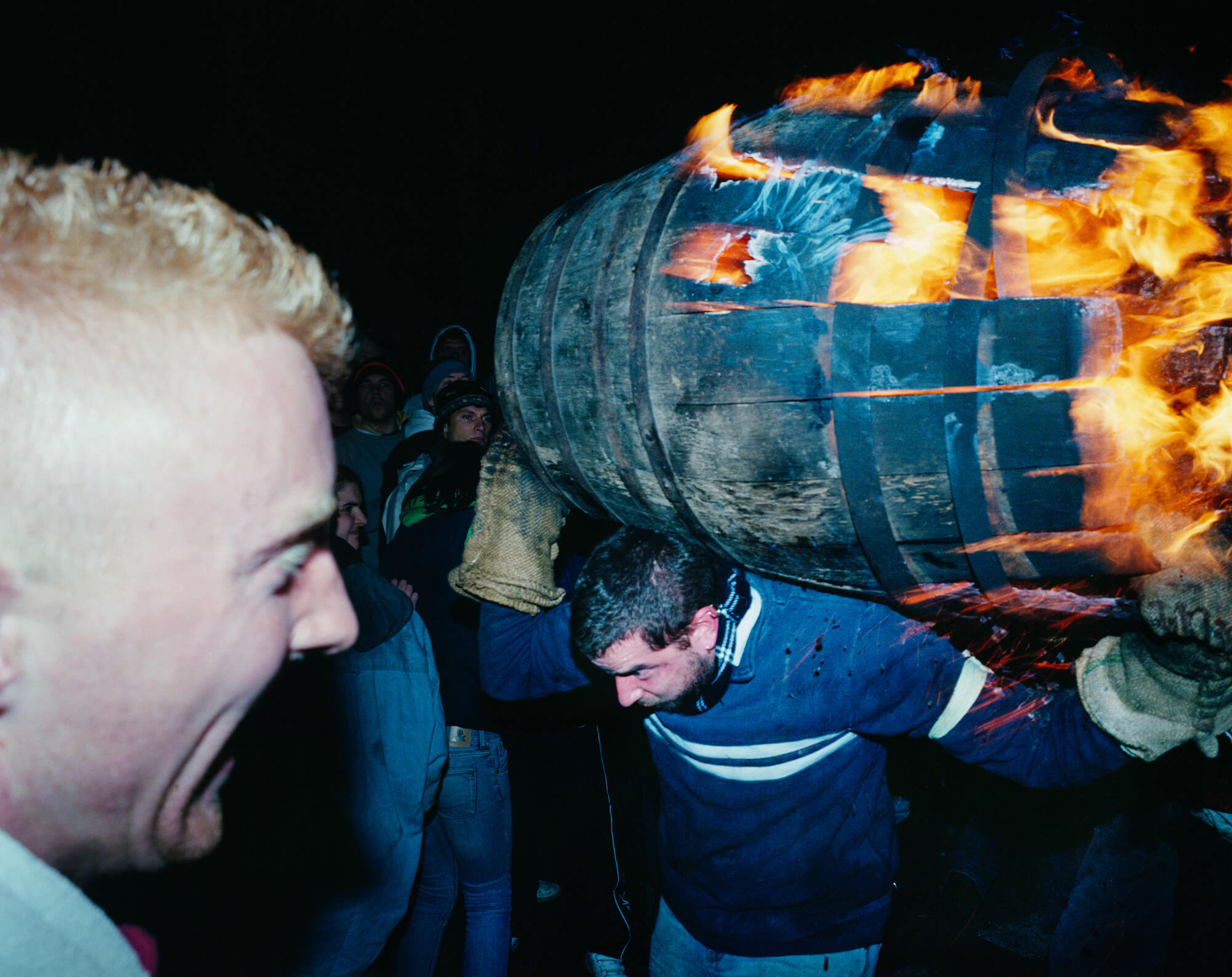
There are far too many to mention but some of my personal favourite customs would have to be Padstow on May Day, the Hastings Jack in the Green Festival, the Barrel Burning in Ottery St. Mary and Lewes Bonfire.


Can you tell us one of the most unusual things you have encountered while touring?

There was nothing particularly unusual as such but certainly one of the most heart warming was the huge amount of support the project was shown from the many thousands of people who visited the caravan and the way that everybody said the same thing, 'Why is it that British people don't seem to value their native customs and traditions like other people in Europe do?'


So what plans do you have for the museum in 2010?

I'm planning a series of mini museum exhibitions which would ideally be situated in various houses which are open to the public. The first will be at Port Eliot in Cornwall, where they have the Lit Fest in August. Each show will deal with the folklore of the region and take one or two of the festivals which take part in that area and look at their history and development.

Then at the end of May, opening on the 29th, is an exhibition featuring work by the various artists who have been involved with the museum project to date such as Jonny Hannah, Mark Hearld, Clare Curtis, Riitta Ikonen, Tamsin Abbot etc. This will be at the Hexham Art Gallery for the Folkworks Hexham Gathering.

The caravan will be appearing at the Ditchling Fair on the 19th June.

There's to be a big folk concert in mid October probably at the Union Chapel although this has yet to be sorted out. This will be done under the museums music umbrella.

There are also going to be a series of mini museum exhibitions opening across the UK, the first being at Port Eliot in Cornwall on 3rd April. Then there's an art show at the Hexham Gallery on May 29th which runs for a month. The caravan will be making an appearance at the Ditchling Festival and the Compton Verney Summer weekend. In October there will be a large concert to raise awareness of the project in London.

Check out The Museum of British Folklore website to learn more

http://museumofbritishfolklore.com

Tuesday, 13 April 2010

Interview: Tharaphita - Estonian Pagan Metal

Ank - photo by AP Childs


-->

Were the band always pagan?
Kaido: Absolutely
Ank: It started in 1993 when the religious movement was a very hot topic. There were bands like Dark Throne and we wanted to do something similar but to our own taste.

How do you incorporate Estonian folk culture into your music?
Ank: It's more like it's subconscious.
Kaido: We don’t take stories directly from folklore, it's more like we use symbols. We have a song called Merekurat, the sea devil. This is not a story of a spiritual being. It is a story of a so called sea devil which would be a symbol of the beast that the Estonians are so well acquainted with. It has taken many lives.


So are you talking occultism here?
K: No.... forget “the beast”. It’s the so called beast, the power of nature that works on the sea. There is a saying in Estonia, “the sea gives and the sea takes.” This basically means that it can provide food but sometimes with a very high cost of lives. The song of the sea devil is not about a man with horns beneath the water, it's giving respect to the power of nature.

Ank - photo by AP Childs
It addresses the nautical and spiritual history of Estonia?
K: Yes. They couldn’t live without the sea but they also had to be wary of it. It’s a good symbol because it's not about us as mortals living here and gods in their pantheon. It's all mixed, entwined in everyday life. It is in us and it surrounds us.

Can you tell us about the Estonian god, Tharaphita, whom you are named after?
Kaido: He has the same roots as Thor. One thing you must understand about Estonian mythology and culture is that there is very little that we know about what people thought and what they wrote down because during all the wars that have happened here, lots of people were killed and couldn’t pass on their verbal knowledge.

As you may know, both the poetic and prose Edda (the principal texts of Norse mythology) were written centuries after the Viking era and by Christians. Nothing like that happened for Estonian folklore. Nobody wrote it down until about 1000 years after the Viking era. You can make the comparison between Thor and Tharaphita, but it doesn’t really make sense, because there is not so much information from our pagan times. In a way that’s good, because as a result there are no set images of any deities. It is all obscure. Set images can be open to personal interpretation, which people use to their own advantage. We have freedom of interpretation. This leaves a lot of room for a personal voyage in the maze of our inheritance. Its hard to put into words, because there are so few that can be said with certainty.

It’s instinctive perhaps?
Kaido: In a way yes. When we talk about being inspired by paganism, you can only relate to what you feel inside and your relationship with your surroundings.

How do you feel about the black metal bands whose interpretation of Nordic paganism has led them to controversial politics?
Ank: Everyone knows what he is doing; we do it our own way. We are not against other people’s views.
K: When you say you don’t like someone else because they have made a stand, you are forming an opinion. You force yourself onto their world. You must allow them to do what they think is best. Maybe it is best, everything has its own purpose.

Does it annoy you, being associated with things like church burning?
K: When something like that happens in a society, especially when it happens in a wave that a lot of people sympathise with and want to participate in, somewhere, something is quite wrong. Maybe it has its roots thousands of years back, maybe it doesn’t. Maybe its just a couple of pissed off kids. When something like that happens, there is a reason. It's not up to us to say It's good to burn any building, but is it good for society to let it come to that? Rather than being a problem in itself, it is probably the result of a problem.

Do you think it true that in Estonia, folk practices have remained more active than in Western Europe?
K: Baltic countries like Lithuania were the last to submit to the church. Lithuanians still had a strong folk culture when Estonia was already under various Christian rulers as a result of the crusades.

photo by Tom Rowsell

How do you see yourselves in relation to the black metal movement?
Ank: Yeah, we have black metal roots. Musically we are black, but not so much lyrically. We have dark and aggressive lyrics but we are not Satanists. My lyrics come like a flow sometimes. It cannot be controlled.

photo by Tom Rowsell

What do you think of Tallinn music week?
Ank: for us it is unusual. The other bands here are totally different from us. We usually play with other metal bands. We are grateful that it is Tallinn music week.
K: It is excellent that this kind of festival is happening in Estonia. It is something we have been missing for half a century. We have been cut off. It's been almost 20 years since then end of occupation and there are still young bands who have no idea how to get a good recording and how to market it. We are comparatively old dudes, although we don’t feel very old. It’s excellent that they could get the knowledge to do well in 2 years while it has taken us 15 years. For some underground bands here, we are a role model.
Ank: (laughing) Still young musicians...