A free preview episode of Radio North Sea International is now available on Survive the Jive podcast.
There is no more potent, holy and enduring symbol of Western man, than the barrow! It links the Iliad, Beowulf, the sagas, the Celts, Germans, Scythians and slavs! 6000 years of excellence!
Anglo-German relations were good in the 19th century up until the Boer war, and have been tense ever since. In this talk, historian, Tom Rowsell , explains the deep roots the two nations share in common; the Anglo-Saxons, the Celts, the Bell Beaker folk, The Single Grave Culture and the network of Bronze Age cultures in Northern Europe who traded with each other and shared mutual descent from the Corded Ware culture. The talk was delivered to students in Hamburg in February 2026.
President Donald Trump descends from several Celtic and Germanic tribes from Germany, Britain and Scandinavia. In this video I describe the sources of his ancestry; the Gaels, Vikings Suebi and other warrior peoples who made him a fighter.
Part two of my Hyperborean Odyssey is in Shetland, Britain's northern most islands and the alleged site of the legendary Thule described by the ancients. I visited the archaeological site of Jarlshof which has Bronze age round houses, Iron-Age wheel houses, a Pictish broch and the largest Norse settlement in the British Isles. Shetland was under Nordic rule up to 1472 so it still has some strong cultural ties to Scandinavia despite also having a rich Pictish history.
Why did Celts of the British Isles build over 4000 hill forts during the Iron Age? The answer may have something to do with the conflict between those Bronze Age cowboys who maintained traditional pastoralist transhumance lifestyles, and those in the forts who depended more on arable farming. This can also explain why British Celts were the most lactose tolerant people on Earth at that time. In this documentary I visited Barbury Castle in Wiltshire, Castle an Dinas in Cornwall and several other magnificent Iron Age hill forts.
Sources:
Patterson, N. et al. Large-scale migration into Britain during the Middle to Late Bronze Age. Nature 601, 588–594 (2022)
Valdez-Tullett A. Sheep in Wealth’s Clothing: Social Reproduction across the Bronze Age to Iron Age Transition in Wiltshire, Southern England. European Journal of Archaeology. 2017;20(4):663-681. doi:10.1017/eaa.2016
Art created for Survive the Jive by Christian Sloan Hall and Alex Cristi. Other images are owned by their respective creators as credited on screen.
Cornwall, or Kernow in the Cornish language, was once part of an independent Celtic kingdom called Dumnonia. In this documentary we travel 2000 years back in time to the Celtic iron-age village and roundhouses of Carn Euny. The Iron Age village preserves some of the oldest Celtic architecture, as well as a mysterious passage and chamber called a fogou and a sacred well which has been in constant use since pagan times. We shall also see reconstructed Celtic roundhouses from Butser ancient farm to get an insight into the daily life, culture, religion and economy of the Ancient Britons.
Sources:
- Berresford Ellis, Peter., ‘The Ancient World of The Celts’ (Constable, 1998)
- Borlase “The Natural History and Antiquities of Cornwall, and Observations of the Scilly Islands"
- Christie, P., et al (1978). The Excavation of an Iron Age Souterrain and Settlement at Carn Euny, Sancreed, Cornwall. Proceedings of the Prehistoric Society, 44, 309-433.
EDIT: Since writing this blog post a thorough genetic study of ancient British and Anglo-Saxon samples has been published by Gretzinger et al (2022). The data in the supplements show that the people of Devon are about 37% Early Anglo-Saxon (CNE), 35% Iron Age Briton (WBI), and 26% Medieval French (CWE) meaning the Germanic ancestry is their dominant component. Cornwall is estimated to be 21% CNE 51% WBI and 26% French
There are some people who erroneously insist that Devon, like Cornwall, was founded on a Celtic rather than English identity. One such individual is attempting to rewrite local history on Wikipedia to claim that Devon is not English. That is simply not the case. Devon has more Anglo-Saxon DNA than Cornwall does, and has not preserved any Celtic language at all. In fact the Devon dialect uniquely preserves some archaic Old English elements which have been lost elsewhere, about which you can learn in the video below.
Ireland has a rich and fascinating ancient history; from the great megalithic structures of the Neolithic, like Newgrange, to the spectacular gold jewellery of the Indo-European Bell Beaker folk, the weapon hoards of the Irish Bronze Age, the enigmatic La Tene Celtic art of the Iron Age and the intricate knot-work of the Hiberno-Norse in the Irish Viking age. I look at all of these in this brief account of the history of Ireland, and then I discover a gothic castle called Knockdrinn, in which my ancestors lived, and which local people believe to be haunted. Finally, I read some spooky accounts of the ghostly creatures of the castle taken from the folklore collection at University College Dublin.
Celts are known for tartan, faeries, druids, bagpipes and the British Isles - but the origins of the Celtic culture lie in the Unetice culture of Bronze age central Europe and it spread out with the Hallstatt and La Tène cultures. In this history documentary, I look at the genetic evidence for the spread of Celts into Britain and Ireland in the Iron Age, as well as the Galatian Celts into Anatolia. Then I examine some Celtic archaeological artefacts such as the Gundestrup cauldron and the Marlborough bucket and I introduce the viewer to some of the basic aspects of Druidry and the Indo-European religion of the ancient Celts.
Celtic chariot warrrior art by Alex Cristi
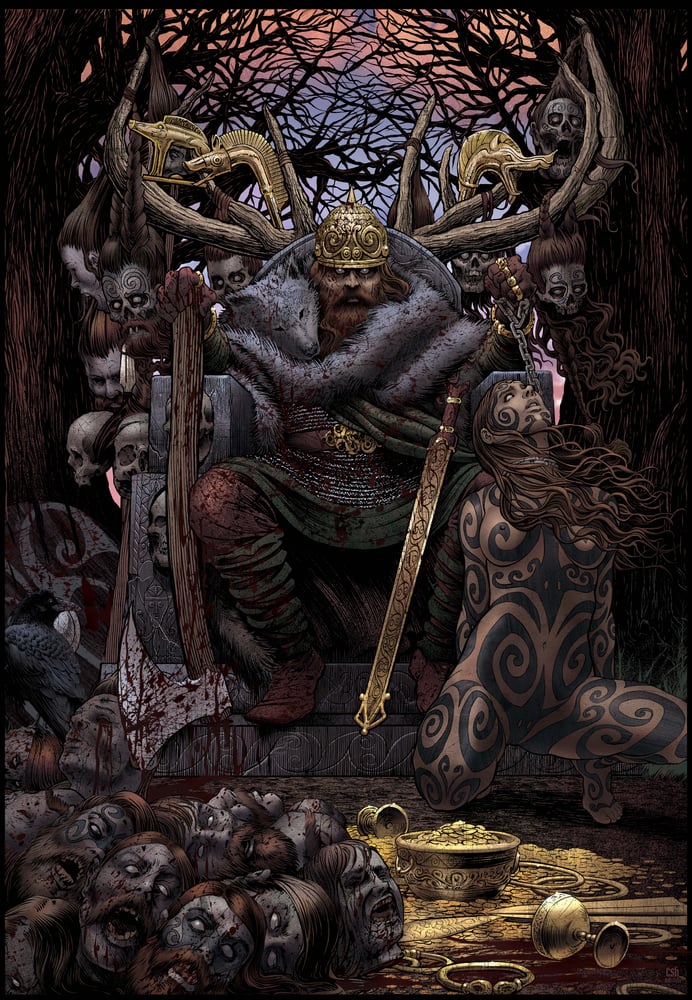
Aristocratic Iron age Gaul and Caledonian Death Lord art by Christian Sloan Hall
Now begins Eastermonth! This is an entire month which the Anglo-Saxons devoted to the goddess Ēastre. Her name is not, as some erroneously claim, related to the Semitic goddess Ishtar, nor to the hormone estrogen, but is in fact Germanic. Ēastre, or as she is known in modern English, "Easter" was equivalent to the continental German goddess Ostara and both names are derived from that of the ancient Indo-European goddess of dawn *H₂ewsṓs (→ *Ausṓs), from whom the Vedic goddess of dawn, Ushas, is also derived. One of the holy names of Ushas was Bṛhatī (बृहती) "high" which is cognate with Proto-Celtic *Brigantī meaning "The High One", and the name of a British goddess Brigantia (Brigid). The Greek goddess Ēōs, Baltic goddess Aušrinė and Roman goddess Aurora are all etymologically derived from the same IE word and likely from the same PIE goddess.
The month is attested by Anglo-Saxon monk Bede, who said feasts of the goddess were celebrated in April, but when we can only guess. There is no reason to believe it was on the exact day Christians now celebrate Easter. Some aspects of Christian Easter resemble paganism because the symbolism of eternal life and rebirth are important for both. The Roman pagans had a flower festival called Floralia on 27th April which may well have had equivalents in Britain, but surely the largest celebration for the dawn goddess was at the end of the Easter month on the eve of May day which heralds the dawn of summer. I consider May day, or specifically the night before it, to be the climax of Eastermonth and a holy celebration to this sacred goddess. I have covered the diverse celebration of May day around the world in a video already (see link below). The photo above is shows the May queen in Devon in 1955, a young girl who symbolises the dawn goddess Easter who heralds the start of Summer, and the May pole which is a phallic fertility symbol.
I would also speculate that since, in Celtic and Germanic countries, the folk culture around May eve has focused heavily on sexuality, even in recent times, usually of an unbridled sort normally prohibited by Christian morality, and since the cult of Aurora was often invoked in sexual poetry, we might well assume that the cult of Easter had a heavy emphasis on the sexuality and fertility of young people, especially women. The Greek Eos was cursed by Aphrodite with unsatisfiable sexual desire causing her to abduct handsome young men - a promiscuity very reminiscent of an account of May eve among the English in the early modern era by a puritan who wrote that on that night "Scarcely a third of maidens going to the woods returned home undefiled", similar account are recorded in Ireland.
The fecundity of the earth is tied explicitly to that of the wombs of nubile girls of the community. For this reason a sort of transgressive sexuality becomes temporarily permissible due to the divine associations of sex on this night.
This map show's Greek geographer Strabo's account of the migration of the Tectosages, one of three Celtic (Gaulish) tribes, descended from the Volcae tribe which originates in Germany, that migrated East to Phrygia to form the Galatian Celtic group. Even Saint Paul wrote that there were Celts there in his Epistle to the Galatians ("you Celtic goyim don't need to get circumcised") so their presence is well attested. But now we have their DNA! (one sample at least)
The Iron Age sample called Anatolia_IA_MA2197 can be modelled as 57% Bell Beaker derived (signifiant because although Beaker folk didn't speak Celtic, we know the Celts were Beaker descended), it also shows a strong affinity with a sample from the Halstatt Proto-Celtic culture of Austria.
Interestingly, if we assume the Hallstatt and Urnfield people to be genetically similar to the Celts who expanded East and West in the 3rd century BC and to the ones who brought Celtic languages to Britain in 6th BC we can see that in all the modern day "Celtic" regions, their genetic influence is small (UK, Brittany and Ireland) to negligible (Galicia - where there are greater amounts of medieval Arabic admixture than Iron Age Hallstatt).
While Germanic language is widely agreed to have emerged around 3000 years ago in Northern Denmark, amongst a people who were genetically like modern Danes, and then to have spread from 750BC as neighbouring peoples adopted the language for some reason, it is harder to pin point who the first Celtic speakers were or explain how their languages got to Britain.
As I have said in videos, the modern British genetic profile emerged 4500 years ago with the arrival of the beaker folk from Holland, but these people did NOT speak a Celtic language, as linguists agree Proto-Celtic isn't that old (maybe 3000 or 3500 years old). This means that either:
a) The peoples of the British Isles adopted a Celtic language due to trade with continental Celts b) A small Celtic elite took over Britain and Ireland and somehow changed the culture and language but not the genetics c) A continental population of Celts took over Britain and Ireland and did change the genetics, but this change is only very slight because they were already closely related to the people of the British Isles.
Archeologically, the Hallstatt culture of the 8th to 6th centuries BC, is seen as the first proper Celtic material culture. The two black stars on the PCA chart above, made by Eurogenes, represent two skeletons from the Hallstatt culture, and it can clearly be seen that one plots among the Dutch and one among the Northern French, but neither among modern "Celtic" areas. However, the purple Iron Age Celts on the chart are between the older Bronze age British samples and the Halstatt samples indicating there WAS an invasion of continental Celts to Britain who were related to these Halstatt samples and that they changed the DNA of Britain and Ireland.
Modern English people plot between these purple Iron Age Celts and the red Anglo-Saxon samples, but there is always the possibility that other 5th century Anglo-Saxon invaders from Frisia, Holland etc would have plotted like modern Dutch people just as the much older Halstatt sample does - thus making the job of distinguishing "Celtic and Germanic DNA" very complicated! Especially when you also see that the Anglo-Saxon samples are closer to the Bronze Age Britons than the Halstatt Celts are.
EDIT: Eurogenes actually said there may have been as much as 10% admixture from a Celtic source in the iron age.




.svg/2052px-Volcae_Arecomisci_and_Tectosages_(migrations).svg.png)

