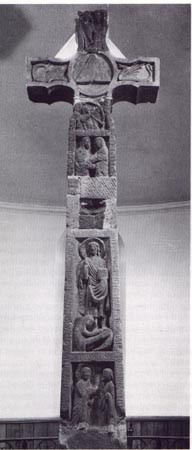
"A shift from one religion to another is not like taking off one hat and putting on another. It is more like putting on a new head" (Robert Bartlett).
Thomas Rowsell
Robert Bartlett’s statement is intended as a warning to historians who downplay the significance that religious conversion can have on a culture.
One may interpret it as an argument that a nation cannot convert to another religion, the cultural values of which may have far reaching social and political significance on all levels of society, without becoming a new and different nation in the process. With specific reference to the conversion of Anglo-Saxon England, from Germanic paganism to Catholicism between the 5
th and 6
th centuries, I will explore this statement and consider its validity in an effort to better understand the two cultures involved.
Migration routes of the "English" peoples.
While Christianity is still practiced to this day, and information on its values and history are readily available, the details of the pre-Christian religions of Northern Europe are comparatively obscure. What we know about
English paganism and the culture of those who practiced it is primarily sourced from speculative interpretation of archaeological finds combined with contemporary or near contemporary Christian literary sources like Bede’s Ecclesiastical history of the English People (8
th century), Beowulf (8
th-11
th century) and The Anglo-Saxon Chronicle (9
th century).
“..the representations of pagan religion all come from hostile Christian sources, predominantly of a missionary nature. To seek to understand native paganism from missionary literature is a little like attempting to form a picture of twentieth-century British socialism from the speeches of Margaret Thatcher.” (Bartlett: 1998, p.56)
Despite the biased nature of the sources, one may reach some conclusions on the ideological nature of the pagan religion by their recorded attitudes toward the new faith as well as the potential motives for conversion. The importance of the monarchy’s role in the conversion must not be underestimated despite the fact that the roots of monarchy are inherently anti-Christian in nature, with kings and noblemen tracing their heritage back to the war god Woden.
“The first chieftains are said to have been the brothers Hengist and Horsa...They were the sons of Wictgils, whose father was Witta, whose father was Wecta, son of Woden, from whose stock sprang the royal houses of many provinces.” (Bede: 1990, p.63)
These Pagan god-kings were proud of their heritage but were happy to marry Christians if it was politically advantageous, as it was for King Ethelbert in 597AD. He received his Christian wife, Bertha, of the Frankish royal house; on the condition that she could still practice her faith and that she would be accompanied by Bishop Liudhard (Bede: 1990, p.75)
The fact that pagans and Christians existed in the same household as well as the same marriage bed lends weight to the argument that early medieval England was a multi-faith society but the arrival of Christianity may not have been recognised as the arrival of an entirely new spiritual ideology, as King Redwald’s misinterpretation of monotheism demonstrates.
“... he tried to serve both Christ and the ancient gods, and he had in the same shrine an altar for the holy sacrifice of Christ side by side with a small altar on which victims were offered to devils.” (Bede: 1990, p.133)
Perhaps it was this willingness to incorporate the perceived power of new deities into their existing pantheons which enabled Christianity to get a foothold in Northern Europe. The wealth and power of Rome attracted barbarian merchants who may have been influenced by the new faith. This was the case for the Swedes, whose religion was similar to that of the English.
“..the Swedes ‘decided to enquire by lots whether their gods were willing to help them....after the lots had been cast, they were not able to find any god willing to bring them aid...’ Finally, some of the Swedes who had traded in Western Europe suggested trying ‘the god of the Christians’. (Bartlett:1998, p59)
Though it is the case for these Swedish pagans, it cannot be said that all pagans were as willing to dabble in the mysticism of Christianity, particularly as many converts were persecuted.
“Converts to Christianity were frequently reproached by fellow pagans for abandoning ‘the laws of their fathers’ or the ‘laws of the father-land” (Bartlett: 1998, p75)
These pagan traditions permeated not only the spiritual dimension but also the social hierarchy of English societies, so that even when the church succeeded in converting a king, rebellion and relapse into paganism were still a threat.
“Not long after Earpwald’s acceptance of Christianity, he was killed by a pagan named Ricbert, and for three years the province relapsed into heathendom.” (Bede: 1990, p.132)
Even the converted royal houses themselves were prone to relapse. This was the case for the Christian King Sabert of the East Saxons, who left his three pagan sons to inherit his kingdom. The sons believed that the Eucharist would strengthen them, but refused to be baptised. Bishop Mellitus would not allow them to take the bread and water and so he and his followers were banished from Essex. (Bede: 1990, p.112)
Bede also tells of how king Edwin of Northumbria converted to Christ as did Coifi, the high priest of the pagan temple there. Bede’s telling of the story depicts Coifi as an antagonist who leads the way for Christian conversion, “I submit that the temples and altars that we have dedicated to no advantage be immediately desecrated and burned.’ (Bede: 1990)
One would imagine that if both the high priest and the ruler of a kingdom were to abandon the old religion, it was surely doomed. It is of interest therefore, that Edwin’s successors reverted to
Anglo-Saxon paganism as though these events had never occurred.
“As soon as they had obtained control of their earthly kingdoms, however, both these kings apostatized from the faith of the kingdom of heaven which they had accepted, and reverted to the corruption and damnation of their former idolatry.” (Bede: 1990, p.143)
The causes of conversion and relapse were varied, but similar in each case. While conversion may secure stronger allegiances and trade routes with Southern Europe, it may also aggravate the native aristocracy who were prone to violent rebellion and could have considered Christianity to be a sign of weakness in their leader.
“Sigbert, king of the East Saxons, was murdered by his kinsmen, and when they were asked why they had done it, they had no better answer than that they were incensed ‘because he was too apt to spare his enemies and forgive the wrongs they had done him.’ Barbarian society imposed a positive duty of revenge on all men,” (Mayr-Harting: 1991, p.20)
The clergy could depict victory or defeat in battle as evidence of the power of the Christian God. This strategy was particularly effective in the case of King Edwin. “The king ...promised that if God would grant him life and victory over... his enemy..., he would renounce his idols and serve Christ.” (Bede: 1990) This was a bold promise, and one that risked backfiring if misfortune were to befall the Christian converts, as it did to those in Essex in 665AD when a plague caused a relapse into paganism (Bede:1990).
Widespread destruction of temples and idols, as executed by Earconbert, King of Kent in 640AD (Bede: 1990), is likely to have been a more powerful and enduring method of converting the heathens and preventing relapse.
Upon hearing of the relapses and failed conversions in England, Bishop Aidan of Ireland, a great stronghold of Christianity in North-Western Europe, recommended a less aggressive method of persuading pagans to convert, as related by Bede in the ecclesiastical history.
“You should have followed the examples of the Apostles, and begun by giving them the milk of simpler teaching, and gradually nourished them with the word of God until they were capable of greater perfection and able to follow the loftier precepts of Christ.” (Bede: 1990 p.151)
Though in some cases the rulers of England may have heeded Aidan’s words, the conversion of a leader to the new faith would undoubtedly have had negative consequences for any heathens living in that region, as it did for those in Kent after King Ethelbert’s conversion in the late 6th century. Though he did not force pagans to convert, he showed “greater favour to believers, because they were fellow citizens of the kingdom of heaven.” (Bede: 1990, p.77)
The process of conversion was not only instigated by missionaries from Ireland or Rome. It could also, as previously mentioned, come from within the royal house. Christian royalty could be subject to pressure from the English church, or even from Rome directly, to convert their kinsmen. Pope Boniface’s letter to Queen Ethelberga, regarding her pagan husband, unapologetically manipulates the institutions of both marriage and monarchy in an effort to pressure her into converting the King. (Bede: 1990, p.124)
The Pope’s Letters that Bede included in his ecclesiastical history show the military and political power Rome was able to exert on the English populace through the monarchy. A letter from Pope Gregory to Abbot Mellitus, written in 601AD, requests that the temples of the English idols are not to be destroyed, but instead only the idols destroyed and replaced with altars, holy water and relics.(Bede: 1990, p.92) Bede may have intended the letter to be evidence of a peaceful conversion but it seems likely there would have been those who opposed the destruction of the idols.
Legal and military power had to be exerted to deprive the people of their old ways. The preservation of the pagan religions of Europe depended on oral traditions of storytelling, folk customs and songs that were passed down through generations. “One thing that Christianity did offer that must be mentioned at once – a thing that, in the main, the older religions did not – was literacy,” (Bartlett: 1998, p56)
Without written histories to preserve the old ways, they were more vulnerable to the effects of persecution. Christianity thrives in such adverse conditions; its message is preserved in the Bible. This was not the case for paganism. English law was implemented in such a way that favoured the converted over the heathen and also made practice of the English religion dangerous.
“Injunctions against tree worship, well worship and stone worship begin in England in the first generations of the new Church and continue in an unbroken series down to the Reformation, and beyond.” (Bartlett: 1998, p71)
The monarchs who were willing to submit their people to these injunctions did not decide to do so lightly. Indeed, there are some instances when instigating conversion may have put their very lives at risk. Ultimately, however, we can be sure that the benefits outweighed the dangers to these Kings, or they would never have converted.
“..it was worth having the notice of the pope and being drawn closer to the civilised and wealthy axis of Mediterranean life. More particularly... the Christian god seemed to serve his adherents well in battle.” (Mayr-Harting: 1991, p.63)
One may compare the difficult decisions that the Anglo-Saxon rulers had to make to those of modern Sheikhs in the Middle East, whose loyalties to the conventionally Islamic populace are sometimes at odds with their desire to play a more significant role in international commerce and the global political stage. While conversion triggered rebellions among the general populace and even the aristocracy, the kings had economic and political interests to consider. They could not pass up on an opportunity to establish a more lucrative relationship with the Christian nations of the Mediterranean.
“The church offered a symbolic and factual connection with pan-continental politico-cultural norms.” (Urbanczyk in Carver: 2003, p.16)
The wealth of the South was not the only appeal of Christianity to the previously pagan rulers. The literary nature of the religion required a literate priestly cast, fluent in both Latin and English, who required the protection of the monarchy to be able to spread their religion without fear of persecution. The relationship between the clergy and the monarchy has therefore been close from the very beginning. “From the start the church acknowledged its helplessness without the support and protection of kings.” (Mayr-Harting: 1991) The kings were aware of this but stood to benefit as much as the clergy. The new era of bureaucracy that the pan-continental religion ushered in, provided a means for the monarchy to secure its power.
“The advice and legal knowledge of churchmen enabled kings to show forth their kingship in a new way by the issue of codes of law, which became increasingly sophisticated; churches provided honourable resting places for kings and queens, and ensured the permanence of their fame.; the fortunes of individual kings could be radically affected by their association with saints,” (Mayr-Harting: 1991, p.249)
Though the benefits that Christianity offered the rulers of England were enough to encourage them to convert and cause their kingdoms to follow suit, they were not sufficient to cause a complete overhaul of the pagan culture. Even today, the days of the week are named after the pagan gods and the dates of the Christian festivals are fixed upon dates already associated with ancient pagan celebrations (Hutton: 2000:285).
As mentioned previously, the church was keen to incorporate certain aspects of the pre-Christian culture in an effort to minimise cultural disruption and the likelihood of pagan rebellion and spiritual relapse. This was important to the process of conversion but also allowed for religious misinterpretation and the preservation of stubbornly enduring cultural habits. “By the ninth century kings underwent a Christian ceremony of consecration and anointing, but they continued to trace their genealogies back to Woden.” (Mayr-Harting: 1991, p.220)
It can be argued that the enduring influence of Woden on monarchic inheritance was not so much the residual pagan culture corrupting the new Christian one, but rather the continuation of a political tradition that saw a close relationship between state and religious authority.
“In pre-Christian societies individuals who aspired to dominating social positions could strengthen their power by combining the functions of military political leadership with religious leadership.” (Urbanczyk in Carver: 2003, p.19)
Not only was Roman Catholicism in England influenced by the existing cultural traditions of pagan England, but it had also previously been influenced by Temple Judaism and by Roman paganism. While human sacrifice was prevalent throughout most of pagan Europe (Bartlett :1998) it had also been practiced in temple Judaism.
“Christianity is the direct descendant of a religion – Temple Judaism – that had given a central place to animal sacrifice...This was not a feature it perpetuated ...Yet Christians were rooted in a sacrificial tradition that left an imprint on their language and thought. Although no animals or humans were to be sacrificed to God, the terminology and concept of sacrifice was not abandoned but deepened.” (Bartlett: 1998, p.64)
Though the pagan traditions of human and animal sacrifice had been abolished, the converted English were likely to have been familiar with the nomenclature of sacrifice and sacred blood that is associated with Catholicism. Sacrifice may well have been the most significant spiritual act that a pagan could make. It is an activity that sunk from a sacred act to one of barbaric ignorance in the minds of the converted populace, but through the terminology of Christ’s sacrifice and the Catholic practice of making offerings to Saints, it has endured into the Christian era.
“The distinction between Christianity and paganism is not between a non-sacrificial religion and a sacrificial religion but between two rival conceptions of sacrifice.” (Bartlett, 1998, p.66)
Such evidence of pagan influence on Christianity defies Bartlett’s statement in the title of this essay and could lead one to believe that the process of religious conversion was an insignificant occurrence to some people. But while the pagan reactions to the new religion were varied, some regarding it as an invasive ideology, others merely as the introduction of yet another deity to their pantheon, the way that Christians regarded the pagans was uniform. “Paganism was indeed understood by Christian thinkers as worship of demons.” (Bartlett: 1998)
So previously law abiding serfs were rendered heretics and witches as a result of the conversion. As a result, it is safe to assume, that many of the old folk customs associated with paganism were destroyed. Though, conversely, Christianity also provided a new legal framework which preserved many of the historic customs of freemen and serfs, which may have previously been vulnerable to shifts in monarchic power. It was the arrival of Christianity that initiated the process by which folk customs became the king’s law (Fletcher, 1997, P118).
The era when these conversions were taking place was one of significant cultural upheavals. Both paganism and Christianity were malleable ideologies, in a state of flux. Pagans were adapting to the arrival of the new Eastern religion, some by incorporating it into the existing spiritual ideology, others through militant rebellion.
The Christian religion was the subject of much debate around Europe, hundreds of years before the arrival of the Cathars and later the Protestants, the Roman Catholic Church had to suppress Arianism in order to protect the notion of the holy trinity and its ideological and political hegemony across Europe. With Arianism being particularly popular amongst the Germanic peoples, it is little wonder that Rome was keen to bring Britannia, the old Roman colony seized by warlike Germanic tribes, back into their influence before Arianism could take hold. Pope Gregory was well aware that by the 590’s, England was the only successor state that was yet to adopt Christianity (Fletcher, 1997, p.114).
The conversion had both positive and negative implications at all levels of society, and while we can see how the religions influenced each other, it surely caused a significant cultural upheaval in England. Bartlett said it was more like putting on a new head, than a new hat, meaning that the conversion was not merely a superficial change in spiritual aesthetics, but an entirely new cultural tradition. The arrival of the clergy meant an increased influence of foreign power, but it also presented an opportunity for freed slaves and serfs to climb the ranks of society, through devotion to the new God. It created a new social hierarchy, based less on war and heritage and more on literacy and learning.
“The matter of cult, and especially liturgy became the domain of properly prepared specialists who had a monopoly of the interpretation of reality.” (Urbanczyk in Carver: 2003, p.22)
The new hierarchy installed was perhaps the most significant change brought by conversion. The conversion was far from a linear process and is complicated further by the reintroduction of paganism from Scandinavia during the Viking age, beginning in 793. These complications require a clear definition of what is meant by a Christian people. When defining a people as Christian, it is not necessary in this instance for them to follow the word of Christ or even to understand it properly; it can be more simply identified as an absence of pagan worship as the result of Christian law or teaching.
Regardless of what measures the church took to soften the blow of conversion, it still signified a major ideological and cultural change for the people of England. The centres of worship were destroyed, the religious authorities were replaced and the new religion was communicated in a language that few people understood. The ancient practices of sacrifice and divination were abolished (Bartlett: 1998) and though some pagan habits remained, such as the oral tradition of storytelling, overtime many of them were also brought into question. By 797, Catholic monks in Lindisfarne regarded the Viking raids as evidence of God’s anger at them for listening to heathen poems at dinner. (Mayr-Harting: p225)
The conversion from paganism to Christianity was by no means clean cut, but despite this I believe it is more accurately compared to putting on a new head with new ideas allowing for the evolution of a new type of society, rather than merely the putting on of a new hat, creating only the outward appearance of change. The shift from paganism, with ritual sacrifices and kings descended from gods, to Christianity with its literary tradition and kings devoted to God and the Roman Catholic Church, was immense. Though the Anglo-Saxons remained a war like people, divided by tribal loyalties, their conversion to Christianity was a step toward the formation of the English nation.
Bibliography.
ROBERT BARTLETT, 'Reflections on Paganism & Christianity in Medieval Europe' in Proceedings of the British Academy, 101 (1998) pp. 55-76 [on German conversions & E Europe]
HUTTON, R. 2000. The Pagan Religions of the ancient British isles. First ed 1991. Oxford:Blackwell.
HENRY MAYR- HARTING, 'The Coming of Christianity to Anglo-Saxon England, (3rd ed. Philadelphia, 1991) Bath Press
URBANCZYK, in MARTIN CARVER (ed), ‘The Cross Goes North’ (2003). York Medieval Press.
LEO SHIRLEY-PRICE (translator), BEDE ‘Ecclesiastical History of the English people, (1990). Penguin.
ALCUIN, Vita Willibrodi archiepiscopi Traiectensis, 11, ed. W. Levison, MGH, Scriptores rerum merovingicarum
RICHARD FLETCHER, 'The Conversion of Europe' (London, 1997)