Showing posts with label neopaganism. Show all posts

Sunday, 22 March 2026

Future Paganism


Among Westerners there is an erroneous belief that Paganism must necessarily involve revival of archaic aesthetics, or historical modes of being. But nothing could be further from the truth, because globally, all pagan religions constantly integrate new technologies and cultural tendencies into their religious practices and always have done, because they are not calcified by a dated text.
 
Latvians and other Balts, the last IE pagans of Europe, still practised paganism when tobacco was introduced from the Americas and so there is a Māte “Mother” of tobacco, among the numerous Mother spirits worshipped.In Thailand, strawberry flavoured Fanta "nam daeng" is the preferred offering for spirits at spirit houses, because of the auspicious qualities of red liquid inherited from older traditions of blood sacrifice. Mae Ya Nang, an old boat spirit, now serves as the patron goddess of modern vehicles, including cars and aeroplanes.

In Japan, it is acceptable to make offerings of beer cans and cigarettes at certain Shinto shrines. Vending machines sell omamori, magical protective amulets, while other vending machines near shrines can contain animatronic “shrine maiden” robots which dispense fortunes. They even built a robot called Buddharoid which can pray to Buddha.

Raijin, the Japanese storm god, is informally associated, not only with thunder and lightning, but now more broadly with electricity itself. The exact same thing happened in West Africa, where Shango, the Yoruba Orisha of thunder, lightning and justice, has metaphorical links with electrical power. Why shouldn’t Thor have these associations too?

Inari Okami, a Shinto god of agriculture, fertility and prosperity is now associated not merely with harvests but with contemporary sources of prosperity; business, commerce etc. Why shouldn’t Ingui Frey be associated with the stock market or crypto?

Japanese Yōkai spirits can embody contemporary social concerns eg. there are now decontamination yōkai that "lick away" radioactive waste. What spirits should we invoke in regards to our concerns about pollution, mass immigration, over-population etc?


In Taiwan the war god Lord Red Flag (Hongqi Gong) or figures under the Star of Fiery Virtue (Huode Xingjun, god of fire) are depicted with rifles rather than ancient weaponry. Why can’t our gods have guns too?

I have been accused by ignorant detractors of wanting to “go back” to some former time in history, or that my religious beliefs are an atavistic indulgence which ignores the reality of the modern world. In reality, paganism is the only religion which can be truly modern. It is the only one which constantly adapts and integrates the changing material reality with our conception of timeless metaphysical truth. 
 
See my 2022 speech in London at the Pagan Futures conference for more in regards to my views about how the question of technology and transhumanism must be approached by pagans

Friday, 20 March 2026

JIVE TALK: Baltic Paganism with Dr Francis Young


Professor Francis Young is an expert in Baltic paganism and folklore and is one of the foremost English speaking scholars of the subject. Here he explains the late medieval and early modern written sources for pagan practices in Lithuania and Latvia. We discuss the Baltic gods like Žemyna and Perkunas, as well as fairies, rituals and traditions of the Balts. 

 Dr Young's latest book Silence of the Gods is available now from Cambridge University Press.

You can see my short film in Lithuania from 2015 HERE

Monday, 12 May 2025

Jive Book Review: HOLY EUROPE by AKi Cederberg


Pagan Finnish author ‪Aki Cederberg joins me as we discuss his latest book Holy Europe (PYHÄ EUROOPPA), published in English in 2024 by Arcana Europa. The book is a travelogue in which Aki invites the reader to join him on a spiritual exploration of the continent, looking at ancient pagan holy sites, as well as places relevant to artists and esotericists who have sought the holy within Europe in various ways. He addresses the spiritual crisis of Western man by showing how the sacred is still accessible in Europe today.

Tuesday, 29 April 2025

Documentary: LOST GODS: The Future of Christianity and Paganism in The North


While I was filming “Sagas of the Raven Land” my colleague Matt Eng of North Hugr was making his own film called Lost Gods. It’s truly brilliant. It includes interviews with me as well as a Danish Lutheran theologian and the TikTok influencer Ian Byington. 

It's is a philosophical exploration of the problem of disenchantment in the West, with a focus on Icelandic and Norwegian nature to tell the tale. Highly recommended viewing!

Monday, 10 March 2025

Interview and painting of Survive the Jive by Rory Paints


This is a fun interview with me in a Celtic roundhouse while the interviewer, Rory, paints a humorous caricature of me. Watch to the end to see the hilarious art.

Tuesday, 5 November 2024

Survive the Jive & Gnostic Informant on Break the Rules


I appeared on Break the Rules with Gnostic Informant. I go over the revelations in Indo-European studies and the revival of pagan religions in this new interview

Thursday, 20 June 2024

Jive Book Review: Polemos: Pagan Traditionalism


Polemos: The Dawn of Pagan Traditionalism is a book by Russian author Askr Svarte which attempts to describe how European pagan religion can be practised in a way consistent with the philosophy of Radical Traditionalism aka Perennial Philosophy. This episode of the Jive Book Review looks at its strengths and weaknesses.

Thursday, 16 May 2024

How to be a Heathen? Asatru online course


Starting Heathenry


Starting Heathenry is a NEW ritual-focused online course which will furnish you with the knowledge and confidence you need to practise the Germanic Heathen religion alone or with others, making wise decisions about worship based on reliable historical evidence.

The course teaches you how to construct Heathen prayers for yourself, not according to the established rites of any modern group, but according to what historical sources show. Starting Heathenry assumes you are interested in Germanic paganism, know about the gods and myths, and want to begin practising this religion, but require guidance on how to do so.


Key points are displayed in videos as bullet-points to help you remember them


Micro-learning

A modern way of learning an ancient religion

Starting Heathenry is based on a micro-learning structure which is proven to improve knowledge retention by 18-80% in students compared to other learning methods. The 10 lessons include over 50 videos, and quizzes to access from your phone or computer. Absorb more than 5 hours of learning material bit by bit, as it suits you. Within just 20 minutes after a hearing a lecture or reading a book, 50% of newly learned information is forgotten. Over the next 9 hours, that number drops by a further 10%, and after a month, only 24% of the information remains without revision or repeat learning. Micro-learning is designed so you retain the knowledge over a long period. I previously worked on crafting such learning material for the WHO to help health care professionals learn about the dangers of side effects from medicines. Now I am using the same technique to help Heathens learn to worship the gods of their ancestors.

Enroll today. Your path to knowing the gods through ritual starts here.

Tuesday, 30 January 2024

Is UK Society anti-Pagan? The Future of Polytheism in Britain

First published in WhyNow magazine 11th May 2022
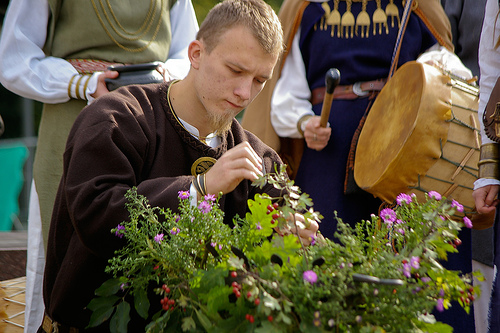


It is estimated there are now over 250,000 pagans in the UK, in addition to a similar number of Hindus, who, like pagans, worship many gods. This summer the latest census results are due to be published and it is expected there will be a significantly greater number of pagans than in any previous year. The growth of pagan religions in the UK over the 20th and 21st centuries has been accompanied by an overall decline in religiosity, and a growing tolerance of religious diversity. The Witchcraft Act of 1735 was repealed in 1951 and common law offences relating to blasphemy were abolished in England and Wales in 2008 and in Scotland as recently as 2021. In light of these developments, it would seem Paganism is now just another faith among the diverse religions practised in modern Britain, but closer analysis reveals that ancient prejudices against traditional polytheistic religions still result in exclusionary language and policies from powerful institutions, even those which claim to promote diversity and interfaith dialogue.

Transnational organisations like the United Nations present themselves as representing the values of a “global humanity”, yet that organisation was founded by Westerners on a specific set of uniquely Western (and therefore Christian) values which they are attempting to impose on the world. While they condemn the old colonial European powers, they are in fact the natural continuation of them. The ancient Indian custom of Sati (ritual suicide of widows) appalled European colonists so it was banned by French, Dutch, Portuguese and British administrators who viewed it through a Christian moral lens. This is hardly different from the UN crusades against other religious customs which are unpalatable to Western tastes such as female circumcision and child marriage. The British government generally conforms to the same values as the UN and so we can see the notion of “religious freedom” is applied selectively both here and abroad.


The author Tom Holland has demonstrated in his book Dominion that the values of the modern West, even when it professes atheism and humanism, are rooted in Christianity. The idea of a global humanity exists in the Bible with the myth of the common ancestors Adam and Eve. The metaphorical description of time as a kind of space, through which one “progresses” becomes possible only with the invention of linear history and the “year 0” of Christ’s birth. Among traditional religious groups such as Hindus and European pagans, time is regarded as cyclical, so for them it is merely an abstraction to speak of “progress”. Yet unshakeable faith in progress is the defining belief system of the modern West and of global powers in general. This faith, looking ever forward to salvation in a future governed by ‘reason’ and furnished with the marvels of technological innovation, has inevitably become affiliated with the rather flimsy but popular philosophy of transhumanism.


Transhumanism has recently been promoted by the UN affiliated World Economic Forum and by UN promoted author Yuvel Harari. This is nothing new for the UN though - way back in 1957, the first director of UNESCO, Julian Huxley, expressed his desire to reject old superstitions and make way for a new belief he called "transhumanism". Its adherents assert that mankind is “limited” and that these limitations need to be overcome through technology. Just as Christ was said to have “conquered death”, some transhumanists see death as undesirable and unnecessary - an obstacle to be overcome through technology. Yet unlike Christians they do not believe in an immaterial, transcendent realm or God. The early Christian Gnostics asserted that this natural world is evil and that we must instead seek unification with God in the next world. Similarly, many transhumanists anticipate the emergence of a super artificial intelligence which shall surpass man, an event called the technological singularity, and that man may unify with this posthuman intelligence in a man-made realm of pure data - the materialist heaven. Feminist author Mary Harrington has coined the term “fully automated luxury Gnosticism” to describe the goals of certain very-online technophiles with an aversion to the natural world. This Messianic anticipation is also connected to the idea of the “posthuman” - the alleged next stage of non-biological human evolution (progress). This is no fringe cult. It is a hugely influential belief system promoted by the most powerful organisations on Earth. It is poised to become a global religion - a desirable outcome according to UN Assistant Secretary-General Robert Muller, “the philosopher of the United Nations'' who said the world’s religions must “globalize themselves” so they can “give birth to the first global, cosmic, universal civilization.”


Pagan thinkers like the Neoplatonist Iamblichus rejected Gnostic beliefs entirely, instead asserting that the material world is divine - existing within the divine. Most modern pagans also regard the natural world as holy. Hinduism and European forms of paganism revere death - some believe that in death you unite with ancestors, others that you are purified in the underworld so that you can be reincarnated. Death is itself deified as various gods of the underworld like Hela, Hades and Yama. As it says in the Atharva Veda “Praise to that Yama; praise to Death!” Whether you seek freedom from samsara, rebirth as a descendant or unification with the divine, death is essential and desirable. 


Another part of what defines pagan religions is their regional and temporal character - gods are worshipped because they are the gods of our ancestors, and rites are observed in sympathy with the cycles of the natural world. We cannot decouple paganism from the natural world - nor can paganisms be integrated into a global religion without ceasing to be pagan since they are defined by their regional and ethnic character.

So pagans are justifiably concerned about the rhetoric echoing from the halls of power which marginalises them, while claiming to represent them. That’s why we are coming together in London on the 25th of June 2022 for the Pagan Futures conference. The speakers are myself, Tom Rowsell, a practising pagan of 13 years, known for my YouTube channel Survive the Jive, and Dr. Borja Vilallonga, also a pagan and a scholar of history and religion previously at Columbia University, New York University, and the University of Newcastle. There will also be a live musical performance from the pagan folk artist Wolcensmen and a Q&A session during which the audience will be able to ask us about the pressing issues regarding the future of paganism in an increasingly anti-pagan, neo-Gnostic world.

Tuesday, 24 October 2023

Ancient Greece Revisited and Survive the Jive at Temple of Poseidon


Michael and I discussed philosophy, history, religion and psychedelic drugs

Thursday, 7 September 2023

How to set up a Heathen Altar in your Home : Paganism 101


A guide for setting up an altar to the gods inside your home which you can use for domestic worship. Many people are requesting this kind of content and its been nearly six years since I last made a video like this, so here you go!

Friday, 15 July 2022

PAGAN FUTURES - Talks, photos and Key points

Panel at pagan futures confernce

The playlist below contains the talks of Dr. Borja Vilallonga and myself, Tom Rowsell, as well as the live musical performances by Wolcensmen and the Q and A panel session with the three of us interacting with the audience.


borja vilallonga at pagan futures in london


Tom Rowsell at pagan futures

Wolcensmen performing at Pagan Futures


Several people have requested that I post the summary of the core assertions of pagan belief from the talk as text for people to refer to. To reiterate them simply; 
  • We revere nature as a path to the divine and therefore require access to sacred natural spaces 
  • We revere death as a path to the divine and therefore reject any ideology that seeks to escape death
  • We revere our bodies as a gift from the gods - which were created according to divine will and are therefore neither incomplete nor imperfect - but must be maintained and kept healthy and strong 
  • We believe that the diversity of mankind is a manifestation of divine will, not a problem to be overcome - and that to approach the divine we must follow the example of our own ancestors, revering the sacred spaces of our own ancestral homelands in order to become closer to the gods of our ancestors
  • We must therefore live in accordance with our own ancestral laws and customs
My talk "Pagan Tradition in a Globalized Future" is also available on Odysee and several podcasting websites.


Monday, 13 June 2022

HAIL DEATH! Why death is not to be feared


 This video is a little teaser regarding the topic of death in advance of my documentary about Indo-European beliefs concerning the afterlife and cosmology. It is also something for everyone to consider before attending the PAGAN FUTURES conference on the 25th June

Tuesday, 29 March 2022

Friday, 9 July 2021

Pagan Calendar by Survive the Jive


In 2018 I commissioned this "pagan calendar" as a guideline for those new to paganism, to help them understand the holy parts of the year. It was not accompanied by a thorough explanation and so has understandably been misunderstood. So now, three years later, I am posting this clarification to help people understand what this is:

  • This is NOT an accurate historical representation of a Germanic, Roman. Celtic or Slavic pagan calendar. It merely demonstrates how those different Indo-European folk-ways each had corresponding annual celebrations which closely resemble each other and are often held at similar, but not identical, times of year.
  • The purpose was to give practicing pagans a jumping off point to so they can make informed decisions about when to celebrate holy days in their own calendars - this was not me telling people exactly when to celebrate holy days, but gives them an idea of the right time of year to do things and the associated gods and rites.
  • This calendar is dated according to the modern Gregorian calendar which none of the pagans ever used. Therefore all the dates are historically wrong. I have mentioned in videos and blogs that the Germanic people, for example, used a lunar-solar calendar, which means we cannot have accurate fixed dates for holy days on a Gregorian calendar. This calendar approximates dates of ancient festivals onto a modern Gregorian calendar for the convenience of modern people.
  • The use of a "wheel of the year" calendar is not really attested reliably in historical sources and many have correctly pointed out that this is an invention of Wiccans. The stylistic choice of representing the year with a solar wheel was based on the fact that this symbol is prominent in the artwork of several Indo-European cultures. I was not influenced by Wicca and their calendar.
  • Prior knowledge was assumed, so the writing style is laconic and no explanation is given for the meaning or purpose of the ritual behaviours. This was because I assumed that only people who watch my videos would use the calendar, and that they would therefore understand it based on my talks. 
  • "Casual sex permissible" requires clarification for those who had not seen the May Day video which was published a couple of weeks before the calendar and explained what this means and why I wrote it (the video and calendar were supposed to compliment each other).
    • The May day/ Easter customs I describe are mostly derived from folkloric accounts from recent times and not ancient pagan customs. The fact that customs in Ireland, Britain, Poland, Sweden, Romania, Lithuania, Spain etc pertaining usually to Spring festivals but sometimes to Midsummer ones, are so similar is, I argue, evidence for their ancient origin. 
    • All of these customs however are only recorded among Christians and by Christians and many continue to this day, not merely in neopagan forms, but as living folk traditions among peasants. 
    • In several places the evening before May day is associated with female sexuality, and certain Protestant accounts in England and Catholic accounts in Ireland lament the fact that young teenagers were prone to having sex on May eve outside of wedlock. For centuries after Christianisation however, it seems young people were able to have casual sex (sex outside of marriage) without suffering the normal social consequences, providing they did it on May eve. 
    • Many such couplings would result in marriages, however it was considered unlucky for a man to marry a woman on May day as she would then have more power over him. I suspect the marriages were often the necessary consequence of unexpected pregnancies. 
    • "Casual sex" applies to young unmarried heterosexual people. None of the sources I looked at mentions any kind of infidelity being socially acceptable. Indeed, the sources are disapproving of the young people having sex at all, since they come from the learned and moralising literate elite who did not participate in such folk customs, which have only been preserved by (mainly illiterate) peasants who probably didn't realise what they were doing had anything to do with "paganism" - they simply did what had always been done. 
    • My inclusion of this statement regarding "casual sex" was not a command that pagans ought to go and have sex on this night, nor even a suggestion. I simply recorded what has occurred throughout Christendom, throughout the entire history of Christian Europe because I believe the custom to be pagan in origin. I wanted to draw attention to the association of sex and fertility with the Spring festival so that pagans could understand it properly. 

Friday, 30 April 2021

The Afterlife and the secret Odin Brotherhood with Dr. Mark Mirabello


Mark Mirabello, Ph.D., is a professor of history at Shawnee State University in Ohio and a former visiting professor of history at Nizhny Novgorod University in Russia. He has appeared on Ancient Aliens and America’s Book of Secrets on the History Channel as well as in the documentary The Kingdom of Survival. He is the author of The Traveler's Guide to the Afterlife which Examines beliefs from many different cultures on the soul, heaven, hell, and reincarnation; and also The Odin Brotherhood, first published in 1992, in which Mirabello reveals some of the secrets of a mysterious society in Britain which values "knowledge, freedom and power" as part of their occult work which honours Odin and the other Norse gods. I asked him about these and other subjects pertaining to magic, the afterlife and pagan beliefs.

Learn more about him and his published works on www.markmirabello.com 

Thursday, 25 May 2017

Survive The Jive: Traditional European Paganism


Interviewed by Tara McCarthy