A free preview episode of Radio North Sea International is now available on Survive the Jive podcast.
There is no more potent, holy and enduring symbol of Western man, than the barrow! It links the Iliad, Beowulf, the sagas, the Celts, Germans, Scythians and slavs! 6000 years of excellence!
I worked with graphic designer, JonuxCreative to make a graph showing 12,000 years of South British genetic history. Starting with Western Hunter Gatherers in Blue, then Neolithic farmers in green and Indo-Europeans in orange. The subsequent migrations of Celts, Anglo-Saxons and French people merely reshuffled the quantity of existing ancestral components. Therefore Britain's genetic history is marked by its remarkable continuity.
A new paper called The Genetic Origin of the Indo-Europeans (2024) reveals that the Proto-Indo-European languages originated in the Yamnaya and Sredny Stog cultures of Ukraine and South Russia. The split of PIE languages from Anatolian languages is revealed to have taken place on the steppe (lower Volga). Sredny Stog DNA is found in Central Anatolian Bronze Age Hittite samples proving the real IE people were indeed Steppe herders from Eastern Europe and not an unknown Armenian population as previously claimed in 2022. I discuss the findings in this stream.
In many regions of Europe people celebrate May day, or the day before, by lighting bonfires. In Ireland they call it Beltaine, in Sweden they call it Valborg, and in both countries you will see people gather around enormous fires. But why?
The roots go back not only to the pagan religions of Celtic and Germanic Europe, but even further, to their shared origins. The earliest reference to Beltane in Ireland is from the 10th century and associates it with bonfires and a Celtic pagan god whose name is something like Belenus. This god has Indo-European roots as we also see a Slavic equivalent called Belobog “The white god” and an English god called Bældæg.
Swedes gather at the ancient barrows of Gamla Uppsala while the Valborg fire burns behind them
The Bel part of Beltane and Belenus means “bright” and is cognate with the Old English bæl meaning “bale” as in bale-fire “funeral fire/bonfire”. Bældæg is a god attested in Anglo-Saxon royal genealogies as the son of the god Woden. His name means “bale day” or “pyre day” and he is the same god as the Norse Baldr, son of Odin. In Norse myth the god Baldr is associated specifically with a funeral pyre and this is likely the reason for the name Bældæg “pyre day”.
The name of the Anglo-Saxon Saint Walburga replaced earlier names for the May fire festivals in Germany and Sweden which became Walpurgis and Valborg respectively. But thanks to Grimm we know that previously the Germans celebrated Pholtag “Phol day” and Phol is also another name for the god Baldr.
The evidence from Germany and England confirms that Baldr was the god of the Spring bonfire in the Germanic regions of Europe, while the Gaelic regions had a similar custom for their god Belenus.
The EU has introduced a new law which bans May bonfires and therefore infringes on the religious rights of European pagans to practise their ancient customs. Our right to practice our religion must be defended at all costs.
This population is alleged to have formed around 2000 BC which is 800 years after Corded Ware folk first entered Scandinavia. It is distinct from earlier Corded Ware populations in the region, and contemporary Corded Ware people in Denmark and Norway, because instead of just WHG admixture it has additional EHG admixture from a source their model predicts to come from Latvia/Lithuania.
The authors suggest a possible migration across the Baltic sea to explain this East Scandi group despite there being no evidence for this in the archaeological record. They point out that the “timing coincides with the introduction of a new, Late Neolithic sheep breed to Scandinavia. It also coincides with the spread of a new burial rite of gallery graves in south Sweden, the Danish islands and Norway, a new house type, the first durative bronze networks, as well as with the end of an east-west divide in Scandinavia between 4050 and 3650 BP. (2050 BC- 1650 BC)” Yet none of these new arrivals they list necessarily came from across the Baltic sea.
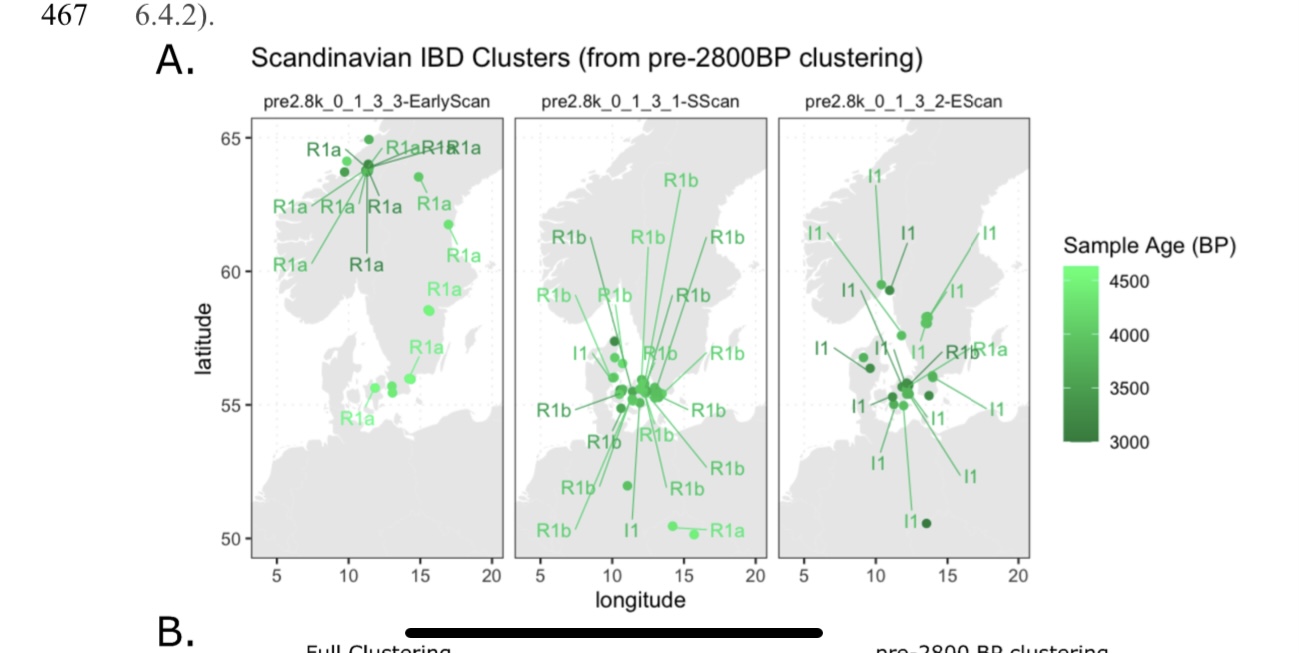
The feasibility of a mass migration of a people across the Baltic at this period in history is questionable. Sea crossings from the South are far more plausible or even land routes via the Arctic North. Figure 4.A shows the geographical distribution of individual samples belonging to the 3 Scandinavian Clusters they identified existing prior to 800 BC, after which they merged. They say there is a strong correspondence between the clusters and specific haplogroups as follows:
Early Scandinavian including the oldest Swedish (Battle Axe Culture) and Danish samples and almost all Norwegians all have R1a.
A later ‘Southern Scandinavian’ cluster restricted to Denmark and the southern tip of Sweden mostly with R1b but some I1.
A second later ‘Eastern Scandinavian’ cluster, spread across Sweden and overlapping with that of the Southern Scandinavia cluster which is dominated by I1.
The third map of this so-called “Eastern Scandi” group shows mainly samples from the South though, and the I1 haplogroup distribution is not demonstrated to have come from the “East”, in fact it appears from this data to have come from the south. We already have an I1 sample from North Germany dating to 3300 BC, older than these samples, so by tying this newly identified group to the I1 haplogroup, they have brought into question their own claim that it has a Baltic origin. This will only be settled with the discovery of an I1 sample in a Corded ware context dating to around 2700 BC.
They admit that it is now necessary to confirm “the proposed Bronze Age source of the
East Scandinavians along the Baltic coast.” My own view is that the elevated EHG ancestry in this East Scandi group may incorrectly have been identified as Latvian in origin due merely to a sampling bias, and lack of SHG samples. The elevated EHG in Sweden seems more plausible to be local and the I1 is most likely to have entered Scandinavia from the South, not across the Baltic. The reliability of their IBD method depends on the reference samples used.
While I question their conclusions about the origin of this East Scandi group, I am more convinced by their suggestion that it was responsible for the spread of the ancestor of what became Palaeo-Germanic language in the period between 1050 BC - 500 BC when it borrowed from Celtic and into Finno-Saamic. They show that after 2000 BC the East Scandi group expanded into Denmark and Norway. The mixing of East Scandi with South Scandi is dated between 1700 BC-1400 BC which spans both Nordic Bronze age 1 and 2 and directly precedes the construction of the famous Kivik tomb in Scania around 1400 BC.
This mixing event formed the Iron Age Scandinavian genetic profile such that by the Iron Age Jutland can be entirely modelled with the admixed Danish Bronze age source, while Iron Age Norway and the Danish Isles also have additional East Scandi admixture on top of the initial Bronze Age mixing, showing further migrations of these intrepid East Scandis.
They say this admixed Iron Age Southern Scandinavian group is “central to understanding the Germanic dispersal” and I agree. We can trace the spread of IA South Scandi ancestry into Germany, Britain and the Netherlands. The findings about Germanic expansion in the historical period are very interesting too.
The custom of burying an animal under the foundations of a house is not only very widespread, found in Britain, Ireland, Scandinavia, Finland and beyond, but is also very old, dating back to the Indo-Europeans of the Bronze Age Europe. It even spread as far away as America and India! In this video I trace the customs origins and dispersal and explain the magical function of the animal and human sacrifices underneath the home.
Sources
Eliade, Mircea - Zalmoxis - The Vanishing God-The University of Chicago Press (1972)
Hukantaival, Sonja. (2009). Horse Skulls and "Alder-Horse": The Horse as a Depositional "Sacrifice" in Buildings. Archaeologia Baltica. 11. 350-356.
Kuzmina, The Origins of Indo-Iranians, 2007
Manning, M. Chris. “The Material Culture of Ritual Concealments in the United States.” Historical Archaeology, vol. 48, no. 3, 2014, pp. 52–83. JSTOR
O’Reilly, Barry. “Hearth and Home: The Vernacular House in Ireland from c. 1800.” Proceedings of the Royal Irish Academy. Section C: Archaeology, Celtic Studies, History, Linguistics, Literature, vol. 111C, 2011, pp. 193–215. JSTOR
Ó Súilleabháin, Seán. “Foundation Sacrifices.” The Journal of the Royal Society of Antiquaries of Ireland, vol. 75, no. 1, 1945, pp. 45–52.
Søvsø, M., et al. 'Om hugorme, dyrekranier og tordensten– bygningsofre og andre skikke med rødder i folketroen'
Historical full length documentary on genetic origins of the nomadic steppe conquerors the SCYTHIANS - Learn about the ancient Scythian gods of Eurasia, and how the first nomadic horselords of the Ponto-Caspian Steppe practiced shamanism and offered animal sacrifices to their god of war!
Sources:
Albuquerque, C., ‘On the Scythian Pantheon’ 2018, Medium.
Bokovenko, Nikolay. (2015). The Emergence of the Tagar Culture. Antiquity. 80. 860-879. 10.1017/S0003598X00094473.
Cunliffe, B., ‘The Scythians: Nomad Warriors of the Steppe’ Oxford:2019.
Gershkovich, Y., Romashko, O., ‘Scythian sanctuaries of Ares: archaeological date and Herodotus' testimonies’ (in English) | - Academia.edu.
Herodotus. The Persian Wars, Volume II: Books 3-4. Translated by A. D. Godley. Loeb Classical Library 118. Cambridge, MA: Harvard University Press, 1921.
Juras, A., Krzewińska, M., Nikitin, A. et al. Diverse origin of mitochondrial lineages in Iron Age Black Sea Scythians. Sci Rep 7, 43950 (2017).
Kuz’Mina, E.E., & Mallory, J.P. (2007). "Chapter Three. Classification of sites and the primary features of Andronovo unity". In The Origin of the Indo-Iranians. Leiden, The Netherlands: Brill. doi:
Sharkey, B. Predators and Prey: Cosmological Perspectivism in Scythian Animal Style Art. Arts 2022, 11, 120.
The rock art from the tomb of Bredarör at Kivik in Sweden is a window into the forgotten world of the Nordic Bronze Age. In this film I interpret all the esoteric imagery, including; sun-wheels, solar crosses, war chariots, armed warriors and ritual axes and boats. With the latest archaeological data, 3D scans and new CGI animations of the art, this film gives a new perspective on a tomb which is 3400 years old!
Arvid Fougstedt 1936
Art:
CGI by Robert Molyneaux
Bronze age rites at dawn, Indian chariot, hellhounds, Wolf Viking by Christian Sloan Hall Kivik reconstruction by Arvid Fougstedt 1936
Bronsåldern by Nils Asplund Fra Bronsåldern by Rasmus Christiansen 1925 NBA king by Beaker Lady Bronze age map by Dan Kogosov Beaker Koryos by Moccus Art
Sources:
Bertilsson, Ulf et al. “The Kivik Tomb: Bredarör enters into the digital arena” New Perspectives on the Bronze Age (2017): 289–306.
Froncek, T., ‘The Northmen’ 1975. Goldhahn - Bredaror on Kivik: a monumental cairn
and the history of its interpretation 2009
Kaliff, Oestigaard ‘Werewolves, Warriors and Winter Sacrifices
Unmasking Kivik and Indo-European Cosmology in Bronze Age Scandinavia’ 2022. Kveiborg, Ahlqvist, Vandkilde. (2020). Horses, Fish and Humans: Interspecies Relationships in the Nordic Bronze Age. Current Swedish Archaeology. 75-98.
Nordquist, Gullög & Whittaker, Helene. (2007). Comments on Kristian Kristiansen and Thomas B. Larsson (2005): The Rise of Bronze Age Society. Travels, Transmissions and Transformations. Norwegian Archaeological Review. 40. 75-84.
Watch above on Rumble or click to watch on Odysee or YouTube
Through comparative mythology we can reconstruct the earliest Indo-European beliefs about the cosmos and the afterlife as far as 6000 years back. but Indo-European religion has many features in common with Siberian and Native American religions. These three groups all share common ancestry from an ice-age population called Ancient North Eurasians, so we can even reconstruct cosmological beliefs of a Siberian people 20,000 years ago! This film helps you to understand the most ancient and fundamental pagan beliefs concerning death, the underworld and reincarnation.
ART
These four artists created original art for this video:
Hell hounds / Wolf art / Gaulish warrior / Yamnaya couple / Hel and her army by Christian Sloan Hall
Sacrifice to the head in Hell / Yamnaya funeral by Graman
Research information relating to *Kolyéh₂ from John of Crecganfordon YouTube
Music
In order of use in the score
Tom May - Atlantis falling
Gvasdnahr - Through the Astral void
Wolcensmen - Sunne (remix by Eternal Rik)
Saichaika - Musica Aeterna
Kevin MacLeod - Rites
Borg - The Dancing Forest
Chris Zabriskie - The_Theatrical_Poster_for_Poltergeist_III
Legionarii - Aristocracy
Andrew weis - scottish medieval
Kevin MacLeod - Enchanted journey
Bark sound productions - Forn
Bark sound productions - Eld
Rishi Shah - song IV - From Runes to Ruins
Borg - May queen enters the circle
Doug Maxwell - Bansure raga
Kevin MacLeod - Dhaka
Doug Maxwell - Arabian nightfall
JR Tundra - Shesh Pesh
Lorcán Mac Mathúna - Caoineadh Fherdia
Stewart Keller - flickers while the door creaks
Myling - Töcken
Xurious - Steppe expansion
Realization of a New Earth - I Think I Can Help You Ormgård - Sjálfsforn
Chris Zabriskie - Virtues inherited
Altyn Tuu - Altai tuva mix
Mauerbrecher - Hunnic horde
Eagle song of the Hopi Indians
Sources
Ara, M. ‘Eschatology in the Indo-Iranian Traditions: The Genesis and Transformation’...
Anthony, David W.; Brown, Dorcas R. (2019). "Late Bronze Age midwinter dog sacrifices and warrior initiations at Krasnosamarskoe, Russia". In Olsen, Birgit A.; Olander, Thomas; Kristiansen, Kristian (eds.). Tracing the Indo-Europeans: New evidence from archaeology and historical linguistics. Oxbow Books. ISBN 978-1-78925-273-6.
Okladnikov, A.P. ‘Yakutia Before Its Incorporation Into the Russian State.’ 1970
Pitulko, V., Pavlova, E., Nikolskiy, P., & Ivanova, V. (2012). The oldest art of the Eurasian Arctic: Personal ornaments and symbolic objects from Yana RHS, Arctic Siberia. Antiquity, 86(333), 642-659. doi:10.1017/S0003598X00047827
Saga Book XVI, Viking Society for Northern Research, UCL 1962-65
Schlerath, B. 1954. Der Hund bei den Indogermanen. Paideuma, Bd. 6, H. 1. pp. 25-40. Frobenius Institute Stable
Scholz, Herbert. The Hound in Greek-Roman magic and religion. Berlin. 1937 (p. 51)
The Viking hero Starkad / Starkaðr was a warrior-poet with extra arms who was blessed by the god Odin. This aristocratic transgressive lone wolf character is actually a prehistoric Indo-European archetype equivalent to Hercules in Greece, Suibhne in Ireland and Krishna’s cousin Siśupāla of Chedi from the Hindu religion of India. In this video I explain who Starkad was and how his myths parallel other Indo-European stories of a Sigma male outsider who loves kings, hates the lower classes, is rude to women and goes into mad rages of extreme violence against his enemies.
-Compton, T., ‘Victim of the Muses: Poet as Scapegoat, Warrior and Hero in Greco-Roman and Indo-European Myth and History’ Washington, DC: Center for Hellenic Studies (2006).
-Cohen, D. “Suibhne Geilt.” Celtica 12:113–124. (1977).
-Dumézil ‘Aspects de la fonction guerrière chez les Indo-Européens’ (1956).
-Hui, J ‘'Svá segir Starkaðr’: Manipulating Memoralisation in Gautreks saga’ (2015).
Once more, before I move on and set my sights ahead, in loneliness I lift my hands up to you, you to whom I flee, to whom I, in the deepmost depth of my heart, solemnly consecrated altars so that ever your voice may summon me again.
Deeply graved into those altars glows the phrase: To The Unknown God. I am his, although I have, until now, also lingered amid the unholy mob; I am his—and I feel the snares that pull me down in the struggle and, if I would flee, compel me yet into his service.
I want to know you, Unknown One, Who reaches deep into my soul, Who roams through my life like a storm— You Unfathomable One, akin to me! I want to know you, even serve you.
—Friedrich Nietzsche, 1864. Translated by Michael Moynihan
Nietzsche here frankly expresses a strikingly honest form of spirituality which I believe typified the highest sentiments of the Indo-European spiritual worldview. It combines faith, which most religions require, with an honest appraisal of what is truly known of the divine by mortals. In this case the existence of the god is unquestioned, but the exact nature or even the name of the god are not known.
In this post I will provide some examples of this heroic spiritual view of the divine and of death. Consider the Nāsadīya Sūkta also known as the Hymn of Creation, the 129th hymn of the 10th mandala of the Rigveda (10:129). In it, the speaker or singer asks philosophical questions about Creation, and answers himself - we do not know and maybe even the creator himself does not know.
1. Then even non-existence was not there, nor existence,
There was no air then, nor the space beyond it.
What covered it? Where was it? In whose keeping?
Was there then cosmic fluid, in depths unfathomed?
2. Then there was neither death nor immortality
nor was there then the torch of night and day.
The One breathed windlessly and self-sustaining.
There was that One then, and there was no other.
3. At first there was only darkness wrapped in darkness.
All this was only unillumined cosmic water.
That One which came to be, enclosed in nothing,
arose at last, born of the power of knowledge.
4. In the beginning desire descended on it -
that was the primal seed, born of the mind.
The sages who have searched their hearts with wisdom
know that which is, is kin to that which is not.
5. And they have stretched their cord across the void,
and know what was above, and what below.
Seminal powers made fertile mighty forces.
Below was strength, and over it was impulse.
6. But, after all, who knows, and who can say
Whence it all came, and how creation happened?
the gods themselves are later than creation,
so who knows truly whence it has arisen?
7. Whence all creation had its origin,
the creator, whether he fashioned it or whether he did not,
the creator, who surveys it all from highest heaven,
he knows — or maybe even he does not know.
This reflects the religious attitude of the Bronze Age Aryan, in which no insincere claims are made about what can actually be known with any certainty by mere mortals. Obviously this is less consoling than a religion which claims to have all the answers, but in this spiritual worldview, truth comes first.
This same attitude is evident in Greece where there was a shrine to the unknown God at the Areopagus. St Paul exploits this in his sermon, twisting the pagan honesty about that which is unknown of the divine, and calling this a failing of the pagan faith.
"As I walked around and looked carefully at your objects of worship, I even found an altar with this inscription: TO AN UNKNOWN GOD. So you are ignorant of the very thing you worship — and this is what I am going to proclaim to you."
Either in ignorance, or as a technique of deception, Paul missed the pious and honest religious meaning of celebrating that which is unknown and unknowable of the divine by mortals. Christianity can not accommodate this kind of expression of faith, if it did we should see Christian prayers where they ask frank questions about what it is possible for them to know with certainty:
"Did the angel really appear to Mary or was it a daemon? We cannot say. Was Jesus really a god or was he possessed by a daemon? It cannot be known. Is YHWH the only god or is he lying? Maybe even He himself doesn’t know for sure.”
Instead, even uttering such things is called heresy. The Bible and the Abrahamic faiths in general provide only a tautological argument that their claims are true because of the scripture and that the scripture is true because it says it is true.
We have seen how Christianity exploited the frank admission by Greek pagans of what can be known of the divine by manipulating the less secure and less knowledgeable pagans who longed for consoling answers to the great unanswerable questions. I believe the same thing occurred 700 years later in England.
In Historia Ecclesiastica Gentis Anglorum, Bede describes how the pagan King Edwin of the Northumbrians calls a council of his wisest retainers to debate whether they should convert to Christianity and it is at this point that one of the "king's chief men" gave the following speech:
“The present life of man upon earth, O King, seems to me in comparison with that time which is unknown to us like the swift flight of a sparrow through the mead-hall where you sit at supper in winter, with your Ealdormen and thanes, while the fire blazes in the midst and the hall is warmed, but the wintry storms of rain or snow are raging abroad. The sparrow, flying in at one door and immediately out at another, whilst he is within, is safe from the wintry tempest, but after a short space of fair weather, he immediately vanishes out of your sight, passing from winter to winter again. So this life of man appears for a little while, but of what is to follow or what went before we know nothing at all.”
Evidently the anecdote is provided by Bede as an example of a pagan feeling hopeless with the uncertainty of pagan beliefs, and thus wanting something more solid in the form of Christian doctrine. However, this story is intended to impress pagans and encourage them to convert and is part of a conversion narrative, therefore we should expect to see in it tropes that would be recognised by pagans. For that reason I believe that Bede has used a well known pagan poetic metaphor about the uncertainty of life, not only after death, but before birth! I have covered in my videos how Germanic and Celtic pagans believed in a form of reincarnation so the fate of the “soul” prior to birth was also a concerning question for them.
The idea that this passage was just an expression of Christian belief is unsatisfactory because Christians do claim to know the fate of the soul after death and they certainly do not consider that souls have a similar existence prior to birth as they do after death. The possibility that this passage is a modified pagan metaphor, misrepresented by Bede in a similar way to how Paul had misrepresented the unknown god, seems very likely and it is therefore mysterious to me that no other historian has suggested it (as far as I am aware). The passage was, after all, put in the mouth of a pagan Anglo-Saxon, so why should we not presume it is intended to reflect a pagan world view to some extent?
I am also convinced it has pagan provenance because it matches the heroic and frank attitude toward death and the divine which is seen elsewhere in Indo-European religions and which I have outlined above.
The same heroic, Indo-European fatalistic resolve in the face of death survives in Buddhism and is beautifully portrayed in the film Kagemusha by Kurosawa. In the scene below, Oda Nobunaga the demon king, quotes the following lines:
"Human life lasts only 50 years, compare it with the life of Geten (a form of Buddhist paradise, where one day lasts years of our world), it is truly a dream and an illusion. Life, once given, cannot last forever”
The text recited by Oda Nobunaga is from a Japanese Noh play called "Atsumori" which was named after Taira no Atsumori, a Taira soldier who died during the Gempei war 1180-1185 (Taira vs Minamoto clan). The Oda clan claimed descent from the Taira and this dance and song is famous for having been recited by Oda Nobunaga which is why Kurosawa included it in Kagemusha. Watching this performance, I can imagine the story of the sparrow in the hall was sung in a similar way, in a meadhall by a scop to all the Thegns and the Lord. I imagine them moodily pondering the unknowable destiny of the soul as the scop strummed his lyre and recited the holy verses.
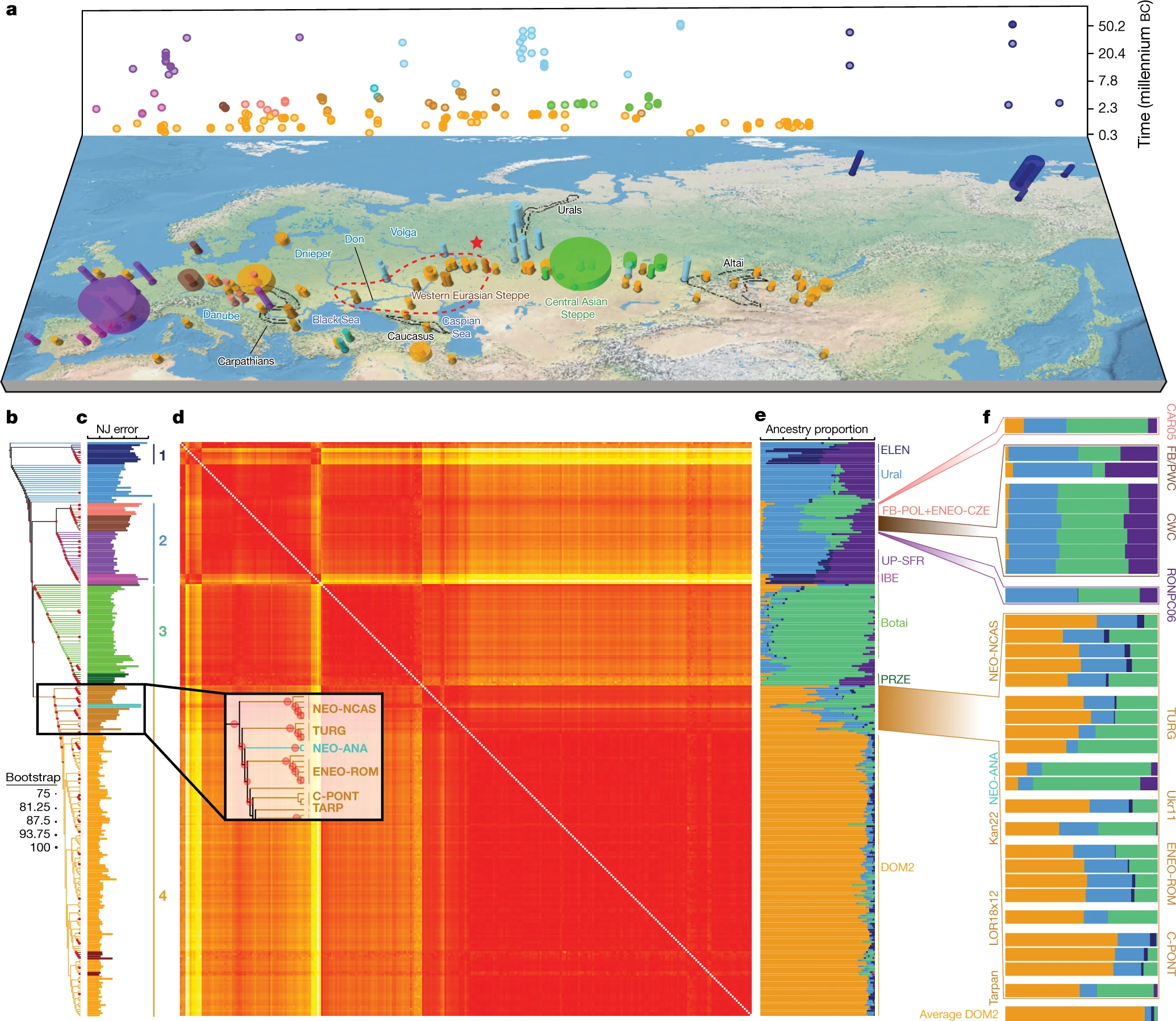
I've been waiting for some concrete DNA evidence about where modern horses came from since I interviewed Alan Outram three years ago and he hinted that it was soon to be published. He indicated that Sintashta horses might end up being more important than Yamnaya ones, and now that the new paper, to which he contributed, has finally been published, I can see why.
The new paper (Librado et al 2021) doesn't make the findings very clear IMO (refers to Europe as West Eurasia and makes the contested assumption that Corded Ware was descended from Yamnaya) but it does answer some important questions. I will summarise the findings in a clear TLDR bullet point list below:
Botai may have been first to corral horses for milking but they didn't ride them.
Yamnaya kept horses for milking too but we cannot see if they were ridden (However Trautmann et al 2023 shows Yamnaya did ride them)
Wilkin et al (2021) looking at milk proteins in pottery agrees with this new paper regarding "a potential epicentre for horse domestication in the Pontic–Caspian steppe by the third millennium BC" = Yamnaya.
Librado et al (2021) points to Volga-Don region (aka Yamnaya EUROPE) as the homeland of modern domestic horses
Sintashta horses (DOM2) were superior for riding (stronger backs) and replaced earlier ones from 2200 BC
Sintashta horses (DOM2) had genetic continuity with earlier Yamnaya /Repin ones(TURG) and Steppe Maykop (Aygurskii), and Poltavka (Sosnovka) - specifically two late Yamnaya specimens from approximately 2900 to 2600 BC
Yamnaya horses had some relation, but not much, to Botai horses
The Tarpan and modern Przewalski’s horses do not descend from the same ancestral population as modern domestic horses
Modern horses were domesticated in Europe but the paper calls it West Eurasia - possibly as a deliberate, politically motivated obfuscation
The ancestors of Sintashta horses came from the steppe East of the Dnieper and West of the Volga-Don region - ie: firmly within European Yamnaya territory during the late fourth and early third millennia BC
Corded Ware horses were not the same as Yamnaya/Sintashta horses
Earlier LBK and other Neolithic horses in Denmark, Poland, Czechia and Hungary had some affinity with Yamnaya/Sintashta horses - the geneflow seems to have been via Thrace
Corded Ware expansion into Europe was not accompanied by horses but rather they adopted local horses as they migrated (not clear if they were ridden)
Replacement of other horse lineages in Europe and Asia by Sintashta ones was accompanied by spread of both equestrianism and (a bit later) light two wheeled war chariots
The spread of Sintashta horses into the middle east was likely accompanied by the spread of a specialised class of Sintashta descended horse trainers like the Mitanni.
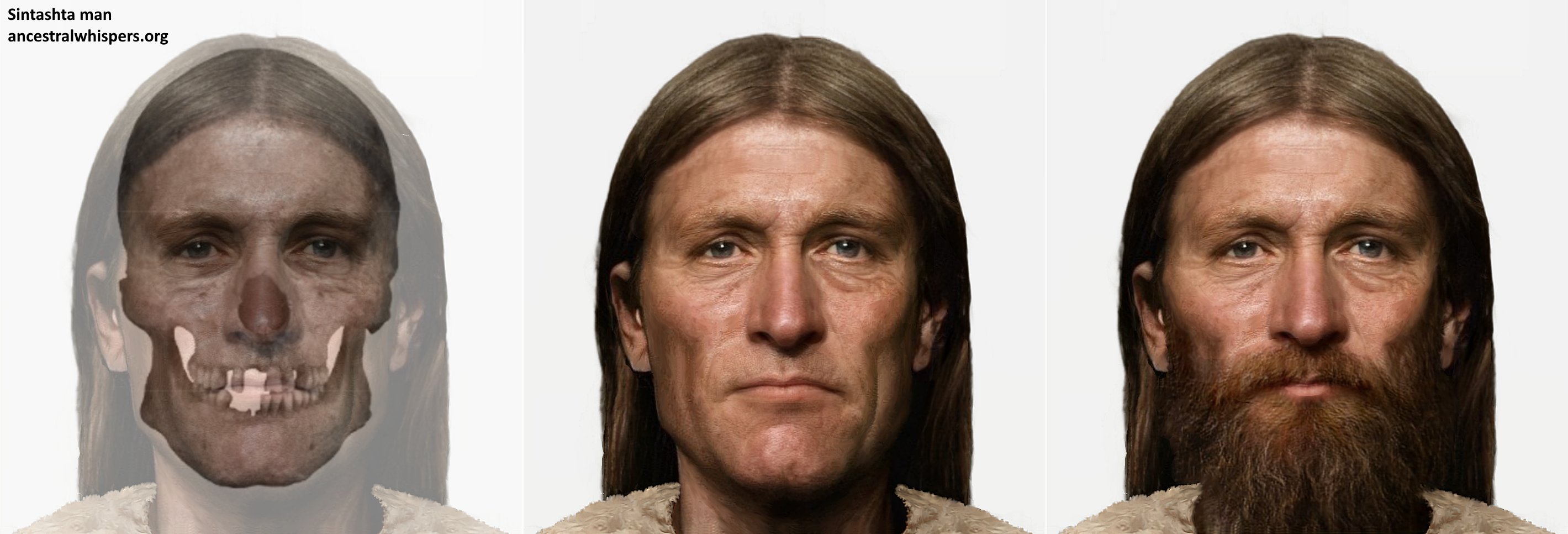
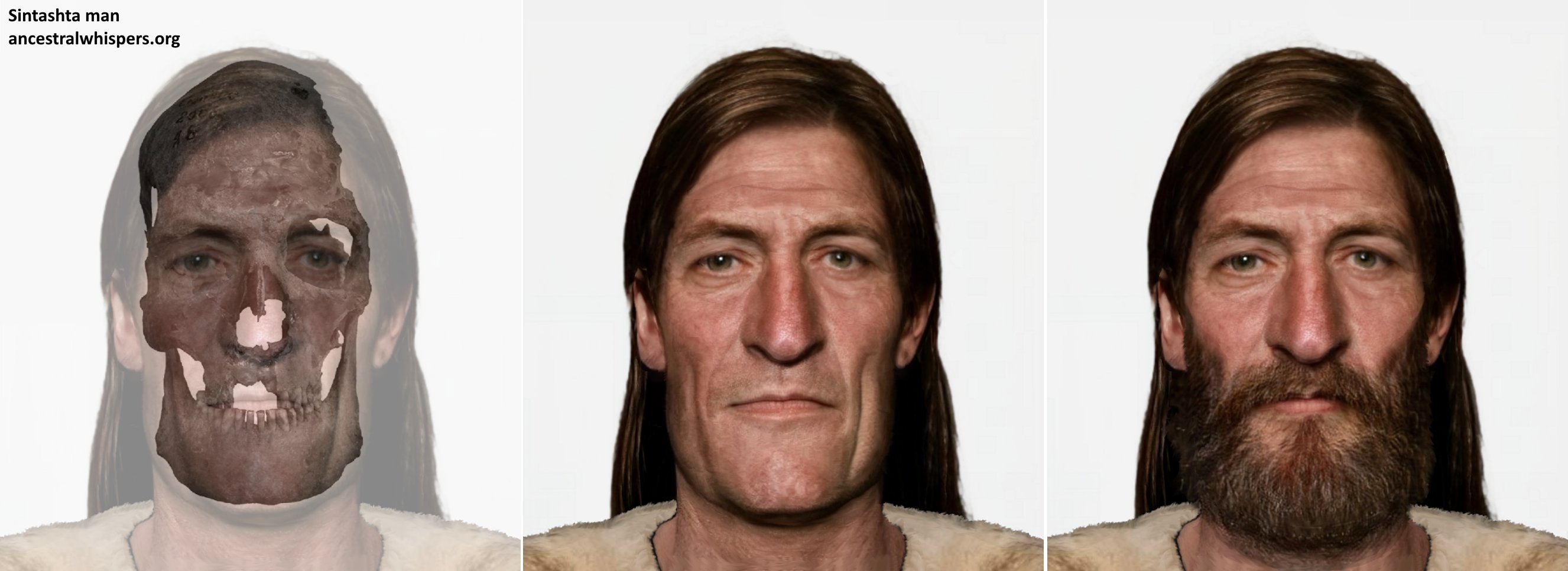
Sintashta were a people of European origin and their horses came from Yamnaya horses and Yamnaya domesticated their horses in Europe (see Robert Molyneaux's forensic reconstruction of a Yamnaya male above). Reminder that Sintashta, despite being Proto-Indo-Iranic speakers, the descendant languages of which are now found in Iran and India, were white people. So it is accurate to say that white people gave modern domestic horses to the world. Below are some reconstructions of Sintashta men by "ancestral whispers".
All this new information should be considered when we examine the evident Indo-European origin of horse sacrifice which I discussed at length in a documentary film on the subject.
EDIT: A new paper from March 2023 presents biological evidence that Yamnaya rode horses and they were the first to do so. So Europeans really were the first horse riders ever.
New genetic data on Tarim mummies disproves my claim that early Tarim mummies were Iranic. It also shows the likely origin of Tocharian languages is in the Dzungarian Basin just north of Tarim rather than Tarim itself. Tarim mummies date from 2000 BC to AD 200 yet this sample only looks at the very oldest of those. Even older samples (3000–2800 BC) in the new study are from the Dzungarian Basin and these samples appear to be Afanasievo derived and therefore are likely the source of Tocharian languages, and if so then the language moved South into Tarim from them, but the early mummies from Tarim itself, at least the 13 in this study which date from 2100–1700 BC, do NOT appear to be Tocharians or even, as I speculated in my video las year, Iranic speaking Aryans, rather an isolated refugia of ice-age like people predominantly descended from Ancient North Eurasians and West Siberian Hunter-Gatherers (WSHG themselves were 72.5% ANE, 7.5% West European Hunter-Gatherer, and 20% Ancient East Asian).
We can't say what language these Siberian mammoth hunters turned lizard-eaters of Tarim spoke (not an Indo-European one though), although we know the genes associated with Tocharian and Iranic speakers both entered the Tarim basin region later on. Interesting that the mummies appear to be European in phenotype despite not descending from Indo-European bronze age steppe peoples who are autosomally like modern Europeans. As the paper says:
“The Tarim mummies’ so-called Western physical features are probably due to their connection to the Pleistocene ANE gene pool,”
So they look physically European because they have ANE DNA. This also answers the question of why some Ainu people from Japan, and some ancient native American skeletons like Kennewick man, look like Europeans; They all have ANE DNA and ANE were obviously Europoid.
This also explains why the material culture of early Tarim people resembles that of Siberian peoples. Take the idols for example:
You find faces similar to this everywhere you find WSHG/ANE ancestry in Siberia and Central Asia. The Mansi, Kalash and Ket all make figurines in similar trends to this day.
It is important to remember that these new samples from Tarim represent only the first 400 years of that burial tradition which lasted a further 1900 years! Without samples from those following long 19 centuries we cannot say for sure when the WSHG people disappeared but I highly suspect that later Tarim mummies like Cherchen man (see below), who died c. 1000 BC, in all probability do have steppe admixture and could well be Iranic or Tocharian speakers.
Chercen man depicted by Andrew Whyte
Tocharian and Iranic speakers of steppe descent entered the Tarim basin from different routes at different times, but the original inhabitants were these ANE descended Siberian people and they mixed with the incoming Indo-Europeans. So I still think that Cherchen man and the Yanghai cannabis shaman were both Indo-European people.
So what do we know about the people of this Siberian ANE-rich refugia?
Their race underwent a bottleneck and formed over 9000 years ago
They were homogenous population scattered in the Tarim desert, rarely mixing with neighbours
They adopted pastoralist lifestyle from neighbouring steppe peoples
They consumed dairy products like kefir but were lactose intolerant
They farmed animals - likely due to Afanasievo influence
They were not European but they looked European due to ANE ancestry
They had genes associated with dark skin in SLC24A5 and SLC45A5 like East asians do
We don’t know what language they originally spoke
They likely adopted Tocharian and Iranic languages after mixing with their Afanasievo neighbours of the Dzungarian basin to the North who were related to Yamnaya, and Andronovo neighbours to the West who were Aryans. This occurred sometime after 1700 BC
They buried their dead with ephedra twigs like later BMAC and Iranic cultures did
They made idols similar to those made by other Siberian peoples
Who were the first cannabis users in history? Cannabis sativa has been cultivated by humans for thousands of years both as a narcotic and also for making hemp fabrics. Brand new genetic and archaeological evidence places the original domestication event in China, but indicates that the plant was mainly spread by Indo-European peoples such as the Yamnaya and the Scythians. Cannabis was used in the funerary and religious rites in many pagan religions as well as in ancient Jewish rites in Israel.
Bennett, C., ‘Cannabis and the Soma solution’ Trine Day (2010)
“Cannabis van 4200 jaar oud in graf Hanzelijn”
Damgaard, et al (2018). ‘The first horse herders and the impact of early Bronze Age steppe expansions into Asia’. Science.
Ecsedy, Istvan. People of the Pit-Grave Kurgans (1979).
Eran Arie, Baruch Rosen & Dvory Namdar (2020) Cannabis and Frankincense at the Judahite Shrine of Arad, Tel Aviv
Haak, W., Lazaridis, I., Patterson, N. et al. Massive migration from the steppe was a source for Indo-European languages in Europe. Nature 522, 207–211 (2015).
Hoffmann, K., Aufsätze zur Indoiranistik II, Wiesbaden, 1976. Georg Holzer, “Namen skythischer und sarmatischer Stämme,” Anzeiger der philosophisch-historischen Klassse der Österreichischen Akademie der Wissenschaften 125, 1988, pp. 193-213.
Hollard, C. et al. (2018). New genetic evidence of affinities and discontinuities between bronze age Siberian populations. American Journal of Physical Anthropology 167 (1): 97–107.
Long, T., et al., (2017). Cannabis in Eurasia: origin of human use and Bronze Age trans-continental connections. Vegetation History and Archaeobotany. 26.
Mandihassan, S., “Etymology of Names-Cannabis and Ephedra,” Journal: Studies in the History of Medicine, Vol.6, 1982
Merlin, M. 2003. Archaeological record for ancient Old World use of psychoactive plants. Economic Botany 57(3)
Narasimhan VM, Patterson NJ, Moorjani P, et al. The Genomic Formation of South and Central Asia. bioRxiv. (2018).
Ning, et al. (2019), ‘Ancient Genomes Reveal Yamnaya - Related Ancestry and a Potential Source of Indo-European Speakers in Iron Age Tianshan’
Ren, M., et al. (2019). The origins of cannabis smoking: Chemical residue evidence from the first millennium BCE in the Pamirs. Science Advances. 5.
Ren, G., et al. Large-scale whole-genome resequencing unravels the domestication history of Cannabis sativa. Sci Adv. 2021 Jul 16;7(29):eabg2286.
Rosetti Dinu V. Movilele funerare de la Gurbăneşti (r. Lehliu, reg. Bucureşti) / Les tumulus funéraires de Gurbăneşti. In: Materiale şi cercetări arheologice, N°6 1959. pp. 791-816;
Ruck, Carl, affidavit in Bennett v The Attorney General for Canada and the Minister of Health for Canada, (2009)
Rudgley, Richard, The Encyclopedia of Psychoactive Substances, (Little, Brown and Company, 1998)
Sarianidi V., Temples of Bronze Age Margiana: traditions of ritual architecture. Antiquity, (1994)
Sherratt, Andrew, “Alcohol and its Alternatives:Symbol and substance in Pre-Industrial cultures,” in Consuming Habits: Drugs in History and Anthropology, by Jordan Goodman, Paul E. Lovejoy, Andrew Sherratt, Contributor Jordan Goodman, (Routledge, 1995)
Sherratt, A. G., “Sacred and profane substances: the ritual use of narcotics in later Neolithic Europe” in E Garwood, D. Jennings, R. Skeates, andJ. Toms, eds., Sacred and profane: proceedings of a conference on archaeology, ritual and religion. Oxford University Committee for Archaeology Monographs. (1995)
Xie, M. et al, (2013) Interdisciplinary investigation on ancient Ephedra twigs from Gumugou Cemetery (3800 B.P.) in Xinjiang region, northwest China. https://www.ncbi.nlm.nih.gov/pubmed/23564427
Yang, Y. (2019), ‘Shifting Memories: Burial Practices and Cultural Interaction in Bronze Age China A study of the Xiaohe-Gumugou cemeteries in the Tarim Basin’
Zhang He, “Is Shuma the Chinese Analog of Soma/Haoma?” Sino-Platonic Papers, 216 (October, 2011)
The Yamnaya culture, also called the Kurgan or Late Ochre Grave culture, of the late Neolithic and Bronze age Pontic steppe is believed to be one of several Proto-Indo-European speaking Western Steppe herder peoples who were ancestral to many modern peoples and who spread Indo-European languages across Eurasia. But what did Yamnaya look like? In this documentary film you can see 3D forensic facial reconstructions of Yamnaya men by the artist Robert Molyneaux and you can learn all about what Yamnaya people ate, why they loved milk, how they lived, their burial customs, how they spread and more.
Chris Zabriskie - The Theatrical Poster for Poltergeist III
Borg - The Dancing Forest
Khan Kurra - Little dragon
Chris Zabriskie - I Am Running Down the Long Hallway of Viewmont Elementary
Sources
Ali J. Berens, et al. “The Genomic Health of Ancient Hominins.” Human Biology, vol. 89, no. 1, Wayne State University Press, 2017, pp. 7–19, https://doi.org/10.13110/humanbiology.89.1.01.
Clemente, et al. (2021). \The genomic history of the Aegean palatial civilizations’. Cell. 184. 10.1016/j.cell.2021.03.039.
Damgaard, et al (2018). ‘The first horse herders and the impact of early Bronze Age steppe expansions into Asia’. Science. 360. eaar7711. 10.1126/science.aar7711.
Frînculeasa, Alin. (2020). The Children of the Steppe: descendance as a key to Yamnaya success.
Gordon, Raymond G., Jr. (ed.), 2005. Ethnologue: Languages of the World,
Haak, W., Lazaridis, I., Patterson, N. et al. Massive migration from the steppe was a source for Indo-European languages in Europe. Nature 522, 207–211 (2015).
Hanel, Andrea. (2020). Skin colour and vitamin D: An update. Experimental Dermatology. 29. 10.1111/exd.14142.
Hegyi, Alexandru & Diaconescu, Dragos & Urdea, Petru & Sarris, Apostolos & Pisz, Michał & Onaca, Alexandru. (2021). Using Geophysics to Characterize a Prehistoric Burial Mound in Romania. Remote Sensing. 13. 842. 10.3390/rs13050842.
Khokhlov, A. A., ‘Morphogenetic processes in the Volga-Urals in the early Holocene (based on craniological materials of the Mesolithic-Bronze Age)’ Federal State Budgetary Educational Institution of Higher Education Samara State Social and Pedagogical University (2017).
Klejn et al. (2017). Discussion: Are the Origins of Indo-European Languages Explained by the Migration of the Yamnaya Culture to the West?. European Journal of Archaeology. 21. 1-15. 10.1017/eaa.2017.35.
Kotova, Nadezhda. (2010). Burial clothing in Neolithic cemeteries of the Ukrainian steppe. Documenta Praehistorica. 524486477634. 10.4312/dp.37.14.
Kruc, S. I., ‘Paleoantropologicheskie issledovaniia Stepnogo Podneprovia: (epoha bronzy)’ ‘Paleoanthropology of the steppe Dnieper region: (Bronze Age)’ ACADEMY OF SCIENCES OF THE UKRAINIAN SSR INSTITUTE OF ARCHEOLOGY, Naukova Dumka: Kiev (1984).
Lazaridis, I., Nadel, D., Rollefson, G. et al. Genomic insights into the origin of farming in the ancient Near East. Nature 536, 419–424 (2016).
Marnetto, D., et al. (2021). ‘Ancestral contributions to contemporary European complex traits’ bioRxiv 2021.08.03.454888
Mathieson, I., Alpaslan-Roodenberg, S., Posth, C. et al. The genomic history of southeastern Europe. Nature 555, 197–203 (2018).
Meyer, Christian et al (2009). The Eulau Eulogy: Bioarchaeological Interpretation of Lethal Violence in Corded Ware Multiple Burials from Saxony-Anhalt, Germany. Journal of Anthropological Archaeology. 28. 412-423. 10.1016/j.jaa.2009.07.002.
Narasimhan VM, Patterson NJ, Moorjani P, et al. The Genomic Formation of South and Central Asia. bioRxiv. (2018).
Olalde, I., Brace, S., Allentoft, M. et al. The Beaker phenomenon and the genomic transformation of northwest Europe. Nature 555, 190–196 (2018).
Preda-Bălănică, Bianca, and Alin Frinculeasa. “(2020)
B. Preda-Bălănică, A. Frînculeasa, V. Heyd, The Yamnaya Impact North of the Lower Danube. A Tale of Newcomers and Locals, Bulletin De La Société Préhistorique Française, 117, 1, p. 85-101.” Bulletin de la Société préhistorique française (2019): n. pag. Print.
K., & Linden, M. V. (2020). The spatiotemporal spread of human migrations during the European Holocene. Proceedings of the National Academy of Sciences of USA
Rascovan, Nicolas, et al. (2018). Emergence and Spread of Basal Lineages of Yersinia pestis during the Neolithic Decline. Cell. 176. 10.1016/j.cell.2018.11.005.
Rasmussen S, et al. Early divergent strains of Yersinia pestis in Eurasia 5,000 years ago. Cell. 2015 Oct 22;163(3):571-82. doi: 10.1016/j.cell.2015.10.009. Epub 2015 Oct 22. PMID: 26496604; PMCID: PMC4644222.
Romain Garnier, Laurent Sagart, Benoît Sagot. ‘Milk and the Indo-Europeans’. Martine Robeets; Alexander Savalyev Language Dispersal Beyond Farming, John Benjamins Publishing Company, pp.291-311, 2017, 978 90 272 1255 9. ff10.1075/z.215.13garff. Ffhal-01667476f
Saag et al, ‘Genetic ancestry changes in Stone to Bronze Age transition in the East European plain’ (2021)
Saag L. Human Genetics: Lactase Persistence in a Battlefield. Current Biology : CB. 2020 Nov;30(21):R1311-R1313. DOI: 10.1016/j.cub.2020.08.087. PMID: 33142099.
Susat, Julian. et al. (2021). A 5,000-year-old hunter-gatherer already plagued by Yersinia pestis. Cell Reports. 35. 10.1016/j.celrep.2021.109278.
Taylor, W.T.T., Barrón-Ortiz, C.I. Rethinking the evidence for early horse domestication at Botai. Sci Rep 11, 7440 (2021).
Ullrich, Herbert & Stephan, Carl. (2016). Mikhail Mikhaylovich Gerasimov’s Authentic Approach to Plastic Facial Reconstruction. Anthropologie (Czech Republic). 54. 97-107.
Wang, CC., Reinhold, S., Kalmykov, A. et al. Ancient human genome-wide data from a 3000-year interval in the Caucasus corresponds with eco-geographic regions. Nat Commun 10, 590 (2019).
Wilkin, S., Ventresca Miller, A., Fernandes, R. et al. Dairying enabled Early Bronze Age Yamnaya steppe expansions. Nature (2021).







/https://tf-cmsv2-smithsonianmag-media.s3.amazonaws.com/filer/51/9f/519fea8a-a215-48fe-ba09-fae09a0bb3e3/kennewick-hero.jpg "kennewick man")


