Showing posts with label swedish history. Show all posts

Friday, 15 March 2024

The Origin of Palaeo-Germanic in Sweden? A new pre-print.

‘Steppe Ancestry in western Eurasia and the spread of the Germanic Languages’ by McColl et al 2024 uses a novel method looking at IBD sharing to identify a previously unknown sub-population within Scandinavia’s Corded Ware culture which it calls “East Scandinavian”. 

    This population is alleged to have formed around 2000 BC which is 800 years after Corded Ware folk first entered Scandinavia. It is distinct from earlier Corded Ware populations in the region, and contemporary Corded Ware people in Denmark and Norway, because instead of just WHG admixture it has additional EHG admixture from a source their model predicts to come from Latvia/Lithuania. 

    The authors suggest a possible migration across the Baltic sea to explain this East Scandi group despite there being no evidence for this in the archaeological record. They point out that the “timing coincides with the introduction of a new, Late Neolithic sheep breed to Scandinavia. It also coincides with the spread of a new burial rite of gallery graves in south Sweden, the Danish islands and Norway, a new house type, the first durative bronze networks, as well as with the end of an east-west divide in Scandinavia between 4050 and 3650 BP. (2050 BC- 1650 BC)” Yet none of these new arrivals they list necessarily came from across the Baltic sea. 
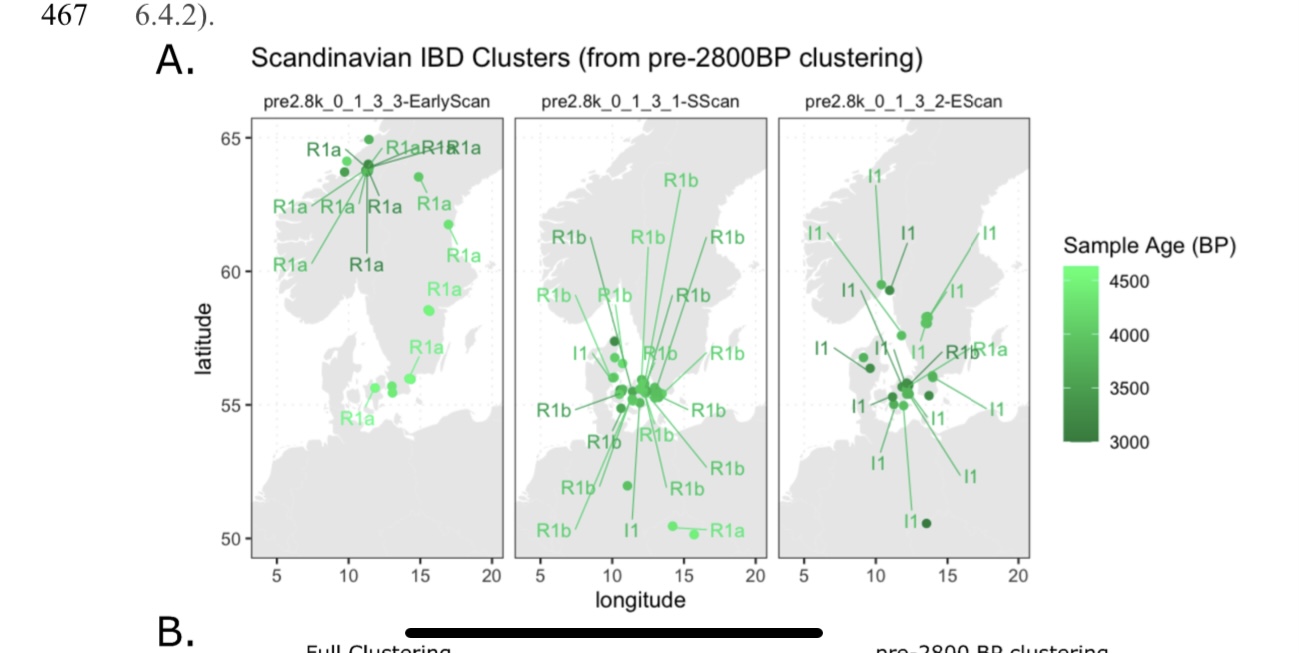


    The feasibility of a mass migration of a people across the Baltic at this period in history is questionable. Sea crossings from the South are far more plausible or even land routes via the Arctic North. Figure 4.A shows the geographical distribution of individual samples belonging to the 3 Scandinavian Clusters they identified existing prior to 800 BC, after which they merged. They say there is a strong correspondence between the clusters and specific haplogroups as follows: 

  1. Early Scandinavian including the oldest Swedish (Battle Axe Culture) and Danish samples and almost all Norwegians all have R1a. 
  2. A later ‘Southern Scandinavian’ cluster restricted to Denmark and the southern tip of Sweden mostly with R1b but some I1. 
  3. A second later ‘Eastern Scandinavian’ cluster, spread across Sweden and overlapping with that of the Southern Scandinavia cluster which is dominated by I1. 

     The third map of this so-called “Eastern Scandi” group shows mainly samples from the South though, and the I1 haplogroup distribution is not demonstrated to have come from the “East”, in fact it appears from this data to have come from the south. We already have an I1 sample from North Germany dating to 3300 BC, older than these samples, so by tying this newly identified group to the I1 haplogroup, they have brought into question their own claim that it has a Baltic origin. This will only be settled with the discovery of an I1 sample in a Corded ware context dating to around 2700 BC. 

 They admit that it is now necessary to confirm “the proposed Bronze Age source of the East Scandinavians along the Baltic coast.” My own view is that the elevated EHG ancestry in this East Scandi group may incorrectly have been identified as Latvian in origin due merely to a sampling bias, and lack of SHG samples. The elevated EHG in Sweden seems more plausible to be local and the I1 is most likely to have entered Scandinavia from the South, not across the Baltic. The reliability of their IBD method depends on the reference samples used. 

While I question their conclusions about the origin of this East Scandi group, I am more convinced by their suggestion that it was responsible for the spread of the ancestor of what became Palaeo-Germanic language in the period between 1050 BC - 500 BC when it borrowed from Celtic and into Finno-Saamic. They show that after 2000 BC the East Scandi group expanded into Denmark and Norway. The mixing of East Scandi with South Scandi is dated between 1700 BC-1400 BC which spans both Nordic Bronze age 1 and 2 and directly precedes the construction of the famous Kivik tomb in Scania around 1400 BC. 


This mixing event formed the Iron Age Scandinavian genetic profile such that by the Iron Age Jutland can be entirely modelled with the admixed Danish Bronze age source, while Iron Age Norway and the Danish Isles also have additional East Scandi admixture on top of the initial Bronze Age mixing, showing further migrations of these intrepid East Scandis. They say this admixed Iron Age Southern Scandinavian group is “central to understanding the Germanic dispersal” and I agree. We can trace the spread of IA South Scandi ancestry into Germany, Britain and the Netherlands. The findings about Germanic expansion in the historical period are very interesting too.

Friday, 10 February 2023

SUN CULT in a Nordic Bronze-Age Tomb at Kivik, Sweden


The rock art from the tomb of Bredarör at Kivik in Sweden is a window into the forgotten world of the Nordic Bronze Age. In this film I interpret all the esoteric imagery, including; sun-wheels, solar crosses, war chariots, armed warriors and ritual axes and boats. With the latest archaeological data, 3D scans and new CGI animations of the art, this film gives a new perspective on a tomb which is 3400 years old!


Kivik tomb
Arvid Fougstedt 1936

Art: 

CGI by Robert Molyneaux
Bronze age rites at dawn, Indian chariot, hellhounds, Wolf Viking by Christian Sloan Hall
Kivik reconstruction by Arvid Fougstedt 1936
Bronsåldern by Nils Asplund
Fra Bronsåldern by Rasmus Christiansen 1925
NBA king by Beaker Lady
Bronze age map by Dan Kogosov
Beaker Koryos by Moccus Art 

Sources: 

Bertilsson, Ulf et al. “The Kivik Tomb: Bredarör enters into the digital arena” New Perspectives on the Bronze Age (2017): 289–306.
Froncek, T., ‘The Northmen’ 1975.
Goldhahn - Bredaror on Kivik: a monumental cairn and the history of its interpretation 2009
Kaliff, Oestigaard ‘Werewolves, Warriors and Winter Sacrifices Unmasking Kivik and Indo-European Cosmology in Bronze Age Scandinavia’ 2022.
Kveiborg, Ahlqvist, Vandkilde. (2020). Horses, Fish and Humans: Interspecies Relationships in the Nordic Bronze Age. Current Swedish Archaeology. 75-98.
Nordquist, Gullög & Whittaker, Helene. (2007). Comments on Kristian Kristiansen and Thomas B. Larsson (2005): The Rise of Bronze Age Society. Travels, Transmissions and Transformations. Norwegian Archaeological Review. 40. 75-84.

Monday, 12 September 2022

Ship of the Sun or Ship of the Dead? Stone Ships


Stone ship settings or Skeppssättning are amongst the most remarkable Viking age monuments in Scandinavia, but what were they for? They were built over a period of 2000 years from the Nordic bronze age until the end of the Viking age, mainly in grave fields but they weren’t just associated with burials and cremations as they were also used for a kind of meeting called a ‘Thing’. This video explains how the stone ships may relate first to a Bronze age cult of the sun in Gotland, and later to a Viking belief that the dead would need a vehicle for a journey to and from the underworld. The stone ship settings included in this film are Tjelvars grave in Gotland, Anundshög in Västmanland, Åsa domaresäte in Södermanland, Ängakåsen and Ale’s stones in Scania and the Jelling stone ship in Denmark.


Art

Original works created for this video

Robert Molyneaux - CGI reconstruction of the Jelling stone ship in Denmark


Other art work used in the video

Christian Sloan Hall - Odin / First blood / Eastre dawn goddess
Roy Douglas - Vendel helmet cgi
Christopher Steininger - Ship to the otherworld animation
Stella Spente - Freyja in her chariot
Ryan Murray - Treudd ritual
Gemini Science - CGI ship burial
Graman - Sutton hoo burial
Eva Gjerde - Storhaug ship burial

Sources


MUSIC: 


The whole other - Ether oar 
Wolcensmen - Sunne (remix by Eternal Rik) 
Saichaika - Musica aeterna 
Halindir - Hedelandet II 
Bark sound productions - My 
Aaron Kenny - yonder hill and dale 
Patrick Patrikios - away 
Kevin MacLeod - Rites 
Stark von Oben - Praetorian Germanicus 
Stark von Oben - Winter Soulstice 
Ormgård - Séta 
Borg - Death of Winter 
Myling - Töcken 
Halindir - Hummocks in fog 
Rishi Shah - From Runes to Ruins 
Xurious - Steppe expansion

Wednesday, 16 June 2021

Holy holes: Passing through and looking through


Passing through rituals involving holes in stones and trees are widespread in Europe and beyond and are related to rituals that involve looking through a hole to see spirits. In this video we look at the passing through rituals associated with megalithic structures in Britain and Ireland, and the arboreal passing through rituals associated with oak and ash trees all over Europe, known as träddragning in Nordic countries. We also look at the related customs of looking through holes among the Sami and the Welsh, the Odinic ritual of looking through an arm akimbo as described in the Viking saga of King Hrólfr Kraki, and at the hagstone or adderstone tradition from Britain and the associated magical practices. 

Animations by Castor and Bollux animation: 
Will  
Eliot  
Efa 

Additional art by: 
Thomas Cormack - Elf blot 
 Christian Sloan Hall - Odin 
Graman Folcwald - Anglo-Saxon burial 
Christopher Steininger - Odin

Sources:

Camden, W., ‘Britain, or, a Chorographicall Description of the most flourishing Kingdomes, England, Scotland, and Ireland’ (London: George Bishop and John Norton, 1610) Copyright 2004 by Dana F. Sutton. 
Campbell, J. G., ‘Witchcraft & second sight in the Highlands & islands of Scotland’ (1902). Davies, J. C., ‘Folk-lore of West and mid-Wales’ (1911). 
Evans, George E., ‘The Pattern Under the Plough’ (1966). 
Guðmundsson, H., ‘Handan hafsins’ Háskólaútgáfan (2012). 
Hand, Wayland D. “‘Passing Through’: Folk Medical Magic and Symbolism.” Proceedings of the American Philosophical Society, vol. 112, no. 6, 1968, pp. 379–402. JSTOR, www.jstor.org/stable/985938. 
Kuusela, T., 'He met his own funeral procession': The Year walk-ritual in Swedish folk tradition. Chapter in: "Folk Belief and Traditions of the Supernatural". Edited by Tommy Kuusela & Giuseppe Maiello. Beewolf Press 2016. Pp. 58-91. 
Saxo Grammaticus. Gesta Danorum: the History of the Danes I, ed. Karsten Friis-Jensen, and trans. Peter Fisher (Oxford, 2014), book 2, ch. 7, pp. 138–39. 
Marwick, E. (1975) The Stone of Odin. In Robertson, J. D. M. (1991) An Orkney Anthology: The Selected Works of Ernest Walker Marwick (Vol 1). Scottish Academic Press: Edinburgh. 
McDowall, Sue ‘PASSING THROUGH & UNDER: A RITUAL HEALING IN ENGLAND’ Folklore Thursday blog. 
Ryan, Derek ‘Hag Stones, are they an example of authentic Irish folklore or a neo-pagan import?’ The Tipperary antiquarian blog (2019) 
Rydving, Hakan. (2010). The 'Bear Ceremonial' and Bear Rituals among the Khanty and the Sami. Temenos. 46. 31-52. 10.33356/temenos.6940. 
Skott, F., ‘Passing Through as Healing and Crime’ (2014). 
Thoms, William J. “Divination by the Blade-Bone.” The Folk-Lore Record, vol. 1, 1878, pp. 176–179. JSTOR, www.jstor.org/stable/1252358.

Sunday, 13 September 2020

Pagan Viking Travel Guide to Sweden / History documentary


In this film, i take you on a trip around Sweden's places of power; sacred spaces remaining from the bronze age, iron age and viking times. I travel through central Sweden to show you some of the most fascinating and mysterious archaeological religious sites and, through them, help you to understand a bit more about the ancient religion of the Norse peoples and where you can go in Sweden to see these things for yourself.

Art:

Viking warriors by Christian Sloan Hall
Treudd by Ryan Murray
Animated god pole and ship by Christopher Steininger


Map:


Sources:

https://www.academia.edu/1366943/The_Grave_as_a_Doorway_to_the_Other_World_Architectural_Religious_Symbolism_in_Iron_Age_Graves_in_Scandinavia
http://www.arkeologiskasamfundet.se/csa/Dokument/Volumes/csa_vol_18_2010/csa_vol_18_2010_s223-250_magnell_iregren.pdf
http://www.isvroma.it/public/pecus/graslund.pdf
http://cogito.ucdc.ro/2012/vol4n2/en/13_the-four-eyed-dog.pdf
https://core.ac.uk/download/pdf/147825787.pdf
http://www.arkeologiskasamfundet.se/csa/Dokument/Volumes/csa_vol_18_2010/csa_vol_18_2010_s79-103_bradley_et-al.pdf
https://www.researchgate.net/figure/Ulan-IV-kurgan-4-grave-15-3D-wagon-reconstruction-created-using-Autodesk-3-ds-Max_fig7_271587800

Friday, 15 March 2019

Thursday, 14 March 2019

Corn God: Endurance of pagan habits in 19th century Sweden!

An account of residual pagan practice in Sweden from 1877!

(Västergötlands Fornminnesförenings Tidskrift, Part 3. 1877. Page 60-61.)

A magazine by Västergötlands Fornminnesförening tells the interesting story of a wooden figure called "the Corn God", which used to be kept in the local church of Vånga. The journalist wrote: 

"Several years ago, Skara Museum was visited by an old man and his wife from Vånga. When he saw the figure he cried, ”Mother, here stands the corn god.” This prompted me to ask him what he knew about the sculpture. He then told me that folk in Vånga called it the Corn God, and that the farmers at spring time would smuggle him out from the church and at sunrise carry him around on the fields to attain good harvest that year. When, despite this, the crops still failed in 1826, one farmer knocked the nose off the figure on a Sunday. Shortly thereafter, the old man added, the sculpture went missing, but no one dared ask where it might have gone to.” 

Even though these people regarded themselves as Christians, they were still aware that this was something the priest didn't want them to do. They even called the figure a god. Not a very Christian thing to do! The figure itself is from late 13th century and depicts an unidentified apostle. The persona of the Corn God, reminiscent of Freyr, was imposed on it by the parishioners, but why? Montelius claimed it was not an apostle but Saint Olaf:

‘The fact that the worship of Saint Olaf [the Norwegian king killed in 1030 AD] was not, like that of the Swedish Saint Erik, limited principally to his own country, shows that there must have been some special reason for the prominent position he occupied within the northern Church … If the Christian Scandinavians looked upon him in the same way as their heathen ancestors had looked upon Thor, we can easily understand why it was so. Just as people in old days believed that Thor could grant good harvests, so even in the nineteenth century they have supposed Olaf to be in possession of the same power. Stories from the south of Sweden and from Denmark tell how the peasants were wont to drag the image of Saint Olaf round the fields after the sowing. The image of Saint Olaf in Vånga church in Vestergötland was carried round in that way, in spite of vigorous protests from the clergy. The peasants had given it the name of the “corn god”’


Montelius, O.A. 1910. The Sun God’s Axe and Thor’s Hammer. Folk-Lore 21(1910): 60-78.

This tradition is an obvious continuation of a Germanic tradition of parading an idol around the land to bestow it with fertility. The earliest source we have on this is Tacitus' Germania (98AD) in which he describes how the Germanic peoples worshipped a goddess called Nerthus whose idol toured the country in a ceremonial wagon drawn by Oxen. Similarly, the 5th century Palestinian historian Sozomenos wrote that the Goths under Athanaric had led about a wooden idol placed on a covered wagon. They passed by a tent of Goths who had converted to Christianity and demanded they pay respect to the idol and make offerings to it. He wrote that those who refused to honour the idol were burned alive in their tents. Finally, in the 8th century Einhard wrote that Childeric III, the last of the long-haired Merovingian kings (long haired rulers being a residual pagan custom) was a degenerate king who was purveyed about the country on a wagon drawn by oxen in an annual celebration, which we can infer was of pagan origin, and originally involved the ruler filling a similar role the idol of Nerthus had 700 years earlier. The touring of idols is also common in other Indo-European religions such as Hinduism. 

Montelius provides more on the enduring cult of Thor in modern Sweden:

Writing about Wärend, that old part of Småland where so much of the belief and customs of former ages still remains, Mr. Hyltén-Cavallius says, - ‘They still look upon the thunder as a person whom they call alternately “Thor” or “Thore-Gud,” “Gofar,” and “Gobonden” [The Good Farmer]. He is an old redbearded man. In 1629 a peasant from Warend was summoned for blasphemy against God. He had said about the rain,— “If I had the old man down here I would pull him by the hair on account of this continual raining.” Thus it is Thor that gives the summer rain, which therefore in Wärend is called “Gofar-rain,” “Gobonda-rain” [The Good Farmer rain] or “As-rain.” The rumbling of the thunder is produced by Thor’s driving in his chariot through the clouds. It is therefore called Thordön after him. People also say that “Gofar is driving,” “Gobonden is driving,” “The Thunder is driving.” Thor drives not only in the air but also on earth. Then they say that “he is earth-driving.” … The most noticeable trace of our country’s older worship of Thor is that “Thor’s day” (Thursday) was still in the nineteenth century considered as a sacred day, almost as a Sunday’ (Montelius 1910:76-77).