
Why we voted leave: voices from northern England from Guerrera Films on Vimeo.
Showing posts with label politics. Show all posts
Showing posts with label politics. Show all posts
Tuesday, 5 July 2016


Sunday, 8 September 2013
Friday, 21 October 2011
The Banning of Oi! Political Subversion in Popular Music
It has long been known that music has the power to inspire emotion into the hearts of audiences. This fact has been utilised historically by politicians, activists, military leaders, musicians and film makers as a way to manipulate the subconscious of the listener into considering a certain ideological message to be more credible.
“Plato worried that music might generate lawlessness; new types of song and forms of music that were created within a society, or music that came from outside, could have a direct impact on the entire society.” Negus (p. 200)
Words that on their own have little effect on those who hear them, attain new significance and meaning when spoken or sang over a piece of music. The political sentiment or intent of the artist is sometimes manipulated and assigned new political meanings by those who wish to benefit from the ideological power of music.
“In 1987 Imagine was collectively sung at a Conservative party conference in Britain to greet Margaret Thatcher – one of Britain’s most right-wing leaders, who led one of the governments least sympathetic to social democratic principles since the Second World War.” Negus (p.195)
John Lennon’s Imagine is largely recognised as an expression of socialist values; however it was effectively used in an opposing political context by the Conservative party. This can be seen as an example of the Marxist Antonio Gramsci’s theory of hegemony in which those with power adopt a variety of cultural symbols to promote their own ideological message. In Britain during the 1970s and 1980s there was a great deal of music associated with both left and right wing politics. Both used the issue of racial tension as a way of rallying support for their causes.

The Rock Against Racism (RAR) concerts started in the 1970’s and were associated with punk rock and reggae music. The movement claimed to be a response to racist organisations but was also clearly an attack on opposing political values, “It was a movement formed in reaction to rising xenophobia and racism fuelled by Nazi organisations like the National Front.” (RAR website) Popular punk musicians such as Tom Robinson, The Clash and X-Ray Spex were aligned to the movement, however all of those were renowned for their left wing politics. The movement attracted its following through talk of racial equality and ending violent attacks, but beneath these objectives was the hidden motive to subvert Marxist politics to a generation of young and impressionable music fans.
“RAR strengthened the idea that rock music could be about more than entertainment, and in a sense provided the inspiration for similar campaigns in the 1980s” Shuker
A rival movement Rock Against Communism (RAC) was started in 1978 which also used music to communicate a political message to young people. RAC concerts were usually held in opposition to rival political groups such as Anti-Fascist Action and the Anti-Nazi League. They were often headlined by Skrewdriver, the most well known of right wing punk rock bands, but also featured other prominent groups.
The RAC was loosely associated with organisations like the National Front, and appealed to working class, white rock fans who were opposed to the communist propaganda prevalent in rock music at the time. RAC bands and their fans were concerned with social problems like unemployment and the increasing immigrant population.
“Europe what have they got to do to make you come alive?
What has happened to the heritage that once was yours and mine?
A capitalistic economy, the communists rule the streets.
The old people aren't safe outside, what solution do we seek?” Ian Stuart
Skrewdriver – Europe Awake (1984)
The political divide within punk resulted in disturbing outbreaks of violence which prevented bands such as Sham 69, who attracted fans from both political ideologies, from playing gigs. Sham 69 were able to acquire a wide fan base because their lyrics were based on personal politics and the issues that working class people of Britain are familiar with such as drinking, football, unemployment and a general mistrust of all politicians. This was noticeably different from Tom Robinson, Billy Bragg and Skrewdriver who were vocal about their political ideologies and used music as a way of trying to influence others and align them to their own ideology.
Other bands started to do the same and eventually a sub-genre of punk was formed known as Oi! the creation of which was credited to journalist Garry Bushell who intended to help launch a genuinely working class punk movement, with the emphasis on skinheads. Oi! differed from punk because it attracted more of a skinhead audience; creating rock music with specific relevance to the British working class. However, as with Sham69, the non political music attracted a politically active fan base.
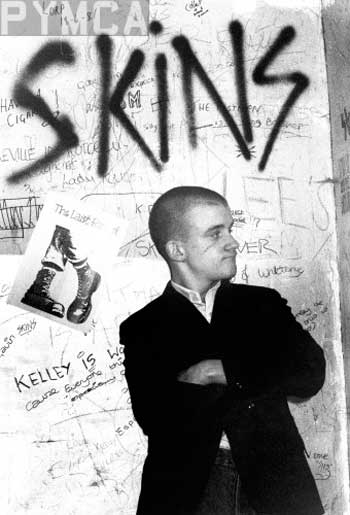
“A big problem with skinheads was despite their fondness of Jamaican music, many 60s/early 70s skins were, paradoxically, racist. To Bushell and the majority of the ‘New Breed’, skin was much more innocent, an affirmation of working class pride” Terrorizer#96 January 2002
The movement was subject to much criticism and was accused of being racist. Although there were leftist political Oi! bands such as The Oppressed and The Angelic Upstarts who were both outspoken about their socialist beliefs, the majority of Oi! bands were proud of their anti-political message that suggested people could make their own decisions without aligning themselves to a preconceived political ideology. The movement undeniably attracted a partially racist audience which resulted in a riot in Southall July 1981, after members of the local South-Asian community set fire to the Hamborough Tavern which was hosting an Oi! concert featuring The Business, The Last Resort and 4 Skins, none of which were racist bands. The bands went to organisations such as RAR in an attempt be cleared of the racist tag assigned to them by lying journalists, like those working for the BBC, but they faced difficulties...
“One such difficulty arose in 1981, when a concert was organised under the banner of ‘Oi! Against Racism’ [...] Proponents of Oi, who defended it as working class music, not white music, wanted to polish its tarnished image through links with RAR. But RAR were wary of such moves, and they turned down a suggestion for a gig under the RAR banner in Southall; the bill was to have included a reggae band, An Asian group, and the 4 Skins […] RAR were suspicious of both the interests of the organizers and of the motives of the 4 Skins, and made their own counter suggestion: an Anti-Racist Skinhead concert in Sheffield, where local skinheads had been vocal in their denunciation of racism. RAR also suggested that none of the Southall bands be involved, preferring an Oi group with proven support for RAR.” (Street, 1986)
This is evidence of the hidden motives of musical organisations like RAR and more recently ANTIFA. Their intention was not merely to eliminate racism from youth culture, but to use this goal as a means to rally support for an exclusively Communist movement, the festivals of which had no room for bands that merely wanted to express their support for anti-racist causes. Such events have come under media criticism for failing to make any progress in race relations in Britain, as a result of their policy only to preach to the converted.
“The last festival of this ilk that I attended, in Burgess Park in South London, was a wonderful day out – but I do not recall a single person uttering to their skinhead mate; “It was a good thing I came today. I was racist but now I’ve seen the light.” Instead, what I saw, among the youths on a day out with their mates, were thousands of middle-class white folks patting themselves on the back for being so tolerant.” Taylor, The Guardian
The Oi! movement became a taboo subject in media and journalism circles after being tarnished by the right wing image associated with what was in fact a small minority of fans. The lyrics of the songs, however, demonstrated mistrust of politicians from both sides.
“Vote for Maggie Thatcher or Tony Benn, you’ll always lose you’ll never win.”
4 Skins – Manifesto (1982)
The racist element was exaggerated by left-wing organisations who were threatened by a movement that encouraged young people to question the left wing hegemony in anti-Thatcherite politics. But it was the media’s demonisation of Oi fans as racist skinhead yobs that led to a moral panic and ultimately censorship of the music from broadcast, performance and distribution. There are eye witness accounts of journalists from The Times paying crowds of young skinheads to "Sieg Heil" for the camera so that the photograph would support the accusations made so frequently in reports. Cohen explains how a moral panic may arise around the emergence of a youth subculture.
“A condition, episode, person or group of persons emerges to be defined as a threat to societal values and interests; its nature is presented in a stylised and stereotypical fashion by the mass media; the moral barricades are manned by editors, bishops, politicians and other right-thinking people; socially accredited experts pronounce their diagnoses and solutions; ways of coping are evolved or (more often) resorted to; the condition then disappears, submerges or deteriorates and becomes more visible.”
(Cohen, 1980: 9)
BBC news broadcasted an expose on Oi! interviewing the 4-skins and doing their best to depict the movement as dangerous and racist. Only DJ John Peel leapt to the defence of the movement, pointing out that unlike 4skins, popular acts such as Joy Division did use Nazi imagery and slogans in their lyrics but were not attacked by the media. The focus of the program, other than the Southall riots, was journalist Garry Bushell’s compilation ‘Strength thru Oi!’ (1981) which shop keepers were arrested for attempting to sell after it was learned that the title was a play on the Nazi slogan ‘strength through joy.’ The bands on the compilation were not racist but the lyrics did encourage violence against police which contributed to it being banned.
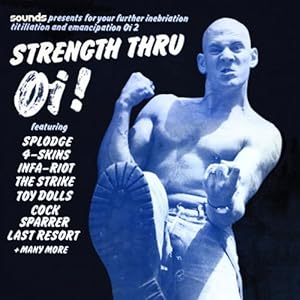
The movement was therefore attacked by left wing movements and media for accusations of racism, but also attacked by the Conservative government who banned the music from being sold, broadcast or performed in Britain. Oi! is comparable to rap in the fact that the controversial issues raised by young musicians were attacked by both the right and left wing.
“In 1990 rap music became the main target of the anti-rock, pro censorship lobby. The new genre had already been attacked from the left for its sexism and homophobia, and was now criticised from the right for its profanity and obscenity.” Shuker (page 267)
Like gangster rap, Oi! music was criticised for advocating violence and general encouragement of criminal activity (theft, benefit fraud, football violence). Unlike rap, Oi! music rarely glamorised violence, and condemned the use of guns. Oi! described how those born into poverty must adopt violent behaviour in order to survive; it also has a strong sense of community and family values which generates the patriotic element of the movement which some misinterpreted as fascism. If the movement were right wing in the institutional sense then it would have been unlikely that the Conservative government would have opposed it. The movement was above all else a reaction against Margaret Thatcher and the Conservative government of the 1980’s.
“Margaret Thatcher the stupid bitch
Takes from the poor and gives to the rich
She thinks we can’t see her plan,
To kill the spirit of the working class man,
Make us redundant; put us on the dole,
Put us in prison without parole.”
The Last Resort – We Rule O.K.
The fact that the bands were so critical of the Conservative government and left wing activists is probably the most likely reason that the movement was so viciously slandered and attacked by the respective camps. This is why two opposing political ideologies were able to unite in the common purpose of banning an art form that encouraged intellectual working class independence and a coherent national identity for British youth. The climate of fear generated by the media was required in order to rally public hatred against the movement.
“a moral panic takes place within what Gramsci defines as a developing ‘crisis of hegemony’, arising out of a particular historical context where the dominant class is endeavouring to win domination and consent through ideological means.” Shuker
Although claiming to be non-political, the politics of the genre were clear; they were an expression of the real activities that young men were occupying their time with in 1980’s Britain. The way the media, government and certain leftist political organisations tried to censor the movement is comparable to the efforts of the Nazi party attempting to ban jazz music in Germany during World War Two.
“The Nazi party were particularly concerned about the influence of jazz, which was considered to be a ‘degenerate music’ […] The Nazis began further to regulate the repertoire that musicians used in performance and also monitored and controlled the catalogues of songs that were printed and distributed by music publishers.” Negus
By this definition the actions of the Conservative government and of ANTIFA and RAR attempting to regulate freedom of expression through music are more comparable to the actions of the Nazi party than are those of the young men who expressed criticism of the government and other political organisations through the medium of Oi! music.
Bibliography
Cohen, S (1980) Folk Devils and Moral Panics, Oxford: Robertson
Street, J. (1986) Rebel Rock: The Politics of Popular Music, London: Blackwell
Taylor, A. Music Festivals against racism give everyone a grand day out – but are they any use? Monday May 29, 2006 The Guardian
Negus, K, (1996) Popular Music in Theory: An Introduction. Polity
Shuker, R, (2002) Understanding Popular Music. Routledge
Selzer, J(January 2002) Under the Skin. Terrorizer issue number 96
RAR website
Gramsci, A. (1971). Selections from the Prison Notebooks. London: Lawrence and Wishart.
Discography
4-Skins – ‘The good the bad and the 4-skins’ Secret Records, 1982
The Last Resort – ‘A way of life’ Captain Oi! 1982
The Business – ‘The anger and the truth’ Hellcat records, 1997
Skrewdriver – ‘Hail the New Dawn’ LP.’ Rock-O-Rama. 1984
Wednesday, 26 May 2010
Folklore on Tour - Simon Costin

Most countries in Europe have places where they celebrate their bizarre old traditions. But Britain, despite its rich history, has no properly funded institution where people can research and celebrate our native traditions and vernacular arts.
Simon Costin is a remarkable individual who has devoted his life to the accumulation of information and artefacts relating to ancient rites and festivals that occur around these isles every year, some of which are centuries old.
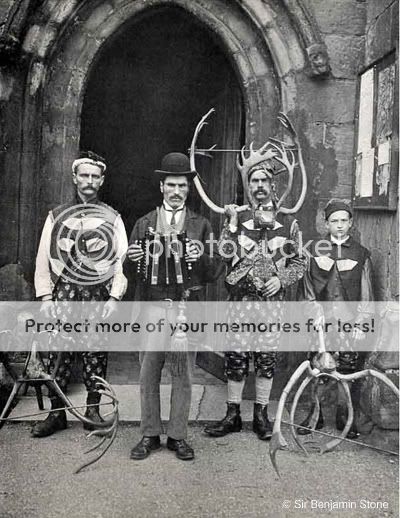
"I intend to establish a permanent collection and national exhibition centre that celebrates and promotes the Folk Culture of the British Isles" he claims. But for now, his museum is on the road. He takes his caravan of artefacts and books around the country to various village fetes in an effort to spread information about these fascinating traditions before they are lost.
Why is it Britain doesn't already have a museum of folklore?
Simon: I suspect there are a number of reasons for our not having any kind of permanent research facility here in the UK. Firstly, the very subject of folklore is perhaps a difficult one to be represented within a museum context. It would come under the heading of 'Intangible Heritage'.
There are very few objects or representative artefacts associated with our annual customs that are not either still in use or that are only constructed for the duration of the event and are then destroyed. Things such as the figure of the Jack from May Day's Jack in the Green, Well Dressing's, Garlands, Lewes Bonfire figures, Punkie Day carved turnips etc, all only exist while the festival is happening. This presents a problem for museums. Should the objects themselves be sourced and preserved in some way? Is there legitimacy if replicas are being made?
So there is a problem from a curatorial point of view as to the kinds of objects that can and should be displayed. This may have discouraged people from tackling the subject in the past.
Another reason could be the way the media has trivialised folk customs in the press, only choosing to highlight the nation's ambivalent attitude towards Morris dancing, or reporting on the casualties of cheese rolling for instance. There have been very few in depth reports, possibly because lazy journalists find it easier to ridicule than study.

Do you think that interest in folklore is tainted by political associations?
Simon: Recently, far right groups such as the BNP, have taken to selling the CD's of various folk musicians at their meetings and attaching spurious meanings to 'Traditional' British songs. This has prompted the formation of a group called Folk Against Fascism which has gained a strong following within the folk community, who are keen to point out that they have absolutely nothing in common with the ideology of the far right.

That the playing of traditional music should be co-opted by a group such as the BNP is of no surprise and it could be argued that in Britain today, anything deemed to be a celebration of certain parts of the UK's national culture has been tainted by the far right, to the point where even the word 'British' carries negative undertows. That can be said of any national symbols which become corrupted by political groups.
Folklore is something that is created by the people living in a specific culture and is a universal phenomena with many cross overs with other nationalities. After all, it deals with universal themes; the coming of summer and the beginning of winter, celebrations of life and memorials for the dead. The origins of that most British dance form, the Morris, are thought to have derived from the Morrish dances of North Africa. St. George was possibly a Roman or a Turkish solider who never even visited the UK. Small minded political groups who would deny this world view do so by showing their ignorance and intolerance.
*Note from STJ - Simon may not be aware that St. George was a Greek speaking Roman born 1000 years before the Turks conquered Byzantium! He was NOT Turkish! Also the theory that Morris dancing is based on dances of the Moors is not proven and is based only on the fact the words look similar. Even if the word Morris is derived from the word Moorish, that is not necessarily because the dances are related, and may be because the dance is based on a Spanish dance after the Reconquista, which celebrated the eviction of Moors from Europe...or the words may be unrelated entirely!

How is folklore relevant to British people today?
Simon: Folklore can be said to be a body of traditional belief, custom, and expression, handed down largely by word of mouth and circulating mostly outside of commercial and academic means of communication and instruction. Every group bound together by common interests and purposes, whether educated or uneducated, rural or urban, possesses a body of traditions which may be called its folklore.
Folklore is reflected in everything from the names we bear from birth to the names of our local pub; The Green Man for instance. Folklore is the slang we use, the secret languages of gangs from school children to guilds and masonic groups. It is the shaping of everyday experiences in stories swapped around the kitchen table or told on blog sites. Folklore can be a roadside shrine to commemorate a killed pedestrian or the massive public display formed when Princess Diana died. Folklore is the cry of fox-hunters as they ride across a field and the weather lore of a farmer. It is scrawled on urban landscapes by graffiti artists or woven into the fabric of churches, mosques and temples. Folklore is community life and values, artfully expressed in myriad forms and interactions. Universal, diverse and enduring, it enriches the country and makes us a commonwealth of cultures.
What is your favourite custom/legend in British folklore?
There are far too many to mention but some of my personal favourite customs would have to be Padstow on May Day, the Hastings Jack in the Green Festival, the Barrel Burning in Ottery St. Mary and Lewes Bonfire.
Can you tell us one of the most unusual things you have encountered while touring?
There was nothing particularly unusual as such but certainly one of the most heart warming was the huge amount of support the project was shown from the many thousands of people who visited the caravan and the way that everybody said the same thing, 'Why is it that British people don't seem to value their native customs and traditions like other people in Europe do?'

So what plans do you have for the museum in 2010?
I'm planning a series of mini museum exhibitions which would ideally be situated in various houses which are open to the public. The first will be at Port Eliot in Cornwall, where they have the Lit Fest in August. Each show will deal with the folklore of the region and take one or two of the festivals which take part in that area and look at their history and development.
Then at the end of May, opening on the 29th, is an exhibition featuring work by the various artists who have been involved with the museum project to date such as Jonny Hannah, Mark Hearld, Clare Curtis, Riitta Ikonen, Tamsin Abbot etc. This will be at the Hexham Art Gallery for the Folkworks Hexham Gathering.
The caravan will be appearing at the Ditchling Fair on the 19th June.
There's to be a big folk concert in mid October probably at the Union Chapel although this has yet to be sorted out. This will be done under the museums music umbrella.
There are also going to be a series of mini museum exhibitions opening across the UK, the first being at Port Eliot in Cornwall on 3rd April. Then there's an art show at the Hexham Gallery on May 29th which runs for a month. The caravan will be making an appearance at the Ditchling Festival and the Compton Verney Summer weekend. In October there will be a large concert to raise awareness of the project in London.
Check out The Museum of British Folklore website to learn more
http://museumofbritishfolklore.com
Friday, 9 January 2009
Breast Surgery in Revolutionary Venezuela

Fake Tits in Venezuela – The ultimate degeneration or an indication of democracy at work?
Venezuela is a country of extreme contrasts. The landscape ranges from the Andean mountains to Caribbean coast and Amazon jungle. The people descend from primitive indigenous tribes, imported African slaves and European conquerors. Venezuela was liberated by national hero Simon Bolivar with the aid of the British army. The modern political history is just as turbulent. Since liberation, a variety of tyrants from all political persuasions have sought to exploit the many natural resources of the country; oil, gold, diamonds, water and the people themselves. The current president, an ex-convict, socialist coup leader, Hugo Chavez, is no less controversial than his predecessors. He has been criticised by globalist powers for manipulating world oil prices after being made president of OPEC, socialising with the likes of Fidel Castro and Saddam Hussein and also for making un-diplomatic statements such as referring to the king of Spain as a fascist and George Bush as the devil.
In the West we hear a lot of negative things about the Venezuelan government and although it is true there is a certain amount of incompetence for which they should be held accountable, the idea that they are imposing some kind of undemocratic communist dictatorship is not true. The press is free to write slanderous lies about the government, more so even than they are in England (there are fewer libel laws in Venezuela). Claiming the elections are not fair and democratic is far-fetched as they were overseen by the ex-US president Jimmy Carter and utilise an electronic system that can’t fall prey to the confusion caused by the cross or tick problems seen in Florida.
Chavez is an outspoken kind of politician, never afraid to speak his mind on the most trivial of issues; he even has his own day time TV talk-show called Hello President which is like a cross between Jeremy Kyle and Question time. One of the statements made on the show last September was a criticism of the Venezuelan attitude towards cosmetic surgery and female beauty; particularly the popular phenomenon of teenage girls being given breast enlargements as birthday presents from their parents.
"Now some people think, 'my daughter's turning 15, let's give her breast enlargements.' That's horrible. It's the ultimate degeneration."
Venezuela is world renowned for its beauty queens, producing more international pageant winners than any other country. If you visit the beaches and cities you can’t help but notice the number of women sporting over-sized artificial breasts. There is no social stigma associated with cosmetic surgery. Middle class women are almost expected to be vain and image obsessed. There was once a mayor of Chacao, a wealthy district in the nation’s capital Caracas, who had previously been a beauty pageant winner. She also ran for president but could not compete with Chavez. I was told that businessmen whose secretaries are not well endowed may be perceived as being losers. This attitude toward a women’s body suggests a sexist culture, this however is not an accurate perception.
Women in Venezuela have infiltrated all areas of power, from science to the military. They are also usually the head of the household; it is not uncommon for a woman to have children with a number of fathers and take her children with her, gaining support from interchangeable husbands. Despite the fact the women are culturally independent and certainly not passive slaves to patriarchal tyranny, one can’t help but wonder if some of these doctors are taking advantage of the insecurities of young women who aspire toward the national ideal of pageant winning beauty, plastic tits and bleached blonde hair. Essentially the same ideal of beauty as is prevalent in California. Chavez also criticised the culture, claiming it was indicative of an Americanised Barbie doll ideal, totally inappropriate for a largely brown skinned country like Venezuela.

When I asked young women about their reasons for wanting surgery, they were defensive in their responses, perhaps seeing the question as an attempt to invalidate their decision. Typically they said that they were doing it for themselves and not being pressured into it by peers or boyfriends but when pushed they would admit to doing it for their careers or because they had a negative self-image. This could be attributed to the way the media in Venezuela constantly portray Americanised visions of beauty as an ideal for women to aspire to; whether on the popular soaps known as telenovelas or on the billboard beer commercials with bikini clad Barbie beach babes, almost always white and no strangers to the surgeon's knife. The popularity of breast surgery and other non essential cosmetic surgery seems unashamedly decadent when you consider that Venezuela is a country where the vast majority of the population live in cinder block houses in vast crime ridden shanty towns. These shanty towns known as barrios are amongst the most dangerous neighbourhoods on the entire American landmass, and it is here that Chavez finds support.
The underclass has been repressed for decades and their problems ignored by a succession of governments, but Chavez’ Bolivarian revolution promised to change this and to some extent it has, with a number of projects and education initiatives providing university education for free as well as housing and food discounts for students. There are also initiatives to provide low level education for children and adults as well as healthcare to those who have fallen through the nets, all paid for with the country’s vast oil wealth, much to the dismay of the old leaders of nationalised oil company PDVSA, who had previously profited in unfair proportions from the oil money. Chavez has registered those living in the Barrios as official citizens with the power to vote. Under the previous president Carlos Andres Perez, they weren't even acknowledged as citizens of Venezuela because their shanty town dwellings are built illegally and births are often unregistered. To the young women of the barrios, breast surgery is a ridiculous luxury that they hold little to no interest in. The young women of the barrios now have hope, They can afford to become students as there are no fees and students get housing and food for heavily reduced rates. Many of them are using the new opportunities to promote the revolution and are ferocious supporters of Hugo Chavez.
There is a lot of tension between the privileged oligarchy and the underclass and the political propaganda of Chavez’ party and the opposition parties tend to exasperate the situation. Opposition supporters sometimes call for the assassination of Chavez who they see as an under-qualified maniac who has given power to a dangerous criminal under class. Chavistas on the other hand regard the wealthier class as decadent, bigoted, right-wing tyrants, whose greed fuels their hatred for the revolution. This tension is certainly not helped by the vast and obvious wealth divide. While some women can go on weekend shopping sprees to Miami, live in waterfront mansions or luxury penthouses and spend a huge amount on luxury items and services such as breast enlargements and designer clothing, other women struggle to keep their children fed and clothed. There are large families living under corrugated iron roofs in tropical conditions where dengue and malaria are a constant threat to their children’s lives and medical treatment is still difficult to acquire.
Many medical professionals in Venezuela refuse to work in public hospitals and won’t go near the practices set up in the Barrios to give treatment to those that need it most. The president tried to overcome this by importing doctors from Cuba, which his good friend Castro was happy to supply. Instead Venezuelan doctors go where the money is, either working for a private practice in Venezuela or perhaps more frequently working abroad. Of course, a career in cosmetic surgery is a lucrative pursuit in Venezuela or California. I saw plastic surgery practices in every city centre and was shocked how easy it was to get surgery. Virtually no checks are made in regards to the ethics of treatment. When I interviewed a surgeon, he said as long as they are of legal age or below age but have parental consent and can pay, then there is no ethical concern. I asked him if he thought that his skills could be put to better use elsewhere for the services of his country “I have to make a living too” was his nonchalant reply. It seems that as long as it is convenient and financially viable to exploit people rather than to help them, then Venezuela’s people will continue to suffer and the divide between rich and poor will continue to grow.
Thursday, 10 April 2008
Challenging the Media War on Chavez.

Hugo Chavez - President of Venezuela
I had been planning a trip to
So it was with a certain sense of optimism and hope that I stepped through the doors of the Venezuelan embassy in London on a pleasant April evening where his Excellency the Venezuelan ambassador Samuel Moncada was to give a speech. A speech in which I hoped the record would be set straight in regards to the relationship between Chavez and the people of Venezuela. I have no doubt that just as Chavez and Moncada say, the Western media is biased against his government. The night marked the 6th anniversary of the military coup that attempted to overthrow the government of President Hugo Chávez and to reverse Venezuela's social gains. Since then there have been ongoing attempts to isolate the Chávez government, including through the dissemination of misinformation. Sure enough, nearly all the news I have heard with regards to Venezuela has been negative; Student protests, widespread hunger, violation of the right to freedom of expression, exchanging insults with the king of Spain, dodgy oil deals with everyone from mayor of London Ken Livingston to President of Iran Mahmoud Ahmadinejad. Most of all - personal attacks on Chavez, who, if certain aspects of the media are to be believed, is taking away the rights of Venezuelans and destroying rival parties. I am assured by Samuel Moncada and the secretary and founder of the Venezuela Information Centre, Gordon Hutchinson, that this is all lies. Chavez, they say, is merely proposing a coalition of all the left wing parties, but opposition still exists and he allows free elections. The media say that Chavez has made a huge mistake allowing oil to be sold so cheaply in his country, and that many are starving, Mr. Moncada and Mr. Hutchinson say that social and economic progress has never been so advanced, and that the majority of their energy needs are met by hydro electric power, and that they are progressive in respect to investing in renewable energy technology.

Samuel Moncada - Venezuelan Ambassador
For every unsubstantiated claim made by Western journalists, both of liberal and conservative persuasions, there is a Venezuelan official or Chavez admiring socialist defender to call it lies and offer their own propaganda. To sort the truth from lies from half way across the world is virtually impossible for two reasons; firstly that the Western media is a propaganda tool obviously used as a means of perpetuating Western ideology and defending a global free market, secondly that some aspects of the media of Venezuela and many of the alternative sources of information such as the lecture of that evening, are merely a forum for socialist back-slapping and feeding the fires of anti capitalist conspiracy theories. The speakers at this evening's lecture were seemingly honest in that they acknowledged there are people in Venezuela, particularly middle class whites, who oppose Chavez, but they said as well as anti socialist students there are pro Chavez students. Their main concern was not just that the Western media makes up lies but more that it disproportionately reports political events in Venezuela with the intention of rallying Western support for deposing Chavez as a dictator despite the fact the vast majority of Venezuelans love him.
The evening ends with questions from the floor. Several people stand up to make vaguely relevant points about biased media broadcasts and socialist uprising in South America. There are also some contributions from bizarre individuals eager for any opportunity to shout their heads off about the evils of capitalism; none asks a proper question, which irritated me. I wanted to ask about speculations of Chavez being involved with the FARC and claims in the American media that evidence had been found on a laptop proving Chavez’ secret involvement with that Colombian terrorist organisation. Mr. Moncada doesn’t address this issue, but he makes it clear anyone who attempts to describe
“Come to
(I travelled to Venezuela later that year)
Friday, 22 February 2008
Shaun Bailey - the Tory tough guy

Shaun Bailey - the Tory tough guy
The fog on the Thames hung over Hammersmith as if from a Dickensian scene. I was out freezing my fingers to the bone, waiting for Shaun Bailey, prospective Conservative MP for North Kensington, who was meeting a mainstream men’s fashion magazine for an interview about his clothing. When, exactly, politicians became associated with style, I don’t know, but that, it seems, is the world we live in now. I took this opportunity during my internship to ask Mr. Bailey a few more pressing questions in an effort to get some insight in to what direction Mr. Cameron was taking the party.
Shaun Bailey is by no means your average Tory. He is a heavy set, bald headed black man, who was brought up by a single Mum in his constituency of North Kensington. He’s is proud to represent the community he grew up in, saying, “I understand it better than I do a community of pig farmers in Berkshire!” Perhaps having a dig at me, A Berkshire country boy, hijacking this photo-shoot for my own unsolicited and unauthorised interview. He claims he avoided the perils of an impoverished black community - drugs and violent crime - by getting involved in the army cadets, which taught him discipline and gave him what he describes as an appreciation for British culture.
I don’t doubt Mr. Bailey when he says he cares about his community; he has worked for years as a social worker and running charities to help people from disadvantaged backgrounds in Britain. Despite his admirable CV, his views come as a surprise on some issues. He says that Labour is ripping off the working class of Britain by making them dependent on the state. In his words, “we’re born with only one instinct, to suck.” I can see where he is coming from, but I wonder what alternatives he could propose to the welfare system.
Youth crime is a major issue to Bailey. He says he was stabbed, that crime is a problem and he blames things like MTV, which he says subjects impressionable young men to graphic sexual imagery, and glamorised violence which encourages dissidence and anti social behaviour. Despite this, he admits to being a fan of MTV bass and challenged me to watch the channel without feeling horny. I think I’ll pass. This struck me as somewhat ironic; I am not keen on MTV myself, and modern society is undoubtedly somewhat desensitised to sexual imagery in the media, but if he hates media institutions that broadcast sexual imagery so much ,what’s he doing on a shoot for a magazine whose front covers are often plastered with the greased up, spread legs of pop stars and actresses?
He has no time for liberal policy on crime, “The liberal democrats are ludicrous!” he says referring to the rival party's policies on crime. Clearly Bailey isn’t a supporter of the softly softly approach on young offenders, but I was unable to pin him down on exactly what measures he would like to see taken to reduce crime. Maybe something along the lines of the military discipline he experienced in his youth? After all, Cameron is calling for a return to conscription.
Race is clearly going to be an issue for a man like Bailey; he just doesn’t fit into the stereotype of a Conservative MP candidate. Race aside, he has an obvious London accent, and an easy-going humorous nature. He says his black mates see him on TV and are amused by his extensive vocabulary and tuxedos, although he admits, he only dresses very smartly when his party require him to, saying “you have to be a team player.” He feels that race is still an issue that needs to be resolved in Britain, supporting the notion of a public apology for the "atrocities of racism", which he believes would not only resolve feelings of victimisation amongst black communities but also would relieve middle class white guilt, which he identifies as being a source of a lot of problems in the nation. But how would yet more grovelling and apology relieve the issue of white guilt?
 The photographer had asked him to bring some items with him that he liked, he brought an RC car, a CD of Martin Luther King speeches and most interestingly from my perspective, Frank Miller’s version of Batman “The Dark Knight Returns.” I couldn’t resist asking him about comic books, being a fan myself. His comic book fascination started for him, as with most, as a child. He got a job at a comic book shop on Portobello road (weirdly, so did I), which he said was the best job he could have imagined having (although his Mum was pretty pissed off when his boss used to pay him in comics). I said I was surprised he was a Batman fan, what with Batman being the rich kid of the superhero world; he didn’t seem bothered by this, saying that it was only Miller’s batman that intrigued him, on the grounds that the heroes he prefers are the ones who really "fuck up the villain". It seems you have to be cut throat in modern politics. His favourites in childhood were Hulk and Thor, and he admits that they had two major effects on him; firstly that he did a lot of weights to get beefed up like the toned bodies of his illustrated idols and secondly the idea that those who are strong should protect the weak.
So, is Shaun Bailey a super hero for Black British citizens? His intentions seem sincere, he is well respected within his constituency (several passing joggers and cyclists stop to pay their respects to him, one even asking how he could make a donation to the party, another bursting into a round of applause after overhearing his passionate speech to me and the stylist on the shoot). But I am ever the sceptic, whilst it is refreshing to hear some common sense being spoken from a politician, I get the feeling Cameron is assembling a team of faces that look good as opposed to a team of people regardless of race and gender who are best for the job.
Bailey stresses a difference from his beliefs and that of the Conservative party of the 80's. A Thatcherite he aint. He believes the NHS is a symbol of Britain and is appalled at how the Labour government have constructed a system of targets that are set by people with no real understanding of hospitals. He suggests giving power to the hospitals to run themselves; I inquire whether he supports any system of privatisation of the health service which, to my relief, he denies.
He is an outspoken euro-sceptic, saying that New Labour have put us so far in debt that even the French with their spiralling national debt are warning us,
“When the French say you're in too much debt, you’re in trouble!”He doesn’t go in to much detail about his mistrust of Europe, but makes it clear he thinks that European authorities and New Labour are ripping off the British public, and I could see he was pretty angry about that. He say that it is easier to jump onto a band wagon late than to jump from a sinking ship.
One issue which we touched on really intrigued me - getting back onto the subject of crime and the streets, I ask him about the new proposals for stop and search. Although these proposals are being made by Labour, its obvious the Tories will lap them up like a bat at blood. I realise that Bailey is likely to have a far better understanding of the realities of police oppression than me so I was surprised when he said he supported restoring police power for searching.
“You don’t seriously support a return to the suss laws do you?” I asked. His reply was difficult for me to argue with, “We’re the ones who get stopped and searched yeah?” referring to black men,
“but we’re also the ones who get shot and stabbed. I’ve been stabbed, It’s not fun!”
Tuesday, 27 November 2007
ID Cards are still go!
 25 million people's details lost! Your personal details are not secure! The evidence is there for all to see! The tabloids express their discontent and lack of faith in the bureaucratic system that is in place, but when the time comes will they or more importantly their readership speak out before a similar disaster can occur on a much larger scale? No! They will continue with their lives, filling in the forms, staying behind the ropes, keeping between the lines and keeping their heads down until the evening when they can either drink their livers into cirrhosis or absorb mind numbing distractions beamed into their brains through modern communication technology.
 Journalist Henry Porter says a mass movement is needed if we are to stand a chance of slowing down the gradual erosion of the liberties our ancestors fought for. The scandal of 25 million people’s details being lost should serve as a fool proof argument that the government is not competent enough to be responsible for a centralized database containing so much personal information and the power that goes with it, but then a mass public march the like of which history has never seen should have been sufficient to encourage the new labour government not to pursue an illegal war for which we are yet to see the remotest shred of justification.
(http://www.guardian.co.uk/idcards/story/0,,2215081,00.html)
Some labour ministers are backing out of the ID card scheme after this scandal. But the pressure from the party leaders will soon change their minds. If new labour has taught us anything, its that incompetence deserves a second chance, and maybe a third, hell as many chances as they want! Tony Blair can have an illegal war, Sir Ian Blair can have innocent civilians shot on public transport and who is responsible? No one seemingly! They make their excuses and continue with their dream of ‘transformational government.’ I am getting increasingly concerned as to what exactly the government intends to transform
Supreme ruler, Emperor Brown will soon continue with his pursuit after every dictator’s dream, total state control. Your finger prints, iris scan, DNA and every transaction, medical history and legal procedure in your life will be recorded onto a pocket size card. Your identity and history and your very genetic coding will be reduced to nothing but numbers in a database to make sure you obey the will of the government. I fear that to believe the proposed system will prevent identity theft is naivety. The fact that a chip and pin code will be introduced makes it fairly obvious even at this early stage that far from protecting us from ID fraud, the new database will leave us more vulnerable than ever before.
Our movements will be monitored far more closely in the future as well, it seems we are on a one way freight train to absolute civil subordination, Jacqui Smith will take away the freedom of movement that British citizens have enjoyed since the Second World War by continuing with her plans to demand 53 pieces of information from people before they travel abroad. And even travel within
(http://www.timesonline.co.uk/tol/news/politics/article2872802.ece)
Besides the obvious problems this will create for the punctuality of the rail service, there is the humiliation of rail travellers to consider, particularly ethnic minorities who are likely to suffer most after these new measures are put in place to battle this elusive and mysterious enemy – international terrorism.
How can we go about making some change? After all the government ignore lobbying and protest marches, and refuse to admit they are incompetent despite the fact it has become painfully obvious to the rest of the world, which is a terrible embarrassment to the people of Britain. Write a letter! Tell your friends and family to get involved. Visit http://www.no2id.net/ to find out about local campaigns. Your time and contribution could make all the difference in the fight for freedom.
contact your local MP here
and let them know how you feel!
Letter to my MP - Francis Maude
Dear Francis Maude,
I am writing to ask that you make two very important contributions to the argument in favour of civil liberty in parliament. Firstly I believe that you should vote in favour of a transparent government, it is becoming increasingly obvious to the British public that the activities of the government shielded from public view are hidden in the interests of those in office as opposed to those they represent. There is a conflict of intent between the Freedom of Information bill and the Official secrets act and it is your responsibility to ensure that the people of your constituency are able to see how their country is being run, and on what their tax is being spent.
Although the prime minister has said he will reinstate certain liberties that have been taken away since 2001, it is clear from the fact he continues to argue the case for mandatory ID cards and a state database that he intends to jeopardise the relationship of trust between the people and their government. Jacqui Smith will take away the freedom of movement that British citizens have enjoyed since the Second World War by continuing with her plans to demand 53 pieces of information from people before they travel abroad.
As well as the ethical questions that the introduction of a national surveillance database containing the transactions, medical history and a whole myriad of other private information on civilians, has on the integrity of our democracy, there are the economical ramifications of such an expensive proposition and questions of public safety, which have recently gained more significance after the recent scandal involving the loss of 25 million people’s details. I have no confidence in the competence of the government to maintain the security of the database once it has been constructed, even at current Home Office estimates, the additional tax burden of setting up the scheme will be of the order of £200 per person, and if this expense does not wound the nation significantly, it is likely that the expenses incurred in the following increase in identity fraud will.
Please speak out against the introduction of ID cards and also in favour of a transparent government so that those in your constituency can be sure their freedom and their identities are safe.
Yours sincerely,
Thomas Rowsell
Dear Mr Rowsell
Thank you for your email.
I fully appreciate your comments about the importance of having a transparent government. You make a number of interesting and valid points which I will bear in mind in discussion with colleagues.
Conservatives are firmly opposed to ID cards on a number of grounds. The cards will not work, they are a waste of money, and an invasion of privacy. My colleague David Davis, the Shadow Home Secretary, has made it clear that, if the conservatives win the next election, his first act will be to scrap the scheme. He has written to the cabinet secretary to inform him of this.
The former Home Secretary, Charles Clarke, has admitted that ID cards would not have prevented the 7th july 2005 bombings in London. In Spain, ID cards are compulsory, but did not stop the Madrid bombings in 2004. People who work for Microsoft and the FBI have warned they will not prevent identity fraud, and may in fact, increase it.
According to Government estimates, you will pay at least £93 for a combined ID card and passport package. Given this Government's appalling record of implementing IT projects, this figure is likely to go up. Also, if your ID card is stolen, or you lose it, you'll have to pay £30 for a replacement. If you change your name when you get married, you'll have to pay for a new ID card. If one of your relatives dies and you forget to return their ID card you could be fined £1,000. While the government claims the scheme will cost £5.6 billion of the tax payers' money, the independent London school of economics estimates it will cost up to £20 billion.
Your ID card could hold almost 30 separate pieces of personal information on you, including your name, date, and place of birth, gender, previous addresses, photograph, signature, fingerprints, and other biometric details. All this information will also be stored on a massive collection of databases, called the National Identity Register.
Following the astonishing loss of data by HMRC it has become even clearer to me that this government cannot be trusted with our personal information. I think they must now reconsider their plans.
For all these reasons , I believe that this is an extremely poor scheme, and i urge you to visit www.conservatives.com to sign our petition calling for the plans to be scrapped
The Rt Hon Francis Maude MP
Monday, 26 November 2007
Qatar, the least corrupt Middle Eastern Nation?

Like many young people in
I am by no means a man of the world (yet) and all aspects of Islamic culture save what I had learnt in school or through the reactionary British media were new and exciting. My work experience was with Smart Global, a production company which was in fact an off shoot department of a construction company, what I learnt very quickly in Qatar is that most businesses are in fact just departments of far larger businesses, almost exclusively oil and gas companies run by Arabic families. Nepotism is the rule for recruitment, manual labour and the service industry being the only exceptions.
My work with Smart Global illuminated the influence of English culture and language on Middle Eastern business. They were in the process of shooting a documentary sponsored by the fifth largest enterprise in the world, RasGas, who had organised a trip for a group of young Qatari girls to visit
“It was therefore highly appropriate to support students in their English language skills” RasGas said in a statement to The Gulf Times. The documentary was a way of using education as an investment for the future of the energy business and also as a means of rallying public support for their friendly energy companies. Not that this is necessary, the public are grateful for the changes that are occurring as a result of their energy industry.

I was foolish enough to make the mistake of visiting during the month of Ramadan, although I knew the locals would be fasting, it hadn’t occurred to me that I would be unable to eat in public until nightfall not to mention the fact I’d have to endure desert heat without so much as a sip of water. I couldn’t bare the thought of going a single day without lunch, so I scurried off to the cinema every lunch time, which was empty on nearly every occasion, so that I could smuggle in crisps and sandwiches, which I attempted to eat without alerting the attention of the ushers.
So what is this gem of the
The country is governed by a somewhat liberal version of Sha’riah law, there is no way to vote a new Emir into power, and it doesn’t seem any one would want to, the locals claim to love Sheikh Hamad Bin Khalifa Al Thani who they believe has rescued the nation from poverty and brought it into the world of 21st century international business, although the lack of human rights laws may cause some of the Indian immigrants to express a quite different opinion. The women of the country are currently gaining more and more power, they are now allowed to work with men, vote and even hold parliamentary office, Doha also has female ambulance drivers (although only women are required to have lessons in order to get a driving license) When contrasted with Western values of gender equality and democracy, however, Qatar like many Islamic nations falls far short. The Emir allows parliamentary elections, but his own power will only be relinquished when it is passed to his son. He claims he wants
The fact that America has moved all of it’s military capabilities from Saudi Arabia to Qatar, making it the military headquarters for America in the Middle East, may cause friction between Qatar and its neighbour Iran. As political tensions between
Subscribe to:
Posts (Atom)

