Showing posts with label ancient dna. Show all posts

Friday, 15 August 2025

DEBUNKING: Anglo-Saxon diversity: Updown Girl


Anglo-Saxon England was racially diverse according to a new genetics paper 'West African ancestry in seventh-century England: two individuals from Kent and Dorset published in Antiquity journal. But is Duncan Sayer misrepresenting the evidence? How significant are two skeletons with 1/4 black ancestry and have they failed to notice middle eastern ancestry in Updown Girl?

It is also worth nothing, as I did not mention it in the video, that the archaeologist Duncan Sayer, named author on the new paper, was the one who has been pushing for said paper since 2022 when Updown girl's sample was published in the supplements for the Gretzinger et al 2022 paper on Anglo-Saxons. 

The 2022 paper undermined a nonsense piece Sayer had written in 2018 for The Conversation in which he denied that English people share a common Anglo-Saxon origin and pretended that the fact the Germanic migrants mixed with Britons was a revelation and an own. This has always been known though, and no one ever denied it. He used the piece as a means to score political points openly attacking both UKIP and a charity for Heathens called The Odinist Fellowship. 

He also said: "The people of the fifth, sixth, and seventh centuries certainly did not think of themselves as Anglo-Saxons and would not have understood the description." The terms 'English' and 'Anglo-Saxon' were synonyms. While 'English' was first recorded as an ethnonym by Bede around 731 AD, the term 'Anglo-Saxon' came a bit later in 886 AD - but there is no reason to think that Anglisc is a term invented by Bede or that the common identity of Germanic people in Britain didn't exist before him. The fact that Jutes, Angles and Saxons all migrated in a coordinated way shows there was a tribal coalition prior even to their arrival. 

 What does he have against the English ethnic group, I wonder? It does explain the inclusion of woke artist Jade Montserrat in the paper. 

Sources

  • B. Foody MG, Dulias K, Justeau P, et al. Ancient genomes reveal cosmopolitan ancestry and maternal kinship patterns at post-Roman Worth Matravers, Dorset. Antiquity. Published online 2025: 
  • Sayer D, Gretzinger J, Hines J, et al. West African ancestry in seventh-century England: two individuals from Kent and Dorset. Antiquity. 2025 
  • Gretzinger, J., Sayer, D., Justeau, P. et al. The Anglo-Saxon migration and the formation of the early English gene pool. Nature 610, 112–119 (2022). 
  • Bryc K, Durand EY, Macpherson JM, Reich D, Mountain JL. The genetic ancestry of African Americans, Latinos, and European Americans across the United States. Am J Hum Genet. 2015 . 

Monday, 10 March 2025

Interview and painting of Survive the Jive by Rory Paints


This is a fun interview with me in a Celtic roundhouse while the interviewer, Rory, paints a humorous caricature of me. Watch to the end to see the hilarious art.

Saturday, 28 December 2024

A visual depiction of Britain's genetic history of migrations

 
I worked with graphic designer, JonuxCreative to make a graph showing 12,000 years of South British genetic history. Starting with Western Hunter Gatherers in Blue, then Neolithic farmers in green and Indo-Europeans in orange. The subsequent migrations of Celts, Anglo-Saxons and French people merely reshuffled the quantity of existing ancestral components. Therefore Britain's genetic history is marked by its remarkable continuity.


Friday, 6 December 2024

Donald Trump's Celtic and Germanic Ancestry


President Donald Trump descends from several Celtic and Germanic tribes from Germany, Britain and Scandinavia. In this video I describe the sources of his ancestry; the Gaels, Vikings Suebi and other warrior peoples who made him a fighter.

Friday, 26 April 2024

NEW DNA Genetic Origin of the Indo-Europeans: Yamnaya/Sredny Stog


A new paper called The Genetic Origin of the Indo-Europeans (2024) reveals that the Proto-Indo-European languages originated in the Yamnaya and Sredny Stog cultures of Ukraine and South Russia. The split of PIE languages from Anatolian languages is revealed to have taken place on the steppe (lower Volga). Sredny Stog DNA is found in Central Anatolian Bronze Age Hittite samples proving the real IE people were indeed Steppe herders from Eastern Europe and not an unknown Armenian population as previously claimed in 2022. I discuss the findings in this stream.

Friday, 15 March 2024

The Origin of Palaeo-Germanic in Sweden? A new pre-print.

‘Steppe Ancestry in western Eurasia and the spread of the Germanic Languages’ by McColl et al 2024 uses a novel method looking at IBD sharing to identify a previously unknown sub-population within Scandinavia’s Corded Ware culture which it calls “East Scandinavian”. 

    This population is alleged to have formed around 2000 BC which is 800 years after Corded Ware folk first entered Scandinavia. It is distinct from earlier Corded Ware populations in the region, and contemporary Corded Ware people in Denmark and Norway, because instead of just WHG admixture it has additional EHG admixture from a source their model predicts to come from Latvia/Lithuania. 

    The authors suggest a possible migration across the Baltic sea to explain this East Scandi group despite there being no evidence for this in the archaeological record. They point out that the “timing coincides with the introduction of a new, Late Neolithic sheep breed to Scandinavia. It also coincides with the spread of a new burial rite of gallery graves in south Sweden, the Danish islands and Norway, a new house type, the first durative bronze networks, as well as with the end of an east-west divide in Scandinavia between 4050 and 3650 BP. (2050 BC- 1650 BC)” Yet none of these new arrivals they list necessarily came from across the Baltic sea. 


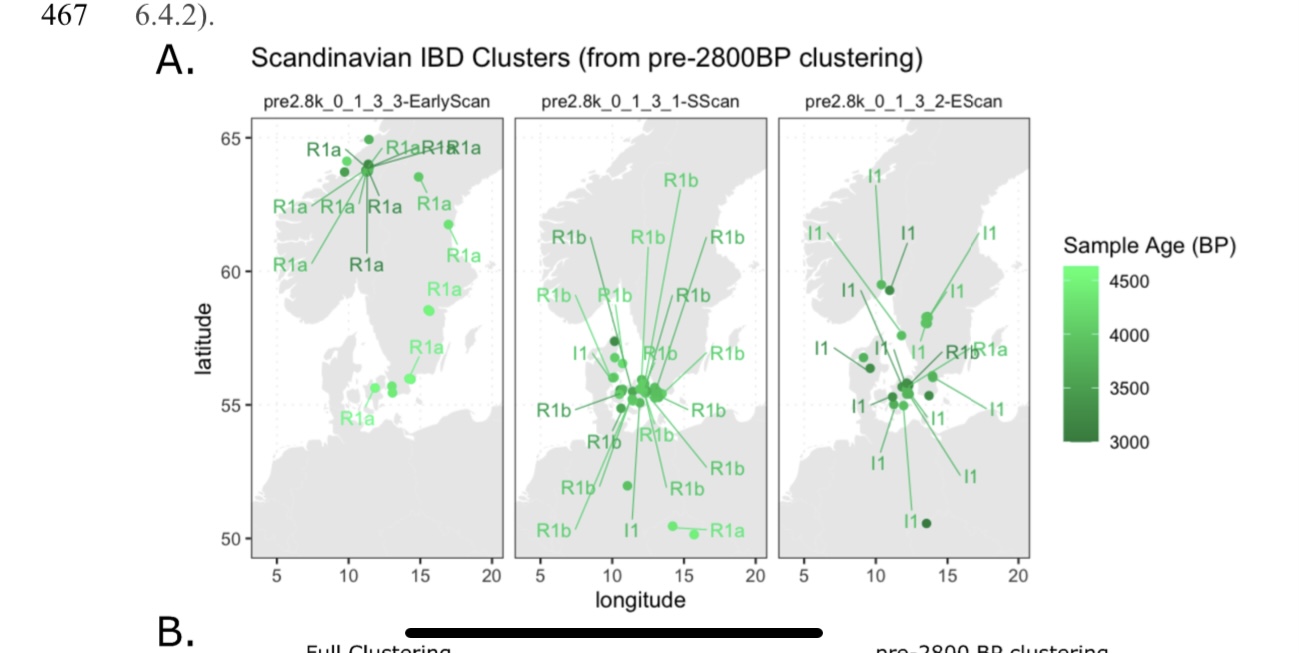
    The feasibility of a mass migration of a people across the Baltic at this period in history is questionable. Sea crossings from the South are far more plausible or even land routes via the Arctic North. Figure 4.A shows the geographical distribution of individual samples belonging to the 3 Scandinavian Clusters they identified existing prior to 800 BC, after which they merged. They say there is a strong correspondence between the clusters and specific haplogroups as follows: 

  1. Early Scandinavian including the oldest Swedish (Battle Axe Culture) and Danish samples and almost all Norwegians all have R1a. 
  2. A later ‘Southern Scandinavian’ cluster restricted to Denmark and the southern tip of Sweden mostly with R1b but some I1. 
  3. A second later ‘Eastern Scandinavian’ cluster, spread across Sweden and overlapping with that of the Southern Scandinavia cluster which is dominated by I1. 

     The third map of this so-called “Eastern Scandi” group shows mainly samples from the South though, and the I1 haplogroup distribution is not demonstrated to have come from the “East”, in fact it appears from this data to have come from the south. We already have an I1 sample from North Germany dating to 3300 BC, older than these samples, so by tying this newly identified group to the I1 haplogroup, they have brought into question their own claim that it has a Baltic origin. This will only be settled with the discovery of an I1 sample in a Corded ware context dating to around 2700 BC. 

 They admit that it is now necessary to confirm “the proposed Bronze Age source of the East Scandinavians along the Baltic coast.” My own view is that the elevated EHG ancestry in this East Scandi group may incorrectly have been identified as Latvian in origin due merely to a sampling bias, and lack of SHG samples. The elevated EHG in Sweden seems more plausible to be local and the I1 is most likely to have entered Scandinavia from the South, not across the Baltic. The reliability of their IBD method depends on the reference samples used. 

While I question their conclusions about the origin of this East Scandi group, I am more convinced by their suggestion that it was responsible for the spread of the ancestor of what became Palaeo-Germanic language in the period between 1050 BC - 500 BC when it borrowed from Celtic and into Finno-Saamic. They show that after 2000 BC the East Scandi group expanded into Denmark and Norway. The mixing of East Scandi with South Scandi is dated between 1700 BC-1400 BC which spans both Nordic Bronze age 1 and 2 and directly precedes the construction of the famous Kivik tomb in Scania around 1400 BC. 


This mixing event formed the Iron Age Scandinavian genetic profile such that by the Iron Age Jutland can be entirely modelled with the admixed Danish Bronze age source, while Iron Age Norway and the Danish Isles also have additional East Scandi admixture on top of the initial Bronze Age mixing, showing further migrations of these intrepid East Scandis. They say this admixed Iron Age Southern Scandinavian group is “central to understanding the Germanic dispersal” and I agree. We can trace the spread of IA South Scandi ancestry into Germany, Britain and the Netherlands. The findings about Germanic expansion in the historical period are very interesting too.

Thursday, 14 December 2023

Norman DNA: Viking or Semitic J2a?


 Were the Normans French or were they Vikings? DNA may reveal the answers but so far only two studies have looked at Norman DNA and there are problems with both. In this video I look at two Norman Y haplogroup studies to see what we can learn and I debunk the claim that J2a in Europe comes from "ancient Semitic kings"

Friday, 30 September 2022

The Rise and Fall of Archaeology with Stone Age Herbalist


 Stone Age Herbalist is a dissident archaeologist, twitter personality and substack blogger. In this Jive Talk he describes the ancient origins of archaeology as a discipline, how it rose to a more rigorous practice in the modern era and then degenerated into modern woke archaeology. We discuss gay cavemen, transgender vikings, the migrations and invasions of Anglo-Saxons, Beaker folk, Yamnaya and others and finally end with a chat about anthropology in general.

Follow Stone age Herbalist on Twitter

Thursday, 22 September 2022

Anglo-Saxon DNA proves the INVASION IS REAL!

'The Anglo-Saxon migration and the formation of the early English gene pool' by Joscha Gretzinger and colleagues (2022) has answered some of the much debated and controversial questions concerning the Anglo-Saxon invasion of England which began in the 5th century AD. The study finds that as much as 75% of the ancestry of skeletons from England in the cemeteries from that time comes from Germanic migrants from Germany and Denmark. In this video I break down and summarise the findings.


Sunday, 31 October 2021

Modern Horses were domesticated in Europe

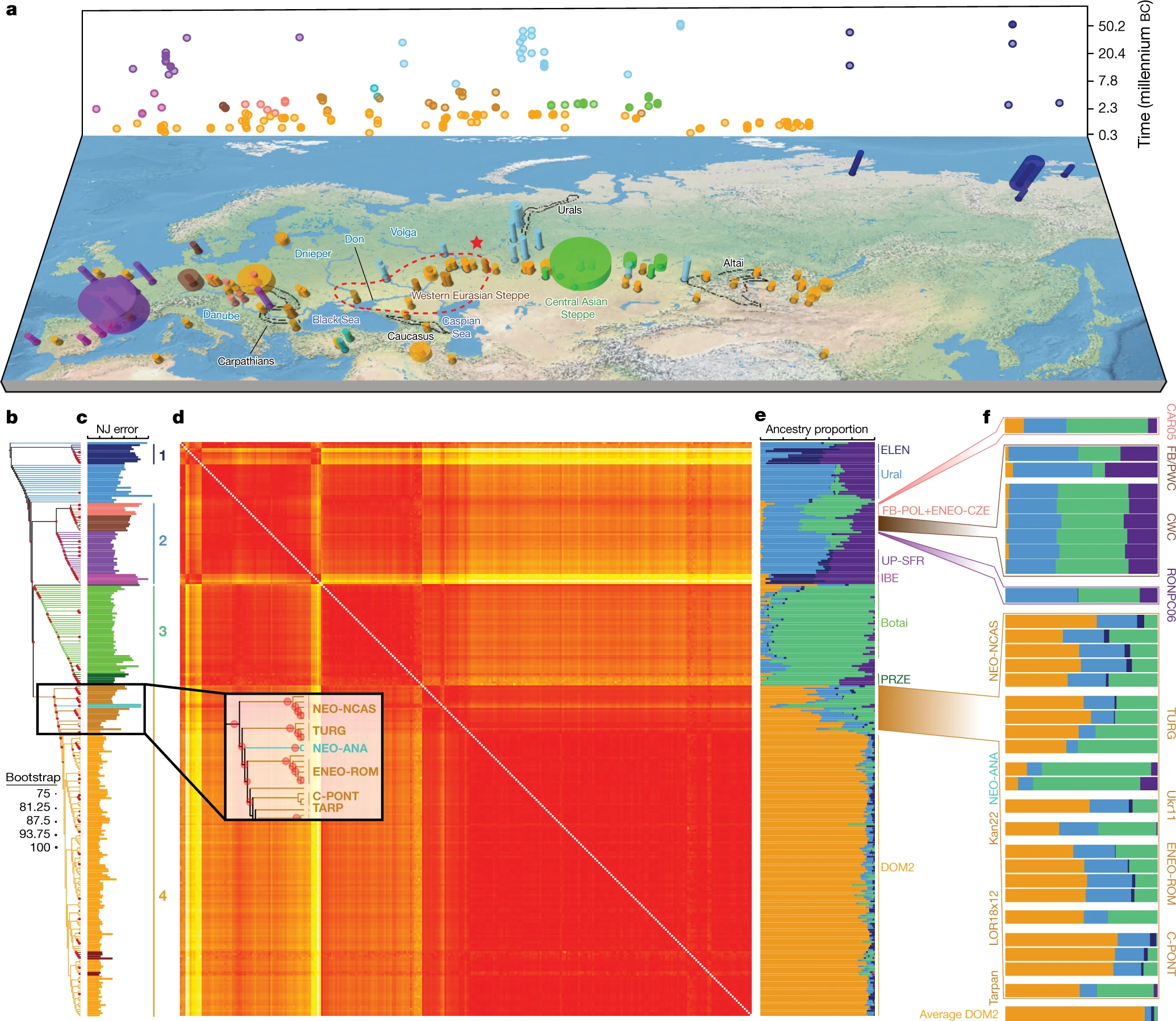
I've been waiting for some concrete DNA evidence about where modern horses came from since I interviewed Alan Outram three years ago and he hinted that it was soon to be published. He indicated that Sintashta horses might end up being more important than Yamnaya ones, and now that the new paper, to which he contributed, has finally been published, I can see why.


The new paper (Librado et al 2021) doesn't make the findings very clear IMO (refers to Europe as West Eurasia and makes the contested assumption that Corded Ware was descended from Yamnaya) but it does answer some important questions. I will summarise the findings in a clear TLDR bullet point list below:
  • Botai may have been first to corral horses for milking but they didn't ride them.

  • Yamnaya kept horses for milking too but we cannot see if they were ridden (However Trautmann et al 2023 shows Yamnaya did ride them)

  • Wilkin et al (2021) looking at milk proteins in pottery agrees with this new paper regarding "a potential epicentre for horse domestication in the Pontic–Caspian steppe by the third millennium BC" = Yamnaya.

  • Librado et al (2021) points to Volga-Don region (aka Yamnaya EUROPE) as the homeland of modern domestic horses

  • Sintashta horses (DOM2) were superior for riding (stronger backs) and replaced earlier ones from 2200 BC

  • Sintashta horses (DOM2) had genetic continuity with earlier Yamnaya /Repin ones (TURG) and Steppe Maykop (Aygurskii), and Poltavka (Sosnovka) - specifically two late Yamnaya specimens from approximately 2900 to 2600 BC

  • Yamnaya horses had some relation, but not much, to Botai horses

  • The Tarpan and modern Przewalski’s horses do not descend from the same ancestral population as modern domestic horses

  • Modern horses were domesticated in Europe but the paper calls it West Eurasia - possibly as a deliberate, politically motivated obfuscation

  • The ancestors of Sintashta horses came from the steppe East of the Dnieper and West of the Volga-Don region - ie: firmly within European Yamnaya territory during the late fourth and early third millennia BC

  • Corded Ware horses were not the same as Yamnaya/Sintashta horses 

  • Earlier LBK and other Neolithic horses in Denmark, Poland, Czechia and Hungary had some affinity with Yamnaya/Sintashta horses - the geneflow seems to have been via Thrace

  • Corded Ware expansion into Europe was not accompanied by horses but rather they adopted local horses as they migrated (not clear if they were ridden)

  • Replacement of other horse lineages in Europe and Asia by Sintashta ones was accompanied by spread of both equestrianism and (a bit later) light two wheeled war chariots

  • The spread of Sintashta horses into the middle east was likely accompanied by the spread of a specialised class of Sintashta descended horse trainers like the Mitanni.


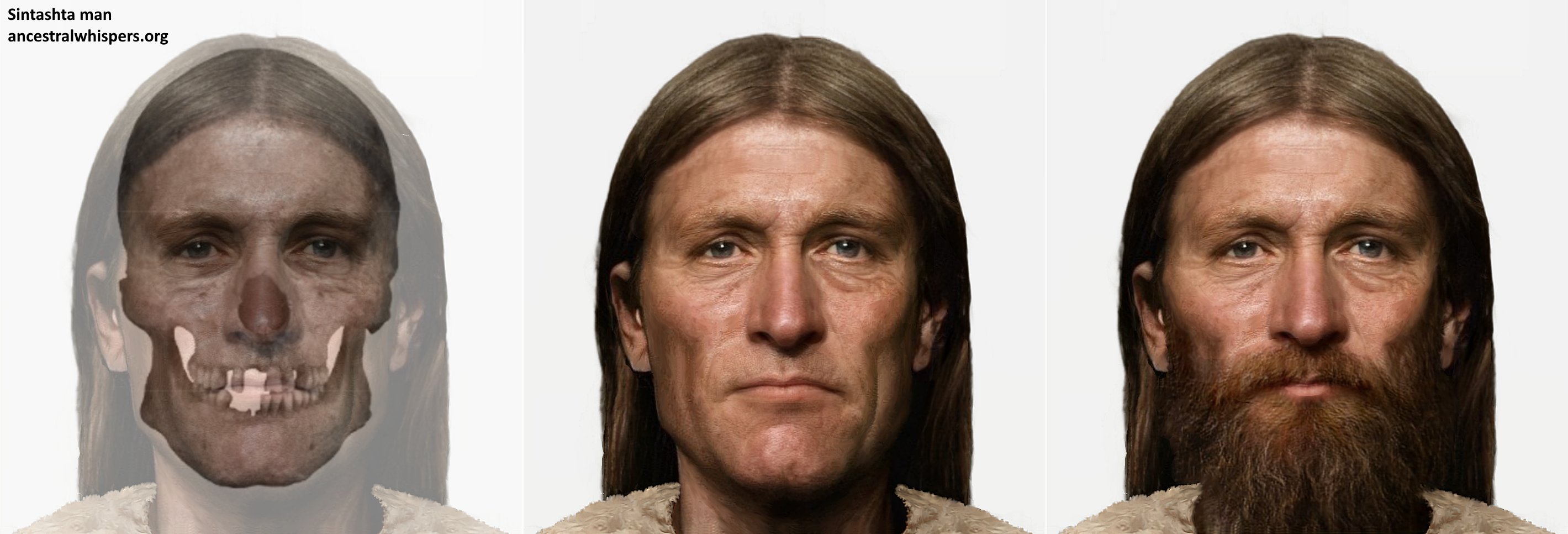
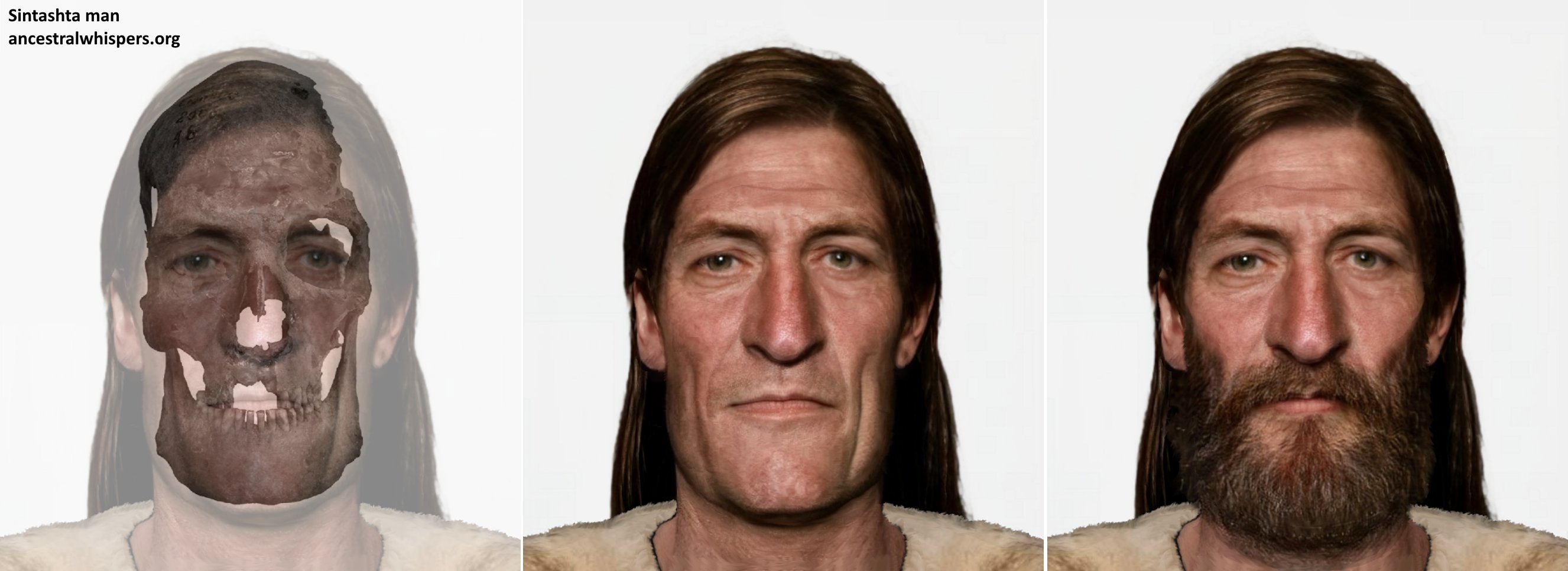
Sintashta were a people of European origin and their horses came from Yamnaya horses and Yamnaya domesticated their horses in Europe (see Robert Molyneaux's forensic reconstruction of a Yamnaya male above). Reminder that Sintashta, despite being Proto-Indo-Iranic speakers, the descendant languages of which are now found in Iran and India, were white people. So it is accurate to say that white people gave modern domestic horses to the world. Below are some reconstructions of Sintashta men by "ancestral whispers".


All this new information should be considered when we examine the evident Indo-European origin of horse sacrifice which I discussed at length in a documentary film on the subject.


EDIT: A new paper from March 2023 presents biological evidence that Yamnaya rode horses and they were the first to do so. So Europeans really were the first horse riders ever. 

Friday, 29 October 2021

Thursday, 28 October 2021

New Genetic Study on Tarim Mummies of China

New genetic data on Tarim mummies disproves my claim that early Tarim mummies were Iranic. It also shows the likely origin of Tocharian languages is in the Dzungarian Basin just north of Tarim rather than Tarim itself. Tarim mummies date from 2000 BC to AD 200 yet this sample only looks at the very oldest of those. Even older samples (3000–2800 BC) in the new study are from the Dzungarian Basin and these samples appear to be Afanasievo derived and therefore are likely the source of Tocharian languages, and if so then the language moved South into Tarim from them, but the early mummies from Tarim itself, at least the 13 in this study which date from 2100–1700 BC, do NOT appear to be Tocharians or even, as I speculated in my video las year, Iranic speaking Aryans, rather an isolated refugia of ice-age like people predominantly descended from Ancient North Eurasians and West Siberian Hunter-Gatherers (WSHG themselves were 72.5% ANE, 7.5% West European Hunter-Gatherer, and 20% Ancient East Asian).


We can't say what language these Siberian mammoth hunters turned lizard-eaters of Tarim spoke (not an Indo-European one though), although we know the genes associated with Tocharian and Iranic speakers both entered the Tarim basin region later on. Interesting that the mummies appear to be European in phenotype despite not descending from Indo-European bronze age steppe peoples who are autosomally like modern Europeans. As the paper says:


“The Tarim mummies’ so-called Western physical features are probably due to their connection to the Pleistocene ANE gene pool,”


So they look physically European because they have ANE DNA. This also answers the question of why some Ainu people from Japan, and some ancient native American skeletons like Kennewick man, look like Europeans; They all have ANE DNA and ANE were obviously Europoid.


This also explains why the material culture of early Tarim people resembles that of Siberian peoples. Take the idols for example:


You find faces similar to this everywhere you find WSHG/ANE ancestry in Siberia and Central Asia. The Mansi, Kalash and Ket all make figurines in similar trends to this day.


Mansi idols


It is important to remember that these new samples from Tarim represent only the first 400 years of that burial tradition which lasted a further 1900 years! Without samples from those following long 19 centuries we cannot say for sure when the WSHG people disappeared but I highly suspect that later Tarim mummies like Cherchen man (see below), who died c. 1000 BC, in all probability do have steppe admixture and could well be Iranic or Tocharian speakers.


Cherchen man Tarim
Chercen man depicted by Andrew Whyte


Tocharian and Iranic speakers of steppe descent entered the Tarim basin from different routes at different times, but the original inhabitants were these ANE descended Siberian people and they mixed with the incoming Indo-Europeans. So I still think that Cherchen man and the Yanghai cannabis shaman were both Indo-European people.


So what do we know about the people of this Siberian ANE-rich refugia?


  • Their race underwent a bottleneck and formed over 9000 years ago

  • They were homogenous population scattered in the Tarim desert, rarely mixing with neighbours

  • They adopted pastoralist lifestyle from neighbouring steppe peoples

  • They consumed dairy products like kefir but were lactose intolerant

  • They farmed animals - likely due to Afanasievo influence

  • They were not European but they looked European due to ANE ancestry

  • They had genes associated with dark skin in SLC24A5 and SLC45A5 like East asians do

  • We don’t know what language they originally spoke

  • They likely adopted Tocharian and Iranic languages after mixing with their Afanasievo neighbours of the Dzungarian basin to the North who were related to Yamnaya, and Andronovo neighbours to the West who were Aryans. This occurred sometime after 1700 BC

  • They buried their dead with ephedra twigs like later BMAC and Iranic cultures did

  • They made idols similar to those made by other Siberian peoples

Wednesday, 1 September 2021

JIVE TALK: Bohemian Corded Ware Rhapsody


A new paper reveals a series of population replacements in Neolithic and Bronze Age Bohemia which are likely indicative of wider population replacements across Europe. Some of the samples from the paper are special and there is a lot to consider. It seems scientists are gradually more willing to admit that population replacements occurred a lot in history and were likely driven by violent male invaders from the Funnelbeakers to the Corded Ware and finally the Pre-Celtic Únětice.

Thursday, 18 March 2021

The 'Black' Viking of York

The eye and nasal cavity shapes of the Roman-era Ivory Bangle Lady from York indicate she may have had some black ancestry too... 


A skeleton found in a coffin in North Yorkshire in 1989 and labelled as SK 3379 was identified as an adult male based on shape of the skull and the pelvis. It was dated to the 10th/11th century so this is regarded as a pre-Norman conquest body. He was quite twisted, with deformity of the spine and shoulder alignment, and with two crushed vertebrae as well as evidence of joint disease in the spine. He also had five abscesses in his gap-toothed mouth. An analysis of skull morphology led researchers in 2015 to conclude that he “may have been of African or mixed ancestry and may have migrated to York or descended from those that did”

Craniometry is actually a pretty good way of identifying race, however it isn’t always perfect, as some skulls, like this one, are a bit ambiguous and it gets much harder when it comes to mixed race individuals. A simple DNA test would make the race of the man who this skull belonged to very clear but no such test has been done - something that also holds true for every other allegedly black skeleton from ancient Britain; eg. Beachy head lady and Ivory Bangle Lady. Yet as with these two, the usual suspects have declared this a black person, and not only that, have started to say it is racist to say anything else!

One explanation for why a black man would be living in Anglo-Danish Yorkshire was suggested by Keefe & Holst with reference to an eleventh-century Fragmentary Annals of Ireland that describes a Viking raid on Morocco in the 860s. Any readers who are knowledgeable about human diversity and DNA will know that Moroccans aren’t really Sub Saharan Africans. Although some of them do have SSA admixture these days, we would expect to see far less (if any) of such admixture 1000 years ago, before the North African Muslims really got stuck into their centuries of black (and white) slave trading. A recent genetic analysis of skeletons from a Moorish cemetery in Al-Andalus showed that none of the early Moors had ANY black ancestry at all until the 10-16th century and then only two samples have black ancestry, and both of them are less than half black! Looking at the table below you can see that Iberian ancestry is more common than SSA (black) ancestry. Analysis of cranial morphology wouldn’t be accurate enough to identify the ancestry of such mixed individuals - which is why autosomal DNA analysis is so helpful.


So maybe Vikings went to Iberia or Morocco and kidnapped a Moroccan, possibly (though statistically unlikely) one who had some black ancestry, and then took him back to Yorkshire where he lived a hard life of back breaking labour. This is unlikely but possible, and even if true, it wouldn’t make him a “black Viking” just a mixed race labourer in Yorkshire. He was put on display at the Jorvik Centre in York where he was described as an ‘Arab’ and this is apparently a colonialist decision according to Paul Ramirez, who describes himself as a “Decolonial heritage specialist” who comes from the “occupied land” of Nicaragua but who lives in York where he works at the Humanities research centre of the university.


I suggest that rather than paying a grievance monger to whine about how an untested skeleton is represented in a museum, that the University of York instead pay for an aDNA analysis of said skeleton, which I understand the Reich lab are able to do for about $100, and thus end the debate once and for all. But perhaps they won’t like the results?

EDIT: since writing this blog post I have learned that Beachy head lady was indeed DNA tested in 2019, and as I predicted she was not black. She did not have any black ancestry!


Watch an interview with a co-author of a paper on Viking DNA who questions "woke" interpretations.