I spent half a month working on a cruise ship, travelling around Norway and the Scottish islands. Part 1 of my Hyperborean Odyssey is in Western Norway, beginning with the ancient burial grounds of Gunnarshaug and Rehaugane near Norway's Viking capital Avaldsnes, then admiring the fjords around Ulvik and Olden and finishing off in the rainy city of Alesund. This is a historical travel series.
This population is alleged to have formed around 2000 BC which is 800 years after Corded Ware folk first entered Scandinavia. It is distinct from earlier Corded Ware populations in the region, and contemporary Corded Ware people in Denmark and Norway, because instead of just WHG admixture it has additional EHG admixture from a source their model predicts to come from Latvia/Lithuania.
The authors suggest a possible migration across the Baltic sea to explain this East Scandi group despite there being no evidence for this in the archaeological record. They point out that the “timing coincides with the introduction of a new, Late Neolithic sheep breed to Scandinavia. It also coincides with the spread of a new burial rite of gallery graves in south Sweden, the Danish islands and Norway, a new house type, the first durative bronze networks, as well as with the end of an east-west divide in Scandinavia between 4050 and 3650 BP. (2050 BC- 1650 BC)” Yet none of these new arrivals they list necessarily came from across the Baltic sea.
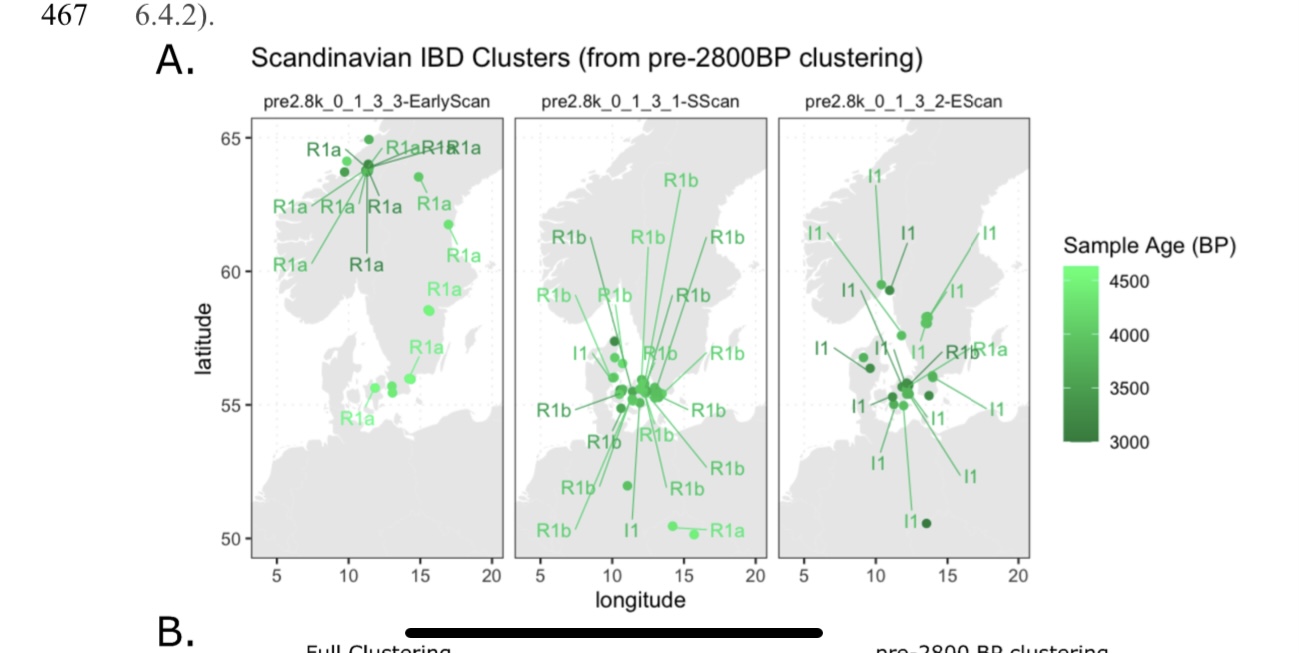
The feasibility of a mass migration of a people across the Baltic at this period in history is questionable. Sea crossings from the South are far more plausible or even land routes via the Arctic North. Figure 4.A shows the geographical distribution of individual samples belonging to the 3 Scandinavian Clusters they identified existing prior to 800 BC, after which they merged. They say there is a strong correspondence between the clusters and specific haplogroups as follows:
Early Scandinavian including the oldest Swedish (Battle Axe Culture) and Danish samples and almost all Norwegians all have R1a.
A later ‘Southern Scandinavian’ cluster restricted to Denmark and the southern tip of Sweden mostly with R1b but some I1.
A second later ‘Eastern Scandinavian’ cluster, spread across Sweden and overlapping with that of the Southern Scandinavia cluster which is dominated by I1.
The third map of this so-called “Eastern Scandi” group shows mainly samples from the South though, and the I1 haplogroup distribution is not demonstrated to have come from the “East”, in fact it appears from this data to have come from the south. We already have an I1 sample from North Germany dating to 3300 BC, older than these samples, so by tying this newly identified group to the I1 haplogroup, they have brought into question their own claim that it has a Baltic origin. This will only be settled with the discovery of an I1 sample in a Corded ware context dating to around 2700 BC.
They admit that it is now necessary to confirm “the proposed Bronze Age source of the
East Scandinavians along the Baltic coast.” My own view is that the elevated EHG ancestry in this East Scandi group may incorrectly have been identified as Latvian in origin due merely to a sampling bias, and lack of SHG samples. The elevated EHG in Sweden seems more plausible to be local and the I1 is most likely to have entered Scandinavia from the South, not across the Baltic. The reliability of their IBD method depends on the reference samples used.
While I question their conclusions about the origin of this East Scandi group, I am more convinced by their suggestion that it was responsible for the spread of the ancestor of what became Palaeo-Germanic language in the period between 1050 BC - 500 BC when it borrowed from Celtic and into Finno-Saamic. They show that after 2000 BC the East Scandi group expanded into Denmark and Norway. The mixing of East Scandi with South Scandi is dated between 1700 BC-1400 BC which spans both Nordic Bronze age 1 and 2 and directly precedes the construction of the famous Kivik tomb in Scania around 1400 BC.
This mixing event formed the Iron Age Scandinavian genetic profile such that by the Iron Age Jutland can be entirely modelled with the admixed Danish Bronze age source, while Iron Age Norway and the Danish Isles also have additional East Scandi admixture on top of the initial Bronze Age mixing, showing further migrations of these intrepid East Scandis.
They say this admixed Iron Age Southern Scandinavian group is “central to understanding the Germanic dispersal” and I agree. We can trace the spread of IA South Scandi ancestry into Germany, Britain and the Netherlands. The findings about Germanic expansion in the historical period are very interesting too.
The rock art from the tomb of Bredarör at Kivik in Sweden is a window into the forgotten world of the Nordic Bronze Age. In this film I interpret all the esoteric imagery, including; sun-wheels, solar crosses, war chariots, armed warriors and ritual axes and boats. With the latest archaeological data, 3D scans and new CGI animations of the art, this film gives a new perspective on a tomb which is 3400 years old!
Arvid Fougstedt 1936
Art:
CGI by Robert Molyneaux
Bronze age rites at dawn, Indian chariot, hellhounds, Wolf Viking by Christian Sloan Hall Kivik reconstruction by Arvid Fougstedt 1936
Bronsåldern by Nils Asplund Fra Bronsåldern by Rasmus Christiansen 1925 NBA king by Beaker Lady Bronze age map by Dan Kogosov Beaker Koryos by Moccus Art
Sources:
Bertilsson, Ulf et al. “The Kivik Tomb: Bredarör enters into the digital arena” New Perspectives on the Bronze Age (2017): 289–306.
Froncek, T., ‘The Northmen’ 1975. Goldhahn - Bredaror on Kivik: a monumental cairn
and the history of its interpretation 2009
Kaliff, Oestigaard ‘Werewolves, Warriors and Winter Sacrifices
Unmasking Kivik and Indo-European Cosmology in Bronze Age Scandinavia’ 2022. Kveiborg, Ahlqvist, Vandkilde. (2020). Horses, Fish and Humans: Interspecies Relationships in the Nordic Bronze Age. Current Swedish Archaeology. 75-98.
Nordquist, Gullög & Whittaker, Helene. (2007). Comments on Kristian Kristiansen and Thomas B. Larsson (2005): The Rise of Bronze Age Society. Travels, Transmissions and Transformations. Norwegian Archaeological Review. 40. 75-84.
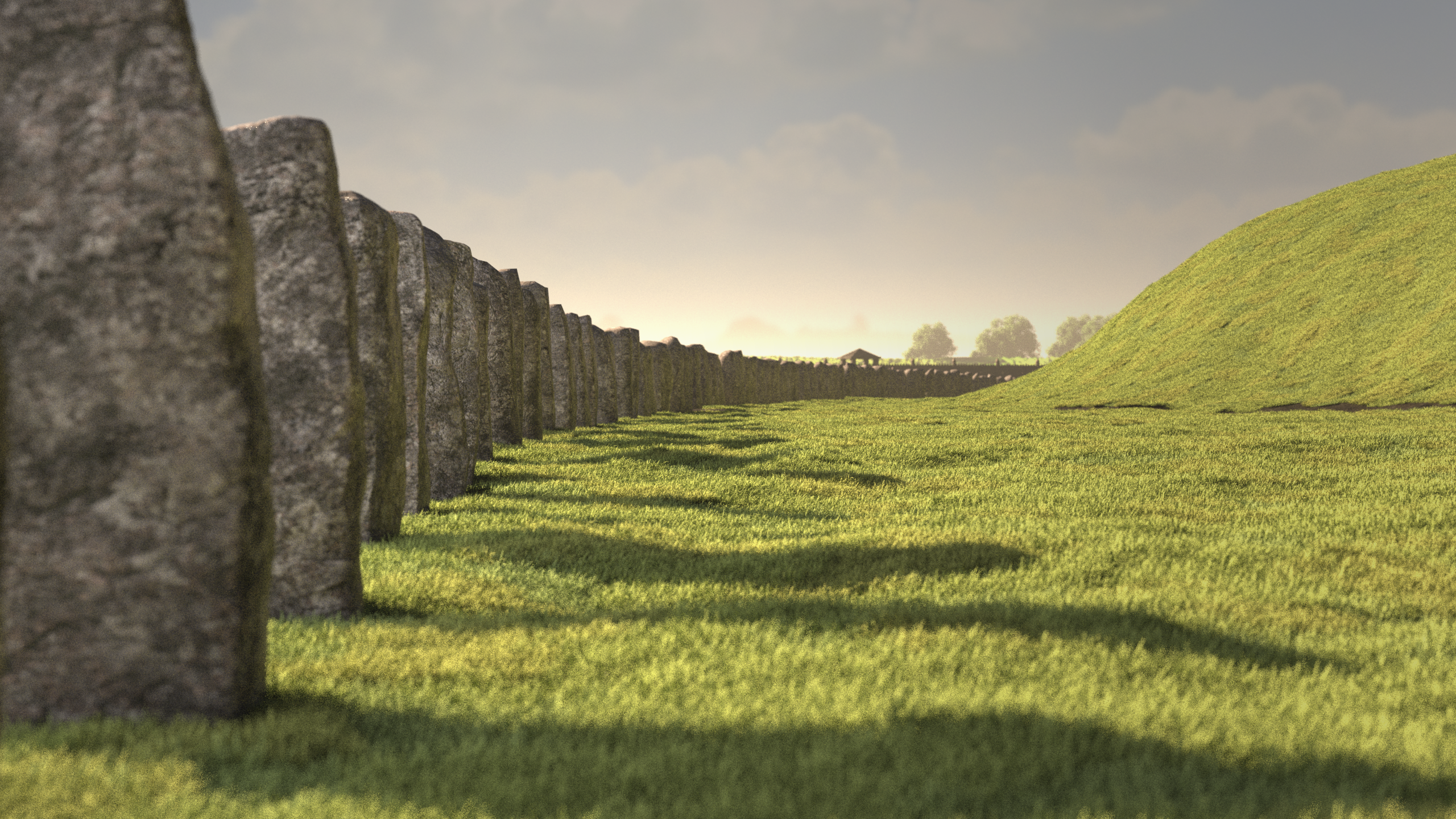
Stone ship settings or Skeppssättning are amongst the most remarkable Viking age monuments in Scandinavia, but what were they for? They were built over a period of 2000 years from the Nordic bronze age until the end of the Viking age, mainly in grave fields but they weren’t just associated with burials and cremations as they were also used for a kind of meeting called a ‘Thing’. This video explains how the stone ships may relate first to a Bronze age cult of the sun in Gotland, and later to a Viking belief that the dead would need a vehicle for a journey to and from the underworld. The stone ship settings included in this film are Tjelvars grave in Gotland, Anundshög in Västmanland, Åsa domaresäte in Södermanland, Ängakåsen and Ale’s stones in Scania and the Jelling stone ship in Denmark.
Art
Original works created for this video
Robert Molyneaux - CGI reconstruction of the Jelling stone ship in Denmark
Jackson, E. “Not Simply Lists”: An Eddic Perspective on Short-Item Lists in Old English Poems. Speculum, 73(2), 338–371. (1998)
Shenk, Peter, To Valhalla by Horseback? Horse Burial in Scandinavia during the Viking Age, (Oslo: The Centre for Viking and Medieval Studies, University of Oslo, 2002).
Skoglund, P., ‘Stone ships: continuity and change in Scandinavian prehistory, World Archaeology, 40:3, 390-406, (2008)
While Germanic language is widely agreed to have emerged around 3000 years ago in Northern Denmark, amongst a people who were genetically like modern Danes, and then to have spread from 750BC as neighbouring peoples adopted the language for some reason, it is harder to pin point who the first Celtic speakers were or explain how their languages got to Britain.
As I have said in videos, the modern British genetic profile emerged 4500 years ago with the arrival of the beaker folk from Holland, but these people did NOT speak a Celtic language, as linguists agree Proto-Celtic isn't that old (maybe 3000 or 3500 years old). This means that either:
a) The peoples of the British Isles adopted a Celtic language due to trade with continental Celts b) A small Celtic elite took over Britain and Ireland and somehow changed the culture and language but not the genetics c) A continental population of Celts took over Britain and Ireland and did change the genetics, but this change is only very slight because they were already closely related to the people of the British Isles.
Archeologically, the Hallstatt culture of the 8th to 6th centuries BC, is seen as the first proper Celtic material culture. The two black stars on the PCA chart above, made by Eurogenes, represent two skeletons from the Hallstatt culture, and it can clearly be seen that one plots among the Dutch and one among the Northern French, but neither among modern "Celtic" areas. However, the purple Iron Age Celts on the chart are between the older Bronze age British samples and the Halstatt samples indicating there WAS an invasion of continental Celts to Britain who were related to these Halstatt samples and that they changed the DNA of Britain and Ireland.
Modern English people plot between these purple Iron Age Celts and the red Anglo-Saxon samples, but there is always the possibility that other 5th century Anglo-Saxon invaders from Frisia, Holland etc would have plotted like modern Dutch people just as the much older Halstatt sample does - thus making the job of distinguishing "Celtic and Germanic DNA" very complicated! Especially when you also see that the Anglo-Saxon samples are closer to the Bronze Age Britons than the Halstatt Celts are.
EDIT: Eurogenes actually said there may have been as much as 10% admixture from a Celtic source in the iron age.