Eric Orwoll is an American Christian Platonist known for his YouTube channel. Eric's beliefs are more compatible with those of pagans than those of typical Christians are. I asked him about how a Platonic view of the One and objective good is compatible with a scientific view of evolution or a pagan view of tribal loyalty. We also discussed transhumanism and the anti-Platonist philosophies of Karl Popper and Friedrich Nietzsche.
About 46% of the world’s population speaks an Indo-European language as a first language, and the majority of humans on earth can speak at least one Indo-European language such as English, Spanish or Hindi. These languages all come from Proto-Indo-European speakers of the Yamnaya culture. The Yamnaya people were indigenous to the Eastern European steppe during the eneolithic and early Bronze age.
Using their skulls, the latest genetic data about their phenotype, and the latest facial reconstruction techniques, the 3D artist Robert Molyneaux was able to create realistic reconstructions of Yamnaya people for a forthcoming Survive the Jive video. We are pleased to reveal the first one in the form of this infographic which shows us what a male from Bykovo cemetery on the Volga looked like.
His features are notably robust, particularly his chin and brow but his skull is quite long, which is typical of the dolichocephalic eastern Yamnaya. We have reconstructed him with brown eyes, which is statistically likely for his people, although we don’t have his personal DNA to check what colour hair he specifically had. His skin tone is at the darker end of the European spectrum and was based on that of modern Georgian people from the North Caucasus who have a similar range of complexions as the Yamnaya.
You can see more of him and learn all about the Yamnaya when the STJ documentary is finished later this year! In the meantime, please share this infographic all around.
Sources:
Anthony, D., ‘The Horse, the Wheel, and Language’, Princeton University Press (2007). Haak, W., et al., ‘Massive migration from the steppe is a source for Indo-European languages in Europe’ (2015). Hanel, A, Carlberg, C. Skin colour and vitamin D: An update. Exp Dermatol, (2020). Heyd, V. Kossinna's smile. Antiquity, 91(356), 348-359, (2017). Khokhlov, A. A., ‘Morphogenetic processes in the Volga-Urals in the early Holocene (based on craniological materials of the Mesolithic-Bronze Age)’ Federal State Budgetary Educational Institution of Higher Education Samara State Social and Pedagogical University (2017). Klejn, L., et al. ‘Discussion: Are the Origins of Indo-European Languages Explained by the Migration of the Yamnaya Culture to the West?’ European Journal of Archaeology (2017). Saag et al, ‘Genetic ancestry changes in Stone to Bronze Age transition in the East European plain’ (2021).
The
NIKK Nordic Gender Institute was the institutionalised manifestation of “Gender Theory”, providing a pseudo-scientific basis for social and educational policies that, from the
1970s onward, transformed the Nordic countries to become the most
“gender sensitive” societies in the world.
The following videos are from episodes of a Norwegian television documentary called Hjernevask "Brainwash" in which a comedian called Harald Eia balances the arguments of sociologists and gender theorists with those of real scientists like geneticists. The TV series exposed the falsehood of the NIKK and resulted in The Nordic Council of Ministers (a regional inter-governmental
co-operation consisting of Norway, Sweden, Finland, Denmark, and
Iceland) deciding to close down the NIKK.
Written as part of my degree at the University of Brighton (2005)
It has long been known that music has the power to inspire emotion into the hearts of audiences. This fact has been utilised historically by politicians, activists, military leaders, musicians and film makers as a way to manipulate the subconscious of the listener into considering a certain ideological message to be more credible.
“Plato worried that music might generate lawlessness; new types of song and forms of music that were created within a society, or music that came from outside, could have a direct impact on the entire society.” Negus (p. 200)
Words that on their own have little effect on those who hear them, attain new significance and meaning when spoken or sang over a piece of music. The political sentiment or intent of the artist is sometimes manipulated and assigned new political meanings by those who wish to benefit from the ideological power of music.
“In 1987 Imagine was collectively sung at a Conservative party conference in Britain to greet Margaret Thatcher – one of Britain’s most right-wing leaders, who led one of the governments least sympathetic to social democratic principles since the Second World War.” Negus (p.195)
John Lennon’s Imagine is largely recognised as an expression of socialist values; however it was effectively used in an opposing political context by the Conservative party. This can be seen as an example of the Marxist Antonio Gramsci’s theory of hegemony in which those with power adopt a variety of cultural symbols to promote their own ideological message. In Britain during the 1970s and 1980s there was a great deal of music associated with both left and right wing politics. Both used the issue of racial tension as a way of rallying support for their causes.
The Rock Against Racism (RAR) concerts started in the 1970’s and were associated with punk rock and reggae music. The movement claimed to be a response to racist organisations but was also clearly an attack on opposing political values, “It was a movement formed in reaction to rising xenophobia and racism fuelled by Nazi organisations like the National Front.” (RAR website) Popular punk musicians such as Tom Robinson, The Clash and X-Ray Spex were aligned to the movement, however all of those were renowned for their left wing politics. The movement attracted its following through talk of racial equality and ending violent attacks, but beneath these objectives was the hidden motive to subvert Marxist politics to a generation of young and impressionable music fans.
“RAR strengthened the idea that rock music could be about more than entertainment, and in a sense provided the inspiration for similar campaigns in the 1980s” Shuker
A rival movement Rock Against Communism (RAC) was started in 1978 which also used music to communicate a political message to young people. RAC concerts were usually held in opposition to rival political groups such as Anti-Fascist Action and the Anti-Nazi League. They were often headlined by Skrewdriver, the most well known of right wing punk rock bands, but also featured other prominent groups.
The RAC was loosely associated with organisations like the National Front, and appealed to working class, white rock fans who were opposed to the communist propaganda prevalent in rock music at the time. RAC bands and their fans were concerned with social problems like unemployment and the increasing immigrant population.
“Europe what have they got to do to make you come alive?
What has happened to the heritage that once was yours and mine?
A capitalistic economy, the communists rule the streets.
The old people aren't safe outside, what solution do we seek?” Ian Stuart
Skrewdriver – Europe Awake (1984)
The political divide within punk resulted in disturbing outbreaks of violence which prevented bands such as Sham 69, who attracted fans from both political ideologies, from playing gigs. Sham 69 were able to acquire a wide fan base because their lyrics were based on personal politics and the issues that working class people of Britain are familiar with such as drinking, football, unemployment and a general mistrust of all politicians. This was noticeably different from Tom Robinson, Billy Bragg and Skrewdriver who were vocal about their political ideologies and used music as a way of trying to influence others and align them to their own ideology.
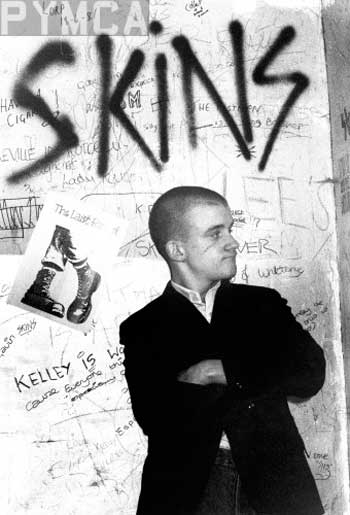
Other bands started to do the same and eventually a sub-genre of punk was formed known as Oi! the creation of which was credited to journalist Garry Bushell who intended to help launch a genuinely working class punk movement, with the emphasis on skinheads. Oi! differed from punk because it attracted more of a skinhead audience; creating rock music with specific relevance to the British working class. However, as with Sham69, the non political music attracted a politically active fan base.
“A big problem with skinheads was despite their fondness of Jamaican music, many 60s/early 70s skins were, paradoxically, racist. To Bushell and the majority of the ‘New Breed’, skin was much more innocent, an affirmation of working class pride” Terrorizer#96 January 2002
The movement was subject to much criticism and was accused of being racist. Although there were leftist political Oi! bands such as The Oppressed and The Angelic Upstarts who were both outspoken about their socialist beliefs, the majority of Oi! bands were proud of their anti-political message that suggested people could make their own decisions without aligning themselves to a preconceived political ideology. The movement undeniably attracted a partially racist audience which resulted in a riot in Southall July 1981, after members of the local South-Asian community set fire to the Hamborough Tavern which was hosting an Oi! concert featuring The Business, The Last Resort and 4 Skins, none of which were racist bands. The bands went to organisations such as RAR in an attempt be cleared of the racist tag assigned to them by lying journalists, like those working for the BBC, but they faced difficulties...
“One such difficulty arose in 1981, when a concert was organised under the banner of ‘Oi! Against Racism’ [...] Proponents of Oi, who defended it as working class music, not white music, wanted to polish its tarnished image through links with RAR. But RAR were wary of such moves, and they turned down a suggestion for a gig under the RAR banner in Southall; the bill was to have included a reggae band, An Asian group, and the 4 Skins […] RAR were suspicious of both the interests of the organizers and of the motives of the 4 Skins, and made their own counter suggestion: an Anti-Racist Skinhead concert in Sheffield, where local skinheads had been vocal in their denunciation of racism. RAR also suggested that none of the Southall bands be involved, preferring an Oi group with proven support for RAR.” (Street, 1986)
This is evidence of the hidden motives of musical organisations like RAR and more recently ANTIFA. Their intention was not merely to eliminate racism from youth culture, but to use this goal as a means to rally support for an exclusively Communist movement, the festivals of which had no room for bands that merely wanted to express their support for anti-racist causes. Such events have come under media criticism for failing to make any progress in race relations in Britain, as a result of their policy only to preach to the converted.
“The last festival of this ilk that I attended, in Burgess Park in South London, was a wonderful day out – but I do not recall a single person uttering to their skinhead mate; “It was a good thing I came today. I was racist but now I’ve seen the light.” Instead, what I saw, among the youths on a day out with their mates, were thousands of middle-class white folks patting themselves on the back for being so tolerant.” Taylor, The Guardian
The Oi! movement became a taboo subject in media and journalism circles after being tarnished by the right wing image associated with what was in fact a small minority of fans. The lyrics of the songs, however, demonstrated mistrust of politicians from both sides.
“Vote for Maggie Thatcher or Tony Benn, you’ll always lose you’ll never win.”
4 Skins – Manifesto (1982)
The racist element was exaggerated by left-wing organisations who were threatened by a movement that encouraged young people to question the left wing hegemony in anti-Thatcherite politics. But it was the media’s demonisation of Oi fans as racist skinhead yobs that led to a moral panic and ultimately censorship of the music from broadcast, performance and distribution. There are eye witness accounts of journalists from The Times paying crowds of young skinheads to "Sieg Heil" for the camera so that the photograph would support the accusations made so frequently in reports. Cohen explains how a moral panic may arise around the emergence of a youth subculture.
“A condition, episode, person or group of persons emerges to be defined as a threat to societal values and interests; its nature is presented in a stylised and stereotypical fashion by the mass media; the moral barricades are manned by editors, bishops, politicians and other right-thinking people; socially accredited experts pronounce their diagnoses and solutions; ways of coping are evolved or (more often) resorted to; the condition then disappears, submerges or deteriorates and becomes more visible.”
(Cohen, 1980: 9)
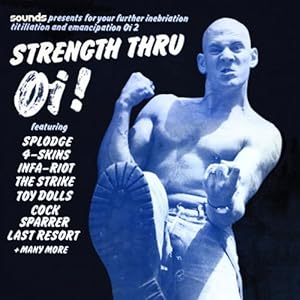
BBC news broadcasted an expose on Oi! interviewing the 4-skins and doing their best to depict the movement as dangerous and racist. Only DJ John Peel leapt to the defence of the movement, pointing out that unlike 4skins, popular acts such as Joy Division did use Nazi imagery and slogans in their lyrics but were not attacked by the media. The focus of the program, other than the Southall riots, was journalist Garry Bushell’s compilation ‘Strength thru Oi!’ (1981) which shop keepers were arrested for attempting to sell after it was learned that the title was a play on the Nazi slogan ‘strength through joy.’ The bands on the compilation were not racist but the lyrics did encourage violence against police which contributed to it being banned.
The movement was therefore attacked by left wing movements and media for accusations of racism, but also attacked by the Conservative government who banned the music from being sold, broadcast or performed in Britain. Oi! is comparable to rap in the fact that the controversial issues raised by young musicians were attacked by both the right and left wing.
“In 1990 rap music became the main target of the anti-rock, pro censorship lobby. The new genre had already been attacked from the left for its sexism and homophobia, and was now criticised from the right for its profanity and obscenity.” Shuker (page 267)
Like gangster rap, Oi! music was criticised for advocating violence and general encouragement of criminal activity (theft, benefit fraud, football violence). Unlike rap, Oi! music rarely glamorised violence, and condemned the use of guns. Oi! described how those born into poverty must adopt violent behaviour in order to survive; it also has a strong sense of community and family values which generates the patriotic element of the movement which some misinterpreted as fascism. If the movement were right wing in the institutional sense then it would have been unlikely that the Conservative government would have opposed it. The movement was above all else a reaction against Margaret Thatcher and the Conservative government of the 1980’s.
“Margaret Thatcher the stupid bitch
Takes from the poor and gives to the rich
She thinks we can’t see her plan,
To kill the spirit of the working class man,
Make us redundant; put us on the dole,
Put us in prison without parole.”
The Last Resort – We Rule O.K.
The fact that the bands were so critical of the Conservative government and left wing activists is probably the most likely reason that the movement was so viciously slandered and attacked by the respective camps. This is why two opposing political ideologies were able to unite in the common purpose of banning an art form that encouraged intellectual working class independence and a coherent national identity for British youth. The climate of fear generated by the media was required in order to rally public hatred against the movement.
“a moral panic takes place within what Gramsci defines as a developing ‘crisis of hegemony’, arising out of a particular historical context where the dominant class is endeavouring to win domination and consent through ideological means.” Shuker
Although claiming to be non-political, the politics of the genre were clear; they were an expression of the real activities that young men were occupying their time with in 1980’s Britain. The way the media, government and certain leftist political organisations tried to censor the movement is comparable to the efforts of the Nazi party attempting to ban jazz music in Germany during World War Two.
“The Nazi party were particularly concerned about the influence of jazz, which was considered to be a ‘degenerate music’ […] The Nazis began further to regulate the repertoire that musicians used in performance and also monitored and controlled the catalogues of songs that were printed and distributed by music publishers.” Negus
By this definition the actions of the Conservative government and of ANTIFA and RAR attempting to regulate freedom of expression through music are more comparable to the actions of the Nazi party than are those of the young men who expressed criticism of the government and other political organisations through the medium of Oi! music.
Bibliography
Cohen, S (1980) Folk Devils and Moral Panics, Oxford: Robertson
Street, J. (1986) Rebel Rock: The Politics of Popular Music, London: Blackwell Taylor, A. Music Festivals against racism give everyone a grand day out – but are they any use? Monday May 29, 2006 The Guardian
Negus, K, (1996) Popular Music in Theory: An Introduction. Polity
Shuker, R, (2002) Understanding Popular Music. Routledge
Selzer, J(January 2002) Under the Skin. Terrorizer issue number 96
RAR website
Gramsci, A. (1971). Selections from the Prison Notebooks. London: Lawrence and Wishart.
Discography
4-Skins – ‘The good the bad and the 4-skins’ Secret Records, 1982
The Last Resort – ‘A way of life’ Captain Oi! 1982
The Business – ‘The anger and the truth’ Hellcat records, 1997
Skrewdriver – ‘Hail the New Dawn’ LP.’ Rock-O-Rama. 1984
"A 40ft high mural painted on the side of a building showing characters like the Krays and the Elephant Man has been unveiled along the ‘2012 Olympics Highway’ in London’s East End.
The mural telling the story of Whitechapel took six weeks of painting by artists Mychael Barratt, Nicholas Middleton and Jim Glover, commissioned by TV Edwards solicitors for their new offices in the Mile End Road.
People depicted on the mural include Captain James Cook who kept a house in the Mile End Road, Salvation Army founder General Booth whose monument is outside the building, and George Bernard Shaw who chaired the Fabian Society in Whitechapel, as well as the Krays, the Elephant Man, artists Mark Gertler and Isaac Rosenberg and TV Edwards himself who opened his first law office in Stepney in 1929."
George Bernard Shaw is the most prominent feature of the mural, depicted shielding his eyes as though looking into the far distance. He was an outspoken socialist eugenicist, it is interesting therefore that his head partially conceals John Merrick, the Elephant Man.
The fog on the Thames hung over Hammersmith as if from a Dickensian scene. I was out freezing my fingers to the bone, waiting for Shaun Bailey, prospective Conservative MP for North Kensington, who was meeting a mainstream men’s fashion magazine for an interview about his clothing. When, exactly, politicians became associated with style, I don’t know, but that, it seems, is the world we live in now. I took this opportunity during my internship to ask Mr. Bailey a few more pressing questions in an effort to get some insight in to what direction Mr. Cameron was taking the party.
Shaun Bailey is by no means your average Tory. He is a heavy set, bald headed black man, who was brought up by a single Mum in his constituency of North Kensington. He’s is proud to represent the community he grew up in, saying, “I understand it better than I do a community of pig farmers in Berkshire!” Perhaps having a dig at me, A Berkshire country boy, hijacking this photo-shoot for my own unsolicited and unauthorised interview. He claims he avoided the perils of an impoverished black community - drugs and violent crime - by getting involved in the army cadets, which taught him discipline and gave him what he describes as an appreciation for British culture.
I don’t doubt Mr. Bailey when he says he cares about his community; he has worked for years as a social worker and running charities to help people from disadvantaged backgrounds in Britain. Despite his admirable CV, his views come as a surprise on some issues. He says that Labour is ripping off the working class of Britain by making them dependent on the state. In his words, “we’re born with only one instinct, to suck.” I can see where he is coming from, but I wonder what alternatives he could propose to the welfare system.
Youth crime is a major issue to Bailey. He says he was stabbed, that crime is a problem and he blames things like MTV, which he says subjects impressionable young men to graphic sexual imagery, and glamorised violence which encourages dissidence and anti social behaviour. Despite this, he admits to being a fan of MTV bass and challenged me to watch the channel without feeling horny. I think I’ll pass. This struck me as somewhat ironic; I am not keen on MTV myself, and modern society is undoubtedly somewhat desensitised to sexual imagery in the media, but if he hates media institutions that broadcast sexual imagery so much ,what’s he doing on a shoot for a magazine whose front covers are often plastered with the greased up, spread legs of pop stars and actresses?
He has no time for liberal policy on crime, “The liberal democrats are ludicrous!” he says referring to the rival party's policies on crime. Clearly Bailey isn’t a supporter of the softly softly approach on young offenders, but I was unable to pin him down on exactly what measures he would like to see taken to reduce crime. Maybe something along the lines of the military discipline he experienced in his youth? After all, Cameron is calling for a return to conscription.
Race is clearly going to be an issue for a man like Bailey; he just doesn’t fit into the stereotype of a Conservative MP candidate. Race aside, he has an obvious London accent, and an easy-going humorous nature. He says his black mates see him on TV and are amused by his extensive vocabulary and tuxedos, although he admits, he only dresses very smartly when his party require him to, saying “you have to be a team player.” He feels that race is still an issue that needs to be resolved in Britain, supporting the notion of a public apology for the "atrocities of racism", which he believes would not only resolve feelings of victimisation amongst black communities but also would relieve middle class white guilt, which he identifies as being a source of a lot of problems in the nation. But how would yet more grovelling and apology relieve the issue of white guilt?
The photographer had asked him to bring some items with him that he liked, he brought an RC car, a CD of Martin Luther King speeches and most interestingly from my perspective, Frank Miller’s version of Batman “The Dark Knight Returns.” I couldn’t resist asking him about comic books, being a fan myself. His comic book fascination started for him, as with most, as a child. He got a job at a comic book shop on Portobello road (weirdly, so did I), which he said was the best job he could have imagined having (although his Mum was pretty pissed off when his boss used to pay him in comics). I said I was surprised he was a Batman fan, what with Batman being the rich kid of the superhero world; he didn’t seem bothered by this, saying that it was only Miller’s batman that intrigued him, on the grounds that the heroes he prefers are the ones who really "fuck up the villain". It seems you have to be cut throat in modern politics. His favourites in childhood were Hulk and Thor, and he admits that they had two major effects on him; firstly that he did a lot of weights to get beefed up like the toned bodies of his illustrated idols and secondly the idea that those who are strong should protect the weak.
So, is Shaun Bailey a super hero for Black British citizens? His intentions seem sincere, he is well respected within his constituency (several passing joggers and cyclists stop to pay their respects to him, one even asking how he could make a donation to the party, another bursting into a round of applause after overhearing his passionate speech to me and the stylist on the shoot). But I am ever the sceptic, whilst it is refreshing to hear some common sense being spoken from a politician, I get the feeling Cameron is assembling a team of faces that look good as opposed to a team of people regardless of race and gender who are best for the job.
Bailey stresses a difference from his beliefs and that of the Conservative party of the 80's. A Thatcherite he aint. He believes the NHS is a symbol of Britain and is appalled at how the Labour government have constructed a system of targets that are set by people with no real understanding of hospitals. He suggests giving power to the hospitals to run themselves; I inquire whether he supports any system of privatisation of the health service which, to my relief, he denies.
He is an outspoken euro-sceptic, saying that New Labour have put us so far in debt that even the French with their spiralling national debt are warning us,
“When the French say you're in too much debt, you’re in trouble!”
He doesn’t go in to much detail about his mistrust of Europe, but makes it clear he thinks that European authorities and New Labour are ripping off the British public, and I could see he was pretty angry about that. He say that it is easier to jump onto a band wagon late than to jump from a sinking ship.
One issue which we touched on really intrigued me - getting back onto the subject of crime and the streets, I ask him about the new proposals for stop and search. Although these proposals are being made by Labour, its obvious the Tories will lap them up like a bat at blood. I realise that Bailey is likely to have a far better understanding of the realities of police oppression than me so I was surprised when he said he supported restoring police power for searching.
“You don’t seriously support a return to the suss laws do you?” I asked. His reply was difficult for me to argue with, “We’re the ones who get stopped and searched yeah?” referring to black men,
“but we’re also the ones who get shot and stabbed. I’ve been stabbed, It’s not fun!”