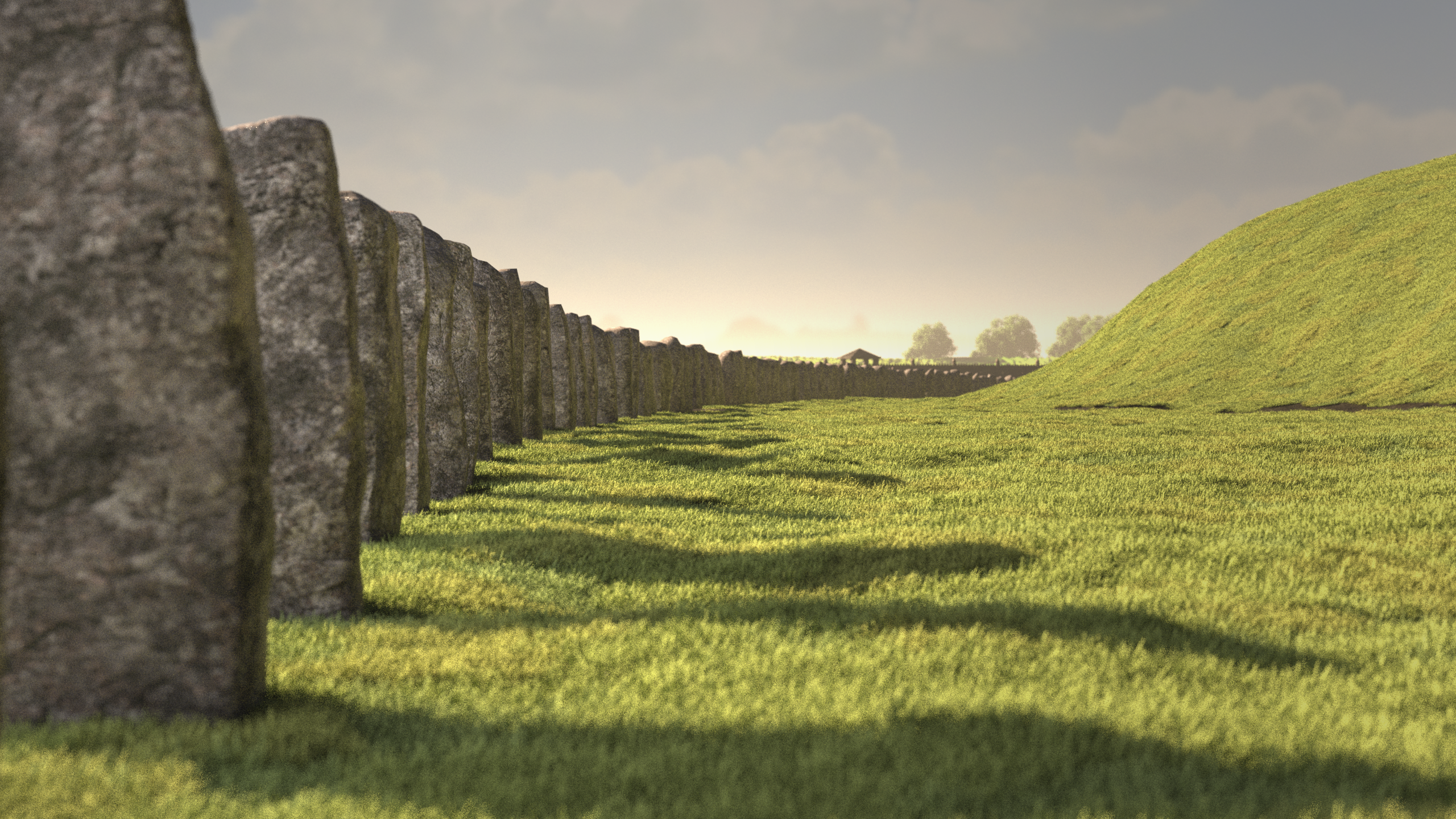
I spent half a month working on a cruise ship, travelling around Norway and the Scottish islands. Part 1 of my Hyperborean Odyssey is in Western Norway, beginning with the ancient burial grounds of Gunnarshaug and Rehaugane near Norway's Viking capital Avaldsnes, then admiring the fjords around Ulvik and Olden and finishing off in the rainy city of Alesund. This is a historical travel series.
Starting Heathenry is a NEW ritual-focused online course which will furnish you with the knowledge and confidence you need to practise the Germanic Heathen religion alone or with others, making wise decisions about worship based on reliable historical evidence.
The course teaches you how to construct Heathen prayers for yourself, not according to the established rites of any modern group, but according to what historical sources show.
Starting Heathenry assumes you are interested in Germanic paganism, know about the gods and myths, and want to begin practising this religion, but require guidance on how to do so.
Key points are displayed in videos as bullet-points to help you remember them
Micro-learning
A modern way of learning an ancient religion
Starting Heathenry is based on a micro-learning structure which is proven to improve knowledge retention by 18-80% in students compared to other learning methods. The 10 lessons include over 50 videos, and quizzes to access from your phone or computer.
Absorb more than 5 hours of learning material bit by bit, as it suits you. Within just 20 minutes after a hearing a lecture or reading a book, 50% of newly learned information is forgotten. Over the next 9 hours, that number drops by a further 10%, and after a month, only 24% of the information remains without revision or repeat learning.
Micro-learning is designed so you retain the knowledge over a long period. I previously worked on crafting such learning material for the WHO to help health care professionals learn about the dangers of side effects from medicines. Now I am using the same technique to help Heathens learn to worship the gods of their ancestors.
Enroll today. Your path to knowing the gods through ritual starts here.
The Vénus of Quinipily is a statue of a goddess that has been worshipped in Brittany for about 2000 years. It was originally associated with the Roman occupation but the local Celts continued to worship her into modern times. I went to pay my respects to her...
Historical full length documentary on genetic origins of the nomadic steppe conquerors the SCYTHIANS - Learn about the ancient Scythian gods of Eurasia, and how the first nomadic horselords of the Ponto-Caspian Steppe practiced shamanism and offered animal sacrifices to their god of war!
Sources:
Albuquerque, C., ‘On the Scythian Pantheon’ 2018, Medium.
Bokovenko, Nikolay. (2015). The Emergence of the Tagar Culture. Antiquity. 80. 860-879. 10.1017/S0003598X00094473.
Cunliffe, B., ‘The Scythians: Nomad Warriors of the Steppe’ Oxford:2019.
Gershkovich, Y., Romashko, O., ‘Scythian sanctuaries of Ares: archaeological date and Herodotus' testimonies’ (in English) | - Academia.edu.
Herodotus. The Persian Wars, Volume II: Books 3-4. Translated by A. D. Godley. Loeb Classical Library 118. Cambridge, MA: Harvard University Press, 1921.
Juras, A., Krzewińska, M., Nikitin, A. et al. Diverse origin of mitochondrial lineages in Iron Age Black Sea Scythians. Sci Rep 7, 43950 (2017).
Kuz’Mina, E.E., & Mallory, J.P. (2007). "Chapter Three. Classification of sites and the primary features of Andronovo unity". In The Origin of the Indo-Iranians. Leiden, The Netherlands: Brill. doi:
Sharkey, B. Predators and Prey: Cosmological Perspectivism in Scythian Animal Style Art. Arts 2022, 11, 120.
Stone ship settings or Skeppssättning are amongst the most remarkable Viking age monuments in Scandinavia, but what were they for? They were built over a period of 2000 years from the Nordic bronze age until the end of the Viking age, mainly in grave fields but they weren’t just associated with burials and cremations as they were also used for a kind of meeting called a ‘Thing’. This video explains how the stone ships may relate first to a Bronze age cult of the sun in Gotland, and later to a Viking belief that the dead would need a vehicle for a journey to and from the underworld. The stone ship settings included in this film are Tjelvars grave in Gotland, Anundshög in Västmanland, Åsa domaresäte in Södermanland, Ängakåsen and Ale’s stones in Scania and the Jelling stone ship in Denmark.
Art
Original works created for this video
Robert Molyneaux - CGI reconstruction of the Jelling stone ship in Denmark
Jackson, E. “Not Simply Lists”: An Eddic Perspective on Short-Item Lists in Old English Poems. Speculum, 73(2), 338–371. (1998)
Shenk, Peter, To Valhalla by Horseback? Horse Burial in Scandinavia during the Viking Age, (Oslo: The Centre for Viking and Medieval Studies, University of Oslo, 2002).
Skoglund, P., ‘Stone ships: continuity and change in Scandinavian prehistory, World Archaeology, 40:3, 390-406, (2008)
Watch above on Rumble or click to watch on Odysee or YouTube
Through comparative mythology we can reconstruct the earliest Indo-European beliefs about the cosmos and the afterlife as far as 6000 years back. but Indo-European religion has many features in common with Siberian and Native American religions. These three groups all share common ancestry from an ice-age population called Ancient North Eurasians, so we can even reconstruct cosmological beliefs of a Siberian people 20,000 years ago! This film helps you to understand the most ancient and fundamental pagan beliefs concerning death, the underworld and reincarnation.
ART
These four artists created original art for this video:
Hell hounds / Wolf art / Gaulish warrior / Yamnaya couple / Hel and her army by Christian Sloan Hall
Sacrifice to the head in Hell / Yamnaya funeral by Graman
Research information relating to *Kolyéh₂ from John of Crecganfordon YouTube
Music
In order of use in the score
Tom May - Atlantis falling
Gvasdnahr - Through the Astral void
Wolcensmen - Sunne (remix by Eternal Rik)
Saichaika - Musica Aeterna
Kevin MacLeod - Rites
Borg - The Dancing Forest
Chris Zabriskie - The_Theatrical_Poster_for_Poltergeist_III
Legionarii - Aristocracy
Andrew weis - scottish medieval
Kevin MacLeod - Enchanted journey
Bark sound productions - Forn
Bark sound productions - Eld
Rishi Shah - song IV - From Runes to Ruins
Borg - May queen enters the circle
Doug Maxwell - Bansure raga
Kevin MacLeod - Dhaka
Doug Maxwell - Arabian nightfall
JR Tundra - Shesh Pesh
Lorcán Mac Mathúna - Caoineadh Fherdia
Stewart Keller - flickers while the door creaks
Myling - Töcken
Xurious - Steppe expansion
Realization of a New Earth - I Think I Can Help You Ormgård - Sjálfsforn
Chris Zabriskie - Virtues inherited
Altyn Tuu - Altai tuva mix
Mauerbrecher - Hunnic horde
Eagle song of the Hopi Indians
Sources
Ara, M. ‘Eschatology in the Indo-Iranian Traditions: The Genesis and Transformation’...
Anthony, David W.; Brown, Dorcas R. (2019). "Late Bronze Age midwinter dog sacrifices and warrior initiations at Krasnosamarskoe, Russia". In Olsen, Birgit A.; Olander, Thomas; Kristiansen, Kristian (eds.). Tracing the Indo-Europeans: New evidence from archaeology and historical linguistics. Oxbow Books. ISBN 978-1-78925-273-6.
Okladnikov, A.P. ‘Yakutia Before Its Incorporation Into the Russian State.’ 1970
Pitulko, V., Pavlova, E., Nikolskiy, P., & Ivanova, V. (2012). The oldest art of the Eurasian Arctic: Personal ornaments and symbolic objects from Yana RHS, Arctic Siberia. Antiquity, 86(333), 642-659. doi:10.1017/S0003598X00047827
Saga Book XVI, Viking Society for Northern Research, UCL 1962-65
Schlerath, B. 1954. Der Hund bei den Indogermanen. Paideuma, Bd. 6, H. 1. pp. 25-40. Frobenius Institute Stable
Scholz, Herbert. The Hound in Greek-Roman magic and religion. Berlin. 1937 (p. 51)
The playlist below contains the talks of Dr. Borja Vilallonga and myself, Tom Rowsell, as well as the live musical performances by Wolcensmen and the Q and A panel session with the three of us interacting with the audience.
Several people have requested that I post the summary of the core assertions of pagan belief from the talk as text for people to refer to. To reiterate them simply;
We revere nature as a path to the divine and therefore require access to sacred natural spaces
We revere death as a path to the divine and therefore reject any ideology that seeks to escape death
We revere our bodies as a gift from the gods - which were created according to divine will and are therefore neither incomplete nor imperfect - but must be maintained and kept healthy and strong
We believe that the diversity of mankind is a manifestation of divine will, not a problem to be overcome - and that to approach the divine we must follow the example of our own ancestors, revering the sacred spaces of our own ancestral homelands in order to become closer to the gods of our ancestors
We must therefore live in accordance with our own ancestral laws and customs
My talk "Pagan Tradition in a Globalized Future" is also available on Odysee and several podcasting websites.
This video is a little teaser regarding the topic of death in advance of my documentary about Indo-European beliefs concerning the afterlife and cosmology. It is also something for everyone to consider before attending the PAGAN FUTURES conference on the 25th June
Back in 2010 a PR company sent me an advance screener of 'Valhalla Rising' so I could review it prior to its official UK release. I heaped praise upon the film, despite the fact it contained many historical inaccuracies, because I was delighted to see a story set in the Viking age which had an esoteric dimension and which was crafted with more concern for artistic vision than with box office sales. In the 12 years since then, that violent, moody tale of an Odinic hero has set the tone for a wave of Viking invasions of popular media, many of which, including History Channel’s Vikings series and the Assassins creed Valhalla video game, copy the “biker Viking aesthetic” established by Winding-Refn’s bloody offering. Discerning audience members are now justifiably fed up with seeing the Viking age depicted with so much brown leather, tattooed heads, woke casting (a recent fad absent in Valhalla Rising) and punk rock haircuts.
So when Robert Eggers, a director whose previous two films each dealt with pagan mythology and folklore in a nuanced and thought provoking way, announced that his third film would be about Vikings, and when the trailer seemed to signal a break from the biker-viking aesthetic, I wasn’t the only one who dared to get his hopes up.
Eggers described the film as Andrei Rublev meets Conan the Barbarian; the former, Tarkovsky’s deeply philosophical biopic of a medieval Russian artist, widely praised as a masterpiece of film making, is a personal favourite of mine while the latter is the definitive sword and sorcery fantasy popcorn movie, yet to meet its match even 40 years after its release. Eggers’ boastful claim is of course promotional hyperbole but, I am pleased to announce, not too far off the mark in the sense that The Northman is indeed, consistent with Eggers’ last film The Lighthouse, a work which delves into mythology as a means to explore the dark caverns of the human psyche. Yet unlike any other of his films, it contains impressively choreographed, high octane, (and perhaps a tad gratuitously gory) action sequences which will appeal to an entirely different audience.
In a nod to the first ever story recorded in Western literature, the Odyssey, the Northman also begins with a plot summary in the form of a pagan invocation. While the immortal lines in Ancient Greek invoke the Muse, likely the goddess Calliope, the husky narration of a character later revealed to be a priest of Odin, invokes that god and then reveals exactly what is going to happen with merciless disregard for spoiler-sensitive surprise-enjoyers. This introduction is also highly reminiscent of the opening of Conan the Barbarian which presents the film as a story told by a wizened old yarn spinner, much like this Odinic priest. Right from the get-go, the very pagan theme of fate inexorably leading our protagonist to his end is introduced, and we know what must occur before we finish our popcorn.
Spoilers should not concern anyone who knows the story of Shakespeare’s Hamlet since this plot borrows from the same source Shakespeare referred to; the medieval Danish tale of Amleth recorded in the 12th century by Saxo Grammaticus. Amleth was previously adapted for the screen in Prince of Jutland (1994), starring a young Christian Bale as ‘Amled’. This formidable adaptation was more faithful to the original plot than The Northman is, but it occupied a more confined cinematic vision, without the much called-for exploration of the Viking world and the dark pagan themes central to the Nordic thought world which make the new film a modern classic. In the original medieval story, the young protagonist, after witnessing his father, the king, killed by his own uncle, feigns madness in order to save himself from the same fate, but is later sent by his suspicious uncle from Denmark to England. Eggers has replaced Denmark with the more dramatic landscape of Iceland, and England with the easternmost colony of the Viking world in Ukraine. But Eggers’ Amleth (Alexander Skarsgård) does not feign madness, rather he descends into a very real divine madness after being initiated as a wolf of Odin.
This transformation is depicted in two scenes showing separate Odinic initiation rituals each of which draws to some extent from historian Kris Kershaw’s work which connects the cult of Odin to the raiding party tradition of the Indo-Europeans. The first scene is early in the film, during Amleth’s childhood, when his father King Aurvandil War-Raven (Ethan Hawke) initiates his son into manhood with the help of the court jester, Heimir (Willem Defoe). This ‘fool’ character is not in the original story but his inclusion was a stroke of real genius on Eggers’ part. Heimir is a clear nod to Shakespeare’s Yorick, the court jester who Hamlet remembered so fondly from his childhood, but who appears in the play only in the form of a disembodied skull. The name Amleth itself, in its Icelandic form Amlóði, had come to mean a fool or jester in medieval Iceland, but it is thought to have originated from a term using the suffix óðr, a word cognate with Odin which refers to the divine madness or frenzy with which that god was associated. Since Amleth’s feigned stupidity is replaced by Odinic frenzy in this plot, his feigned stupidity is instead personified as a character who Defoe skilfully portrays in a manner at turns hilarious and terrifying. But Heimir is not just a fleshed out Yorick backstory, but is also a deeply Odinic figure who introduces the young Amleth to the mysteries of the Odin cult in a visually captivating scene which reimagines the world tree of Norse mythology as a family tree on which all the royals of that lineage hang like the hanged god Odin. This interpretation of the world tree as a family tree is also present in stanza 21 of Sonatorrek in Egils saga. Additionally, the Vikings also believed that kings were descended from Odin and the visual device of a family tree also serves to illustrate an unforeseen plot twist at the end of the film. During the first initiation, young Amleth not only becomes a "wolf of the High One", but is also advised by the fool in regards to the mystery of women which he says is connected to the Norns; semi-divine female entities who weave the fates of gods and men. Some Viking-age women practised a kind of shamanic, divinatory magic relating to the threads of fate which was called seiðr - a word which originally referred to a kind of thread like those used in spinning. Odin himself had to learn this magic from a goddess. The theme of the threads of fate is frequently invoked throughout the film with shots of spinning whorls and woollen threads as well as a Norn-like witch played by the Icelandic post-punk popstar Björk. While Shakespeare’s Hamlet agonises over the question of his own being and is thereby delayed from the righteous action of vengeance, Eggers’ Amleth remains almost constantly focused on his vendetta, and when he tries to turn from this path, the threads of fate pull him back to his inevitable end.
The second Odinic initiation scene occurs when Amleth has become a man with enormous trapezius muscles (row-maxing will do that), employed as a slaver in the kingdom of the Rus in Ukraine. He and a group of men all wearing the skins of wolves are led by a horned priest (Ingvar Eggert Sigurðsson) in a shamanistic ritual which culminates in the men howling and snarling like wolves possessed by Odinic frenzy. Neil Price, Professor of Archaeology and Ancient History at Uppsala University, who was an advisor for the film, is likely to have guided Eggers in respect to this well-crafted scene. The priest wears a headdress with horns which terminate in bird heads and this motif is recorded on dozens of Germanic artefacts from Anglo-Saxon England and Scandinavia all of which are thought to pertain to a cult of Odin, with the birds representing that god’s two ravens. See my video on the subject for more on this. Several depictions also show the horned man dancing with spears and one such depiction from Sweden shows the dancer next to a man in a wolf skin. Thus the priest in this scene struts rhythmically around a ritual fire brandishing two spears in one hand. Kris Kershaw identified this wolf cult, known in Norse as the Úlfhéðnar, as a continuation of a prehistoric Indo-European tradition she called the Männerbünde, in which young men would leave their homelands and live as wolves in raiding parties, preying upon foreign cultures they encountered.
This is immediately followed by a testosteronous, adrenaline pumping sequence depicting the wolf men raiding a Slavic town for slaves. The town’s defenders launch a spear at Amleth who catches it in mid air and returns it in one impressively fluid movement. This seemingly impossible manoeuvre is taken directly from the medieval Icelandic story of Njáls saga in which the Viking hero Gunnar catches a spear and throws it straight back into his enemy. So even the action choreography has benefited from consulting historical sources!
After the raid Amleth receives advice from the Slavic witch Björk who sets him back on his fated path of revenge, stowing away on a slave shipment to Iceland. This part was a bit strange, since Russian slaves are unlikely to have been sent further west than Sweden because Icelanders were able to acquire slaves more locally from Scotland and Ireland.
Next Olga and Amleth live as slaves on a remote Icelandic farm owned by his uncle and Mother who don’t recognise him. This part of the film bears rather a close resemblance to 'When the Raven Flies' (1984), an Icelandic Western about an Irish slave who, having been taken to Iceland by Vikings, seeks revenge on his masters who murdered his parents. Although perhaps partially derivative, there is an innovative and enigmatic sequence when Amleth is led by a supernatural guide in the shape of an Arctic fox to a cave in which he finds a priest of Odin who Bjork had called "the ancient one" - the god Odin was also known as Forni which means ‘the ancient one’ and this wizard is a priest of the god Odin which means to an extent he also is Odin just as the horned spear dancer was in the other scene. The wizard, like Shakespeare’s gravedigger in Hamlet, shows Amleth the disembodied head of the court jester he loved so well as a boy. "Alas poor Yorick" is shortened to "poor Heimir". But this is not merely a skull like Yorick’s, rather the priest has preserved the head with magic, just as Odin preserved the severed head of Mimir so that it could recite to him the esoteric wisdom of Hell. Now we leave Elizabethan courts, descending into the misty realm of telluric pagan esotericism. We hear Defoe’s voice speak from beyond the grave telling Amleth how the sword was forged by dwarves from the bones of a Jötunn. Then the priest tells Amleth to enter a barrow at night to retrieve a legendary sword, ᛞᚱᚼᚢᚷᛦ Draugr the Night blade, with which he shall avenge his father. Heimir, like Mimir, serves as a prophet in death, but in fact he had been a prophet even in life too, for at the start of the film he makes lewd insinuations about Amleth’s Mother the Queen (Nicole Kidman) and her intentions toward her brother in law. A grave warning disguised as bawdy humour.
We never see the lips of the head move, and as with all the supernatural sequences in the film, Eggers leaves open the possibility that these phenomena are only depictions of what the characters imagine or dream they are seeing. This ambiguity regarding supernatural elements is also present in The Witch (2015) and The Lighthouse (2019) and permits a more nuanced reading of the text. It is employed again in the following scene when Amleth, beneath the light of the full moon, breaks into a barrow containing a boat burial in order to obtain his fated sword. We see again how faithfully the film adheres to historical accuracy, since the corpse of the great man in the barrow can be dated to the pre-Viking Vendel era based on his shield mounts and the domed mounts of his sword sheath. This is implausible since Iceland was not yet colonised by Norsemen in the Vendel era. There are, however, many stories of men retrieving ancient swords from barrows such as the poem Hervararkviða in which a woman climbs into her father’s barrow to retrieve an ancient family sword called Tyrfing from his ghost. The corpse Amleth encounters is sat upright on a throne, which in Norse lore is a sure sign that he will come back to life as a zombie/ghost which the Vikings called a draugr (confusingly the sword he retrieves from the draugr is called Draugr). Sure enough an intense fight scene between Amleth and the Vendel-era draugr ensues, ending with Amleth shoving its decapitated head between its buttocks - not merely gratuitous Hollywood filth for this too is attested in Grettir's saga. After the battle it cuts back to Amleth standing before the seated corpse as though nothing had happened. Was it all a dream? This may seem an insufferable cliche but here too there is a similar historical precedent to justify it. Barrows were associated with strange dream visions in many cultures. In the Icelandic Flateyjarbók, a Viking named Thorsteinn sleeps on a barrow and dreams of the ghost buried within who reveals to him that there is magic gold inside. When he awakes he discovers there is. So even if Amleth only dreamed that he fought the draugr, that doesn’t mean it didn’t really happen. Exactly the sort of supernatural ambiguity we should expect from Eggers.
Going back to the previous scene with the priest of Odin, though brilliant, it takes liberties with historical accuracy. The grizzled priest wears a sleeveless dress with two so-called tortoise brooches (I call them booby brooches) - typical women’s attire for the Viking age. We know from clear examples in texts like Njals saga and Gautreks saga that it was utterly unacceptable for a man to wear a woman’s garment. Even offering a man a slightly feminine garment would be justification for him to kill you. The idea that Odin or his priests cross-dressed is the theory of Neil Price, but it is strongly opposed by other experts such as Jens Peter-Schjødt. There is no source which proves these priests or Odin himself wore the garments of women for magical purposes, rather the theory depends on Price’s interpretation of Lokasenna in which the wicked god Loki, who is himself severely guilty of transgressing gender roles, accuses Odin of practising magic on the island of Samsø in the same way women usually do, and that he was in the form of a (male) sorcerer (vitki). Loki thinks this is ragr "perverted" but there is no mention of cross-dressing. He is referring to seiðr which was associated with weaving/spinning (a female gendered activity) and the Norns who control fate. Odin does actually cross-dress in another story, but only as a disguise so he can rape a woman. The other problem with the priest’s attire in this scene is that he wears a headdress with some tree bark bearing a magical Icelandic symbol known as ægishjálmur - this is a Christian symbol dated no earlier than the 17th century yet the film is set in the late 9th century. It has nothing to do with Odin.
Later in the story we learn that Amleth’s regicidal uncle Fjölnir (Claes Bang) is a devotee of the god Freyr, disparagingly referred to by Amleth as a “god of erections.” The form of ritual devotion depicted draws in part from the same source in which Amleth’s story was originally preserved; Saxo’s Gesta Danorum. Saxo wrote that the hero Starkaðr considered the cult of Freyr in Uppsala to be unmanly due to the associated dances and clattering of bells. Fjölnir doesn’t dance but he does ring bells before the idol of Freyr, and along with his ill-gotten wife, and a priestess, veils his head in the presence of the god. There is no evidence that Germanic pagans such as the Vikings were veiled during rituals, but this practice is perennial among many pagan cultures including the Romans, who even required that the Emperor himself, along with other officiants, would veil his head (capite velato) during a public sacrifice to the gods.This representation of pagan piety was in stark contrast to the orgiastic wolf ritual for Odin depicted earlier, however the priestess of Odin in the first initiation scene at the temple in Iceland is also wearing a ritual white robe and veil. In an interview Eggers reveals that the decision to include the robes arose when he questioned Neil Price about how sacrificers would prevent their clothes being covered in blood, and Price replied that he had never had to think about this in this way before. Fjölnir's devotion to Freyr is also demonstrated through his horse sacrifices at two points in the film offered as part of funeral rituals. This is well established in the archaeological record and is something I attribute specifically to the cult of Freyr in my dissertation.
The dream sequences featuring a Wagnerian valkyrie (Ineta Sliuzaite) are also worth a mention. The mounted woman is adorned with an ahistorical helmet embellished with what appears to be a swan, presumably in reference to the association of valkyrja with the swan maidens of Germanic folklore. People have asked me why she is wearing braces - she isn’t - those are meant to be filed marks on her teeth- a peculiar practice which is attested in the archeological record.
The film is not without its flaws. I was unconvinced by the Slavic love-interest’s accent, fluctuating between faux Norse (all the characters use this ill-advised 'Allo 'Allo technique) and faux Russian, and the Slavic slaves in Iceland felt like a shoehorned incongruence. However, the touching theme of a man driven purely by hatred and revenge who finds salvation in a woman’s love, although cliche, is timeless. It speaks of an eternal truth contrasting the masculine with the feminine and I always prefer what is eternal to what is merely novel. Fans of Kentaro Miura’s Berserk will recognise the hyper masculine, ultra violent medieval wolf-man raised in gore and hate, driven by an obsessive thirst for vengeance tempered only by moments of tenderness in the embrace of the one person he loves. There is even a touching post-coital halcyonic respite in the woods when Amleth and Olga are allowed a moment of peace - a little too similar to Guts and Casca to be coincidental maybe?
I consider this to be the best Viking film ever made and I expect it will be remembered as such for some time. But while I had hoped this would mark the long awaited end of the biker Viking-age aesthetic which has so permeated popular culture over the last decade, its tawdry mark can still be detected. Not so much in the costumes, but more in regards to the colour palette and score - the former consists of the rather familiar Hollywood medieval drabness with which historical dramas consistently deny the era’s vibrance. The score, while competently composed by Robin Carolan and Sebastian Gainsborough, and effective in keeping the adrenaline pumping while the blood flows across the screen, will date the film since it owes much to the recently invented percussion driven fusion of neo-folk, world-music and martial-industrial that has become the stereotypical “le Viking music” of our time. Widely perceived as authentic because it uses medieval instruments, the combination of far flung elements such as didgeridoos, Siberian drums and Mongolian throat singing would have been as unfamiliar to Vikings as it was to anyone before the likes of Hagalaz Runedance and Wardruna invented it some 20 years ago.
These are, however, minor quibbles with an expertly crafted film which is well cast, with actors pulling off some phenomenal performances (Nicole Kidman deserves particular praise for her role as the detestable Queen Gudrún). Eggers is certainly among the greatest filmmakers of his generation and regardless of how well The Northman performs at the box office, I don’t need to put on a dress to prophesy that it will be remembered as a cult classic of cinema history.
Theme – European polytheistic traditions in a globalised future
Pagans represent a small but growing force within the diverse religious landscape of the UK and Europe at large. Despite this, the philosophical and political foundations of British, and Western institutions in general, presume common values predicated on thought systems which exclude pagans. How can the integrity of our tradition be upheld going forward?
Key Points
This conference is being organised in association with the Survive the Jive™ Historical Research Project.
The theme of this conference is- 'Preserving European spiritual traditions in a globalised future'.
The purpose of this conference is to bring together polytheist thought leaders of the Indo-European traditions to consider building a philosophical framework for preserving the integrity of our traditions within an emerging new world order
Historian, YouTuber and renowned polytheist Thomas Rowsell known for the Survive the Jive YouTube channel shall be the keynote speaker.
Dr.Borja Vilallonga, Ph.D. is a scholar of history and religion previously at Columbia University, New York University, and the University of Newcastle. He has devoted his research to the relationship between traditional religion and modernity and runs a YouTube channel called 'The Modern Platonist'
There will a live musical performance from the pagan folk artist Wolcensmen
Audience participation is encouraged during a Q and A session with the speakers
It is estimated there are over 250,000 pagan polytheists in the UK in addition to a similar number of Hindus
Current political rhetoric regarding alleged ‘common values’ of ‘global humanity’ deliberately marginalises, excludes or misrepresents the deeply held beliefs of polytheists
Advancements in technology pose challenges to those who uphold pagan systems of ethics
Mark Mirabello, Ph.D., is a professor of history at Shawnee State University in Ohio and a former visiting professor of history at Nizhny Novgorod University in Russia. He has appeared on Ancient Aliens and America’s Book of Secrets on the History Channel as well as in the documentary The Kingdom of Survival. He is the author of The Traveler's Guide to the Afterlife which Examines beliefs from many different cultures on the soul, heaven, hell, and reincarnation; and also The Odin Brotherhood, first published in 1992, in which Mirabello reveals some of the secrets of a mysterious society in Britain which values "knowledge, freedom and power" as part of their occult work which honours Odin and the other Norse gods. I asked him about these and other subjects pertaining to magic, the afterlife and pagan beliefs.
What exactly are elves in the Anglo-Saxon pagan belief system? Did Anglo-Saxon pagans believe in an afterlife and Hell? I will answer all these questions in this video which is the second part of a 2 part series - I will also show you what their pagan temple at Yeavering looked like, and explain how the elves, orcs, dwarves, land wights and ents of their belief system were all classed as demons after Christianisation.
Abram, C. ‘In Search of Lost Time: Aldhelm and The Ruin’, Quaestio (Selected Proceedings of the Cambridge Colloquium in Anglo-Saxon, Norse, and Celtic), vol. 1, 2000. Dowden, Ken (2000). European Paganism: The Realities of Cult from Antiquity to the Middle Ages. Doyle, Conan. (2018). Dweorg in Old English: Aspects of Disease Terminology. Gunnel, T., ‘How Elvish were the Elves?’ 2007. Hall, A., 'Are there any Elves in Anglo-Saxon Place-Names?', Nomina: Journal of the Society for Name Studies in Britain and Ireland, 29 (2006), 61-80. Hall, A., (2004). The Meanings of Elf, and Elves, in Medieval England. 2007. Lund, J., "At the Water's Edge" in "Signals of Belief in Early England" Lysaght, P. ‘the banshee: the irish supernatural death messenger’ North, R. 1997 Heathen gods in Old English literature. Pollington, S. 2011. The Elder Gods: The Otherworld of Early England. Price, Neil & Mortimer, Paul. (2014). An Eye for Odin? Divine Role-Playing in the Age of Sutton Hoo. European Journal of Archaeology. Semple. S., A Fear of the Past: The Place of the Prehistoric Burial Mound in the Ideology of Middle and Later Anglo-Saxon England. (1998)
The most important sacrificial animal in the original Indo-European religion was the horse - The very power of their kings depended on an elaborate ritual horse sacrifice. In this video we will look at the rite of horse sacrifice in various Indo-European traditions in order to get an idea of why the Proto-Indo-Europeans considered it such an important royal ritual and what it looked like. Beginning with the enormous Ashvamedha in India, and moving on to Rome's October Horse rite and ending on old Norse written sources combined with archaeological evidence from the Nordic Bronze age through to the Viking age - we get a pretty clear picture of the gruesome and often sexual rituals associated with the inauguration of kings and the necessary solar horse sacrifice. This video is mainly based on the recent book on the same subject by Kaliff & Oestigaard.
Sources:
Dumézil, G. 1970. ‘Archaic Roman Religion. Volume One.’ The John Hopkins University Press. Baltimore and London.
Eliade, M. 1993. ‘Patterns in Comparative Religion.’ Sheed and Ward. New York.
Eliade, M., ed., ‘Encyclopedia of Religion’ (NY: Collier Macmillan, 1987), VI:463;
Kaliff, A., & Oestigaard, T., ‘The Great Indo-European Horse Sacrifice: 4000 Years of Cosmological Continuity from Sintashta and the Steppe to Scandinavian Skeid’ (2020)
Outram, A., et al. ‘Horses for the dead: funerary foodways in Bronze Age Kazakhstan’ - (March 2011)
Puhvel, J., ‘Comparative Mythology’ 1987
Rowsell, T., Riding To The Afterlife: The Role Of Horses In Early Medieval North-Western Europe. (2012)
Sikora, M., ‘Diversity in Viking Age horse burial’ in The Journal of Irish Archaeology(Belfast: 2003-4). P.87.
Solheim, S. 1956. Horse-fight and horse-race in Norse tradition. Studia Norvegica No. 8. H. Aschehoug & Co. (W. Nyaard). Oslo.
Veil, Stephan & Breest, Klaus & Grootes, P. & Nadeau, Marie-Josée & Huels, Matthias. (2012). A 14 000-year-old amber elk and the origins of northern European art. Antiquity. 86. 660-673.
The Proto-Indo-Europeans of the Pontic Caspian Steppe and other parts of Eastern Europe in the neolithic worshipped a paternal deity who they called Dyḗus ph₂tḗr “sky father”. With comparative linguistics and comparative mythology we can learn a lot about this ancient god from whom Greek Zeus, Roman Jupiter, Irish Dagda, Vedic Dyáuṣ Pitṛ́ and Norse Odin and many others also derive. In this video I explain what we know about the god’s mythic roles relating to cattle, his relationship to other gods in the Indo-European religion and his association with different animals in later pagan religions.
Anthony, D., ‘The Horse, the Wheel, and Language’ 2007 Dumezil, G., ‘Mythe et Épopée’ 1973 Dumezil, G., ‘Mitra-Varuna: An Essay on Two Indo-European Representations of Sovereignty’, 1988 Kershaw, K., ‘The one-eyed god: Odin and the (Indo-)Germanic Männerbünde’ (Journal of Indo-European studies monograph) 2000 Lincoln, B., ‘THE INDO-EUROPEAN MYTH OF CREATION’ 1975 Matasović, R., ‘A Reader in Comparative Indo-European Religion’ 2010 Mylonas, G. E., ‘The Eagle of Zeus’ 1946 Puhvel, J., ‘Victimal Hierarchies in Indo-European Animal Sacrifice’: The American Journal of Philology , Autumn, 1978, Vol. 99, No. 3 (Autumn, 1978), pp. 354-362 Puhvel, J., ‘Comparative Mythology’ 1987