
Anglo-German relations were good in the 19th century up until the Boer war, and have been tense ever since. In this talk, historian, Tom Rowsell , explains the deep roots the two nations share in common; the Anglo-Saxons, the Celts, the Bell Beaker folk, The Single Grave Culture and the network of Bronze Age cultures in Northern Europe who traded with each other and shared mutual descent from the Corded Ware culture. The talk was delivered to students in Hamburg in February 2026.
Showing posts with label archaeogenetics. Show all posts
Showing posts with label archaeogenetics. Show all posts
Monday, 9 March 2026


Tuesday, 28 October 2025
What Is An Englishman?
The English ethnic group traces its origins to 5th-century Germanic migrants who integrated with native Britons. Modern genetic studies confirm English people, first documented by Bede in 731 AD, are today 25-47% Anglo-Saxon.

England is named after the English ethnic group, not the other way around. An Englishman may move abroad and remain an Englishman, and a foreigner who moves to England does not thereby become English. English culture is defined by whatever ethnically English people do. English ethnicity is determined by heritage. If you descend from the medieval English people and were enculturated among their descendants in England, then you are ethnically and culturally English.
England was first united under one crown in 927 AD, which is 1,098 years ago. So England as a nation-state is over 1,000 years old, but England – that is, the land of the English – is much older.
The English were first defined as a native ethnic group in Britain by Bede in c. 731 AD. However, their ancestors, the Angles on the continent, are first described by the Roman historian Tacitus, who called them the 'Anglii' in 98 AD (and we cannot imagine that they did not exist before the Romans learned about them).
Not only do we have these written sources, making us one of the most historically well-attested, extant ethnic groups on Earth today, but we also have scientific evidence confirming the recordings of our origins first presented by the Venerable Bede and in the Anglo-Saxon Chronicle.
A combination of new genetic evidence, old archaeological evidence and a novel approach to the analysis of skull morphology (craniometry) have revealed what really happened in this obscure period of history, traditionally called the Dark Ages, to which we trace our ethnogenesis.
In the fifth century AD, large numbers of Germanic peoples from the continent migrated, in a seemingly coordinated way, to Britain. The initial impact on the Eastern part of the country has been estimated to indicate a population displacement of up to 75% according to a study of skulls (Plomp KA, et al, 2021) or a displacement of up to 80% according to genetic evidence (Gretzinger J, et al, 2022). There followed a period of integration as the English moved further West, causing formerly Brythonnic speaking natives either to adopt the Germanic language and culture of the English, or to flee to the Western fringes of the island where they became the Cornish and Welsh peoples. This integration with the natives resulted in a modern English population that was estimated to be 40% of Germanic origin and 60% Brythonic in a 2016 study (Schiffels S, et al, 2016). A larger and more conclusive study of ancient English DNA from 2022 estimates that modern English people range from 25-47% Anglo-Saxon (CNE), 11-57% Iron-age Briton (WBI), and 14-43% French. The ethnic English must therefore be modelled with three Iron-Age source populations, not just two, due to continuous immigration from France during the Middle Ages (Gretzinger J, et al, 2022). The variations in ancestral proportions reflect regional diversity within the English ethnic group, with Brythonic ancestry remaining higher in the West and Germanic ancestry being higher in Eastern and Central regions.
However, it must be understood that while the English are about 40% like the fifth century Germanic migrants (averaged across all regions, ignoring modern population density), they have a far greater genetic affinity to the English of the Middle and Late Anglo-Saxon periods, who had already assimilated the native Britons. The modern English genetic group existed in the Middle Anglo-Saxon era and by the time the term “Anglo-Saxon” was in use, the people who it referred to were almost entirely the same as modern ethnically English people.
The archaeological record includes one man of entirely native “Celtic” British ancestry (grave 37, Updown Eastry, Gretzinger et al 2022) interred along with weapons in a high-status pagan Germanic barrow – showing that the natives not only became English but were able to achieve high status within the Germanic English culture.
Another ancient pagan grave, including a cow sacrifice, was found at Oakington near Cambridge (grave 80, Gretzinger et al 2022) among a total of 124 inhumations. It contained a woman whose genetic ancestry has been determined to be around 60% native British and 40% Germanic invader – and this mix is much the same as that of the average Englishman today, even though the term 'English' did not yet exist when she was buried (Gretzinger et al 2022).
The terms 'English' and 'Anglo-Saxon' were synonyms. While 'English' was first recorded as an ethnonym by Bede around 731 AD, the term 'Anglo-Saxon' came a bit later when King Alfred the Great, formerly just King of the West Saxons, captured the Mercian-Anglian territory of London in 886 AD, and was thenceforth known as 'Rex AngulSaxonum'. Both terms continued to be used for the next two centuries. A 10th-century charter of King Eadwig describes him as “King of the Anglosu” – an abbreviation of 'Anglo-Saxonum' – and King Cnut sometimes used the title "King of the Anglo-Saxons" as recently as the 11th century.
After the Normans invaded in the 11th century, they referred to the natives as 'Engleis' and in so doing recognised their distinct ethnic identity. The Normans brought an end to the so-called Anglo-Saxon era, but not to Englishness. Neighbours on the continent referred to the English then, and still do, with names derived from Angle such as “Anglais” while Celtic speaking British neighbours refer to the English as “Sassenach” - a word derived from Saxon.
Nor were Anglo-Saxon origins of the English forgotten at home. Henry of Huntingdon’s Historia Anglorum, published around 1129, relied on Anglo-Saxon texts to tell a history of England. Henry there coined the expression Anglia plena jocis, “England full of jokes”, a phrase which may be the origin of the “Merry old England" trope - a nostalgia for an England which has been lost, widely regarded as a central component of English culture, at least since the Industrial Revolution.
In 1215, a history of Britain was written called Layamon's Brut - which, while including a number of Norman words, deliberately employs archaic Anglo-Saxon vocabulary.
Around 1400, Chaucer’s Canterbury Tales invoked pre-Norman English figures such as the Germanic water god Wade. An anonymously authored poem from the late 14th century titled ‘Athelston’ is set in Anglo-Saxon England and seems to be about Alfred’s grandson, King Aethelstan of the Anglo-Saxons.
The word 'Anglo-Saxon' reappears along with a renewed interest in the early English past in the mid-16th century – motivated by an awakening Protestant national consciousness seeking to define itself in opposition to the Catholic South which did not share their Germanic ancestry. Consequently, Englishness and its Anglo-Saxon origins, became associated with an imagined liberty of pre-Norman governance.
In the 17th century, Gerrard Winstanley, one of the leaders of the radical dissidents known as The Diggers, wrote:
“O what mighty Delusion, do you, who are the powers of England live in! That while you pretend to throw down that Norman yoke, and Babylonish power, and have promised to make the groaning people of England a Free People; yet you still lift up that Norman yoke, and slavish Tyranny, and holds the People as much in bondage, as the Bastard Conquerour himself, and his Councel of War.”
(Winstanley, Gerrard, The True Levellers Standard Advanced: Or, the State of Community Opened, and Presented to the Sons of Men (London: [n.pub.], 1649)
For the last 500 years, this English identity has repeatedly relied on an Anglo-Saxon origin to define itself. But since the two world wars, the word “Germanic” has had negative connotations associated with a national enemy and so some, such as Francis Pryor, have attempted to manufacture an imagined “Celtic” origin for the English instead (In his BBC series Britain AD (2004) and Britain BC (2003), and his books, Pryor proposes a continuity model: major cultural transformations in Britain (like the transition to Anglo-Saxon England) occurred through gradual internal development and cultural exchange).
Certainly, the genetic evidence demonstrates that the English are not entirely descended from Germanic migrants. But the Iron-Age Britons themselves were not entirely descended from Celtic migrants either. The genetic history of the British Isles over the last 4400 years is characterised by long periods of stability interspersed with mixing events with closely related peoples.
 |
| This infographic illustrates the last 12,000 years of Britain’s genetic heritage. |
The blue in the above diagram represents the Western Hunter-Gatherers like Cheddar man, from whom we still descend in part, but who were largely displaced by the first farmers 6000 years ago, represented by the green. It was this second group who built the megalithic monuments such as Stonehenge. Then, around 4400 years ago, the Bell Beaker folk arrived from the Netherlands and hastened the Bronze Age. This was the largest population displacement in the history of Britain, with some 90% of the Neolithic people being displaced in just a few generations (Olade I, et al 2018). The Beaker folk introduced Western Steppe Herder ancestry from Ukraine/South Russia, represented on the graphic by orange, and which is associated with the Indo-European language family to which both Brythonic (Celtic) and English (Germanic) belong. This was the last genetic component of the three prehistoric peoples who constitute the populations ancestral to the English. However, the Beaker folk were also already mixed with the same farmers and hunters that were previously present in Britain, which is why the orange on the graphic does not show the full 90% displacement.
Migrations of Celts in the Late Bronze Age (Patterson N, et al 2022), Anglo-Saxons in the Dark Ages and French people in the Middle Ages (Gretzinger J, et al, 2022) did not introduce any new prehistoric ancestry to the island. They merely altered the proportions of the three pre-existing ancestral components, as the graphic demonstrates. The nearly four centuries of Roman occupation, surprisingly, left no genetic legacy in the native gene pool (Martiniano R, et al 2016). Therefore the alleged diversity of Roman Britain has no relevance to the identity of English people today. It is also important to note that the Anglo-Saxons were already closely related to the Iron Age-Britons before they mixed together, both being indigenous North-West European peoples descended from the Bell Beaker folk, Neolithic farmers and hunter-gatherers.
While the roots of the English nation, ethnicity and language are tied to the Germanic invaders of the fifth century, the English ethnic group have much deeper ancestral ties to Great Britain. Via the Britons who mixed with the Saxons, the English people descend from the Bronze Age Beaker folk, the first Neolithic farmers and even the hunter gatherers who collected shellfish on these shores over 10,000 years ago when Britain was not yet an island. The English share in the deep Celtic ancestry of their Welsh and Scottish neighbours, but are also distinguished by a unique connection to Germanic Europe.
This article was originally written for The Restorationist in June 2025
Monday, 29 September 2025
Friday, 15 August 2025
DEBUNKING: Anglo-Saxon diversity: Updown Girl

Anglo-Saxon England was racially diverse according to a new genetics paper 'West African ancestry in seventh-century England: two individuals from Kent and Dorset published in Antiquity journal. But is Duncan Sayer misrepresenting the evidence? How significant are two skeletons with 1/4 black ancestry and have they failed to notice middle eastern ancestry in Updown Girl?
It is also worth nothing, as I did not mention it in the video, that the archaeologist Duncan Sayer, named author on the new paper, was the one who has been pushing for said paper since 2022 when Updown girl's sample was published in the supplements for the Gretzinger et al 2022 paper on Anglo-Saxons.
The 2022 paper undermined a nonsense piece Sayer had written in 2018 for The Conversation in which he denied that English people share a common Anglo-Saxon origin and pretended that the fact the Germanic migrants mixed with Britons was a revelation and an own. This has always been known though, and no one ever denied it. He used the piece as a means to score political points openly attacking both UKIP and a charity for Heathens called The Odinist Fellowship.
He also said: "The people of the fifth, sixth, and seventh centuries certainly did not think of themselves as Anglo-Saxons and would not have understood the description." The terms 'English' and 'Anglo-Saxon' were synonyms. While 'English' was first recorded as an ethnonym by Bede around 731 AD, the term 'Anglo-Saxon' came a bit later in 886 AD - but there is no reason to think that Anglisc is a term invented by Bede or that the common identity of Germanic people in Britain didn't exist before him. The fact that Jutes, Angles and Saxons all migrated in a coordinated way shows there was a tribal coalition prior even to their arrival.
What does he have against the English ethnic group, I wonder? It does explain the inclusion of woke artist Jade Montserrat in the paper.
Sources
- B. Foody MG, Dulias K, Justeau P, et al. Ancient genomes reveal cosmopolitan ancestry and maternal kinship patterns at post-Roman Worth Matravers, Dorset. Antiquity. Published online 2025:
- Sayer D, Gretzinger J, Hines J, et al. West African ancestry in seventh-century England: two individuals from Kent and Dorset. Antiquity. 2025
- Gretzinger, J., Sayer, D., Justeau, P. et al. The Anglo-Saxon migration and the formation of the early English gene pool. Nature 610, 112–119 (2022).
- Bryc K, Durand EY, Macpherson JM, Reich D, Mountain JL. The genetic ancestry of African Americans, Latinos, and European Americans across the United States. Am J Hum Genet. 2015 .
Thursday, 27 March 2025
Monday, 2 December 2024
Thinking Class: The Genetic Histories & Identities Of The British Peoples
I appeared on the Thinking Class podcast for the interview
Monday, 23 September 2024
Friday, 26 April 2024
NEW DNA Genetic Origin of the Indo-Europeans: Yamnaya/Sredny Stog
A new paper called The Genetic Origin of the Indo-Europeans (2024) reveals that the Proto-Indo-European languages originated in the Yamnaya and Sredny Stog cultures of Ukraine and South Russia. The split of PIE languages from Anatolian languages is revealed to have taken place on the steppe (lower Volga). Sredny Stog DNA is found in Central Anatolian Bronze Age Hittite samples proving the real IE people were indeed Steppe herders from Eastern Europe and not an unknown Armenian population as previously claimed in 2022. I discuss the findings in this stream.
Friday, 15 March 2024
The Origin of Palaeo-Germanic in Sweden? A new pre-print.
‘Steppe Ancestry in western Eurasia and the spread of the Germanic Languages’ by McColl et al 2024 uses a novel method looking at IBD sharing to identify a previously unknown sub-population within Scandinavia’s Corded Ware culture which it calls “East Scandinavian”.
This population is alleged to have formed around 2000 BC which is 800 years after Corded Ware folk first entered Scandinavia. It is distinct from earlier Corded Ware populations in the region, and contemporary Corded Ware people in Denmark and Norway, because instead of just WHG admixture it has additional EHG admixture from a source their model predicts to come from Latvia/Lithuania.
The authors suggest a possible migration across the Baltic sea to explain this East Scandi group despite there being no evidence for this in the archaeological record. They point out that the “timing coincides with the introduction of a new, Late Neolithic sheep breed to Scandinavia. It also coincides with the spread of a new burial rite of gallery graves in south Sweden, the Danish islands and Norway, a new house type, the first durative bronze networks, as well as with the end of an east-west divide in Scandinavia between 4050 and 3650 BP. (2050 BC- 1650 BC)” Yet none of these new arrivals they list necessarily came from across the Baltic sea.
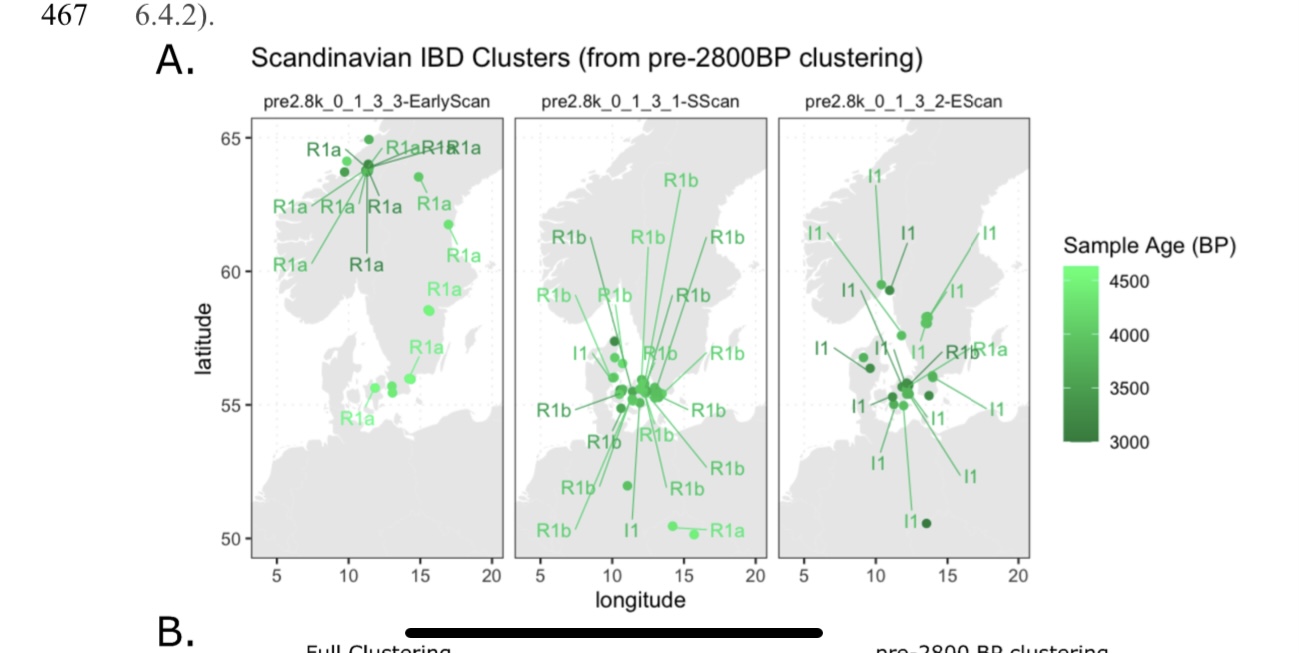
The feasibility of a mass migration of a people across the Baltic at this period in history is questionable. Sea crossings from the South are far more plausible or even land routes via the Arctic North. Figure 4.A shows the geographical distribution of individual samples belonging to the 3 Scandinavian Clusters they identified existing prior to 800 BC, after which they merged. They say there is a strong correspondence between the clusters and specific haplogroups as follows:
- Early Scandinavian including the oldest Swedish (Battle Axe Culture) and Danish samples and almost all Norwegians all have R1a.
- A later ‘Southern Scandinavian’ cluster restricted to Denmark and the southern tip of Sweden mostly with R1b but some I1.
- A second later ‘Eastern Scandinavian’ cluster, spread across Sweden and overlapping with that of the Southern Scandinavia cluster which is dominated by I1.
The third map of this so-called “Eastern Scandi” group shows mainly samples from the South though, and the I1 haplogroup distribution is not demonstrated to have come from the “East”, in fact it appears from this data to have come from the south. We already have an I1 sample from North Germany dating to 3300 BC, older than these samples, so by tying this newly identified group to the I1 haplogroup, they have brought into question their own claim that it has a Baltic origin. This will only be settled with the discovery of an I1 sample in a Corded ware context dating to around 2700 BC.
They admit that it is now necessary to confirm “the proposed Bronze Age source of the East Scandinavians along the Baltic coast.” My own view is that the elevated EHG ancestry in this East Scandi group may incorrectly have been identified as Latvian in origin due merely to a sampling bias, and lack of SHG samples. The elevated EHG in Sweden seems more plausible to be local and the I1 is most likely to have entered Scandinavia from the South, not across the Baltic. The reliability of their IBD method depends on the reference samples used.
While I question their conclusions about the origin of this East Scandi group, I am more convinced by their suggestion that it was responsible for the spread of the ancestor of what became Palaeo-Germanic language in the period between 1050 BC - 500 BC when it borrowed from Celtic and into Finno-Saamic. They show that after 2000 BC the East Scandi group expanded into Denmark and Norway. The mixing of East Scandi with South Scandi is dated between 1700 BC-1400 BC which spans both Nordic Bronze age 1 and 2 and directly precedes the construction of the famous Kivik tomb in Scania around 1400 BC.

This mixing event formed the Iron Age Scandinavian genetic profile such that by the Iron Age Jutland can be entirely modelled with the admixed Danish Bronze age source, while Iron Age Norway and the Danish Isles also have additional East Scandi admixture on top of the initial Bronze Age mixing, showing further migrations of these intrepid East Scandis. They say this admixed Iron Age Southern Scandinavian group is “central to understanding the Germanic dispersal” and I agree. We can trace the spread of IA South Scandi ancestry into Germany, Britain and the Netherlands. The findings about Germanic expansion in the historical period are very interesting too.
Thursday, 14 December 2023
Norman DNA: Viking or Semitic J2a?
Were the Normans French or were they Vikings? DNA may reveal the answers but so far only two studies have looked at Norman DNA and there are problems with both. In this video I look at two Norman Y haplogroup studies to see what we can learn and I debunk the claim that J2a in Europe comes from "ancient Semitic kings"
Thursday, 23 November 2023
Friday, 30 September 2022
The Rise and Fall of Archaeology with Stone Age Herbalist
Stone Age Herbalist is a dissident archaeologist, twitter personality and substack blogger. In this Jive Talk he describes the ancient origins of archaeology as a discipline, how it rose to a more rigorous practice in the modern era and then degenerated into modern woke archaeology. We discuss gay cavemen, transgender vikings, the migrations and invasions of Anglo-Saxons, Beaker folk, Yamnaya and others and finally end with a chat about anthropology in general.
Follow Stone age Herbalist on Twitter
Follow Stone age Herbalist on Twitter
Sunday, 25 September 2022
Thursday, 22 September 2022
Anglo-Saxon DNA proves the INVASION IS REAL!
'The Anglo-Saxon migration and the
formation of the early English gene pool' by Joscha Gretzinger and colleagues (2022) has answered some of the much debated and controversial questions concerning the Anglo-Saxon invasion of England which began in the 5th century AD. The study finds that as much as 75% of the ancestry of skeletons from England in the cemeteries from that time comes from Germanic migrants from Germany and Denmark. In this video I break down and summarise the findings.
Subscribe to:
Posts (Atom)
